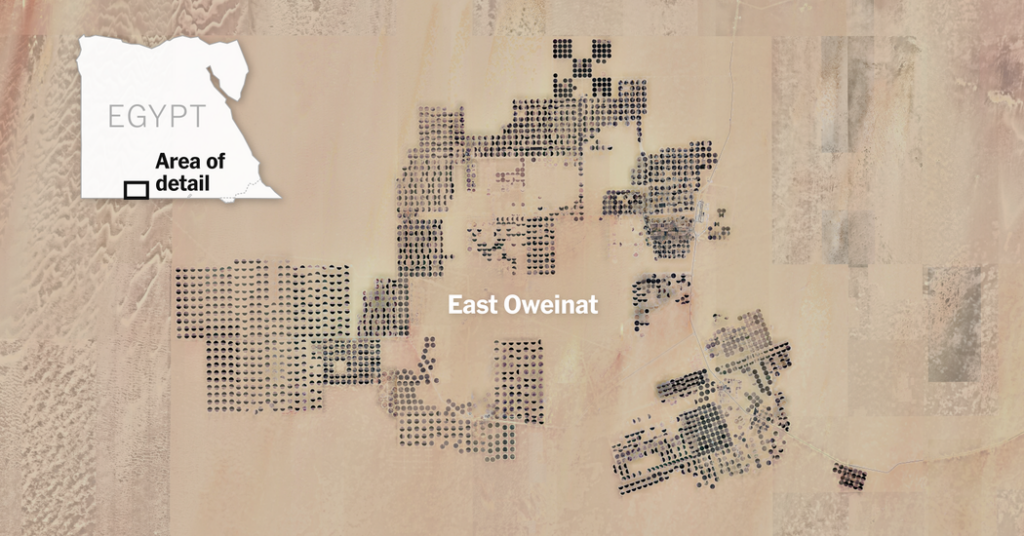
The airstrip sits next to giant crop circles at the edge of the Sahara. Military drones take off over enormous fields of wheat, leaving their covert base for one of the world’s biggest drone wars.
The base is in Egypt, hidden amid a vast, agricultural project in the country’s Western desert. But the targets are in Sudan.
The clandestine drone operation offers new evidence of how the civil war in Sudan — racked by famine, atrocities and tens of thousands of deaths — is morphing into a sprawling theater for high-tech drone warfare driven by the interests of rival foreign powers.
Satellite images, flight records and videos reviewed by The New York Times, as well as interviews with American, European and Arab officials, suggest that for at least six months, advanced military drones based at the Egyptian airstrip have been carrying out strikes in Sudan. Their target is the ruthless paramilitary group, the Rapid Support Forces, or R.S.F., which has been battling the Sudanese military for more than 1,000 days.
Egypt’s foreign ministry and foreign press center, and Sudan’s military, did not respond to questions for this article.
Egypt, until recently, was mostly a diplomatic player in Sudan. But the drone activity suggests it has entered the fight alongside Sudan’s military, adding yet another layer to a war bursting with foreign powers on either side.
The United Arab Emirates supplies weapons to the R.S.F., officials say. Saudi Arabia and Qatar back the army, which has also acquired weapons from Turkey, Iran and Russia.
Now Egypt, Sudan’s neighbor on the Nile, has joined the fray, its covert drone base earning veiled threats of retribution from the R.S.F.
Egypt’s involvement shows how technology, more than ever, is shaping one of the world’s most catastrophic wars, which has displaced an estimated 12 million people. Powerful, long-range drones are now doing much of the fighting in Sudan — firing missiles on fighters and supply convoys, but also hitting mosques, hospitals and power plants. The strikes have killed thousands, civilians as well as combatants.
The global gold boom is partly what drives the drone warfare. Soaring prices have swelled war chests, with both the R.S.F. and the Sudanese military rapidly extracting their country’s reserves. But mostly, the drone activity is driven by foreign powers.
The R.S.F. uses Chinese long-range CH-95 drones that are supplied by the Emirates, the group’s wealthy Gulf ally. Sudan’s military uses the latest satellite-operated drones from Baykar, Turkey’s largest defense contractor.
The Emirates denies backing either side in the war. A senior Turkish official said the Baykar drones were exported in accordance with international law, and that the government does not provide any direct support to Sudan’s military.
The Turkish drones are being hidden in Egypt to keep them safe, according to four American officials and one from the Middle East. It is unclear if Egyptian or Sudanese forces operate the drones. Like others who were interviewed for this article, the officials spoke on the condition of anonymity to discuss sensitive intelligence.
What pushed Egypt into the war, the officials say, was the fall of the Sudanese city of El Fasher, in the Darfur region, in late October. After a brutal 18-month siege, R.S.F. troops seized the famine-stricken territory, drawing global condemnation. Within weeks, the paramilitary’s fighters were advancing on a new battleground, in the Kordofan region of central Sudan, threatening once again to sweep across the country.
President Abdel Fattah el-Sisi of Egypt, who had long feared an R.S.F. takeover, was visibly alarmed by the news. In December, he warned that a “red line” had been crossed in Sudan, from which 1.5 million refugees had already flooded into his nation.
Around that time, Turkish Akinci drones, the same type visible in satellite images of the base in southern Egypt, began to strike deep inside Sudan, hitting R.S.F. fighters and supply convoys as they wound through the desert, according to video analysis.
In one video from Nov. 5, a convoy of four trucks is seen ablaze in the Sudanese desert, hit after crossing the border from Libya, which officials say has become a crucial source of weapons, fuel and fighters for the R.S.F.
The drone outpost in Egypt poses a delicate balancing act for Mr. el-Sisi. Egypt’s economy is highly dependent on the Emirates, which in 2024 invested $35 billion in a development project on Egypt’s Mediterranean coast — the country’s largest ever foreign investment.
But the Emirates also backs the R.S.F.
Both sides have been accused of war crimes. Sudanese military warplanes have carried out indiscriminate attacks on villages, killing dozens.
The most notorious drone strikes have been attributed to the R.S.F., including a barrage of strikes on a kindergarten that killed 114 people, 63 of them children, according to the World Health Organization.
While R.S.F. drones often help its fighters punch through front lines, Sudan’s military uses its Turkish drones to cut off the vital R.S.F. supply lines coming from Libya and Chad, a senior European official said.
To counter those strikes, the R.S.F. appears to have acquired Chinese drone-jamming and surface-to-air missile systems, likely provided by its Emirati sponsors, said Wim Zwijnenburg, a drone expert at the Dutch organization PAX.
Images from the battlefield, some verified by The Times, show R.S.F. fighters claiming to have shot down at least four Turkish Akinci drones, which cost about $25 million each, in the last four months.
The race to acquire drones has brought “more chaos and destruction” to the conflict, said Mr. Zwijnenburg. The R.S.F. strikes have taken out electricity stations and water plants, cutting power and clean water for millions.
The drones “sow terror among the population,” he said.
Egypt’s role in the drone war began in a place so unusual that NASA astronauts on the International Space Station once photographed it from space.
Started over three decades ago, the East Oweinat desert reclamation project on the eastern edge of the Sahara, about 40 miles from the border with Sudan, draws on the world’s largest known fossil aquifer system to deliver water for giant, fertile crop circles.
In 2023, Mr. el-Sisi visited the military-controlled project, Egypt’s second biggest wheat producer, to celebrate its harvest. Foreign investors include major agricultural companies from the United Arab Emirates.
For two decades the project was served by a single airport runway that was used to export produce and transport workers. But from 2018, the airport started to quietly expand, satellite images show.
By 2024 a second runway and about 17 aircraft hangars had been built, apparently for military purposes. Fighter jets and small drones were positioned at the base, the satellite images show. Smaller drones flown from the base appear to monitor Egypt’s border with Sudan, according to satellite data captured by Ursa Space, a U.S.-based satellite intelligence company.
In July of last year, Turkish cargo planes landed at East Oweinat, spurring activity. A satellite communications system was installed beside one hangar and vehicles were visible outside a ground control system, Ursa Space determined. Two weeks later, an Akinci drone was pictured on the tarmac.
By then, Sudan’s military had already done business with the Baykar company in Turkey, which makes the Akinci. In November 2023, seven months into Sudan’s civil war, the military signed a $120 million deal to buy six Bayraktar TB2 drones, as well as 600 warheads and a training and maintenance package. The Times obtained a copy of the contract, which was first reported by The Washington Post.
But the arrival of Akinci drones last year provided vastly greater capabilities. With a range of more than 4,500 miles, the Akinci can carry at least three times more bombs than the TB2, according to experts. It also costs at least four times more.
By December, at least two Akinci drones were operating from the base and striking targets inside Sudan.
Videos of one strike, reviewed by The Times, show a drone firing a guided bomb on a gathering of R.S.F. fighters in a village in Darfur over 800 miles from the Egyptian base. Three weapons experts identified the munition as a Turkish Roketsan guided bomb, and only the Akinci has such a range, one of the experts said. At least 20 people were killed in the strike, according to analysis by The Times.
Other videos verified by The Times showed the aftermath of strikes on a truck convoy near the border with Chad.
“A drone hit Adikong, in the border, guys. Drone, drone,” one witness said as he filmed a strike at a busy border crossing called Adikong. The strike ignited an inferno and destroyed more than a dozen buildings, satellite imagery showed.
As the drones hit their targets inside Sudan, Turkish military and cargo planes continued to land at the Egyptian base, sometimes coming from Port Sudan. Several originated from Corlu, a Turkish base where Baykar developed and tested Akinci drones, flight data from Aireon, an air traffic surveillance company, showed.
Other flights were operated by Aviacon Zitotrans, a Russian airline under American sanctions since 2023 for its role in global arms smuggling, Ursa Space found.
Turkey’s defense ministry said in an email: “Turkish Armed Forces do not have any activities in Sudan.”
Despite the technological scramble, neither side shows any sign of winning the war. The United States has accused Sudan’s military of using chemical weapons, the R.S.F. of committing genocide, and imposed sanctions on both sides, ostensibly to limit their ability to buy more weapons. That effort seems to have failed.
The pace of strikes from the Egyptian air base accelerated drastically after the fall of El Fasher. In an apparent acknowledgment that Egypt had sided with its enemy, the R.S.F. has issued veiled threats.
The R.S.F. knew the drones hitting its troops were “being launched from a foreign base,” it said in a statement in November, warning it would respond “at the appropriate time and place.”
“Listen to these words carefully,” the group’s leader, Lt. Gen. Mohamed Hamdan, said in a video address months earlier. “Any drone that takes off from any airport is a legitimate target for us.”
Ronen Bergman and Abdalrahman Altayeb contributed reporting. Videos produced by James Surdam and Jeffrey Bernier.
Declan Walsh is the chief Africa correspondent for The Times based in Nairobi, Kenya. He previously reported from Cairo, covering the Middle East, and Islamabad, Pakistan.
The post The Secret Egyptian Air Base Behind Sudan’s Drone War appeared first on New York Times.