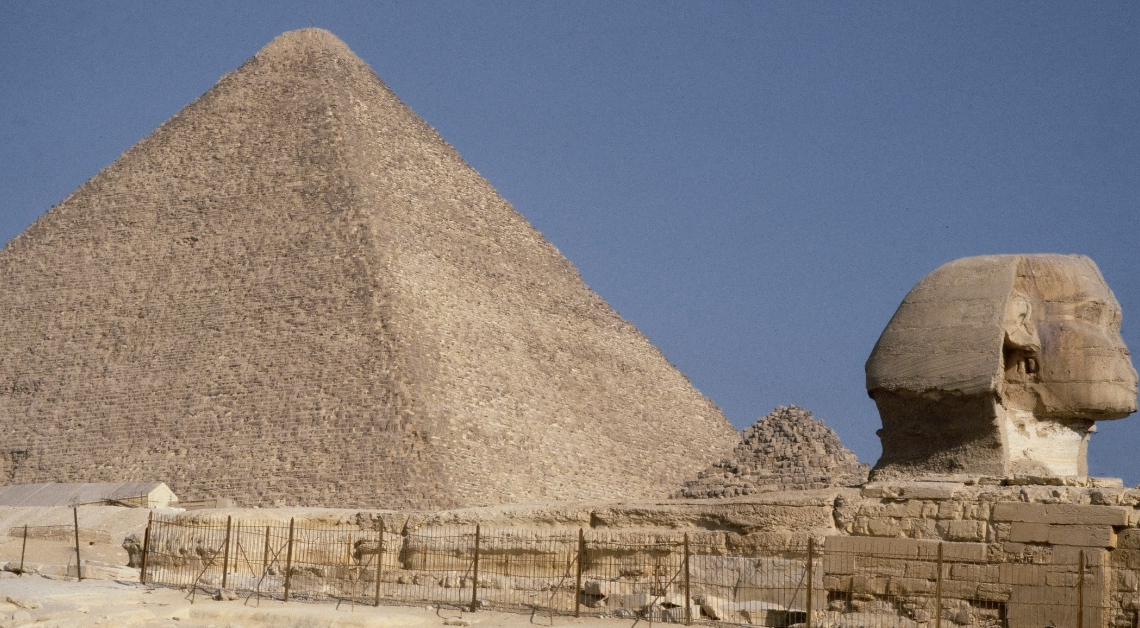
The Great Pyramid of Giza is one of the oldest and most mysterious megastructures on Earth… and now someone is saying that they’re even older than you think.
A new study is the latest to make that case, suggesting the pyramid could predate recorded Egyptian history by tens of thousands of years. But according to James Felton of IFLScience, the study, not yet peer-reviewed and posted to ResearchGate, makes sense from a distance but falls apart the closer you look.
The study comes from Alberto Donini, an engineer at the University of Bologna. His argument is centered around erosion. The pyramids were once covered in a smooth limestone casing, most of which was stripped away over the centuries and reused in Cairo.
Donini compared erosion on stones that were once protected by this casing with erosion on stones that were exposed for longer periods, then ran the data through a statistical model. That model estimated a 68 percent chance that the Great Pyramid dates to between 9000 BCE and 37,000 BCE, with an average of around 23,000 BCE.
A New Study Claims the Great Pyramid of Giza Is Older Than We Thought
All of those dates suggested to Donini that there must have been a civilization in Egypt before the birth of Christ that was capable of building the pyramids. To be more specific, and in Donini’s words, “it can be concluded that around 20,000 years before Christ there existed a civilisation in Egypt capable of constructing at least the Khufu pyramid.” It’s a wild claim.
The problem with the theory, as Felton points out, is that erosion is a notoriously unreliable unit of measure. Egypt’s climate has changed dramatically over millennia, from wetter periods to long stretches of arid heat. Stones can be shielded by sand, damaged by tourists, or eroded unevenly by wind and rain. Assuming a constant rate of weathering across 20,000-plus years is a big leap.
On top of all that, the study runs counter to decades of archaeological evidence. Countless studies and archaeological teams have determined that the pyramids neatly fit into the known evolution of Egyptian architecture, supported by the discovery of pottery, inscriptions, and one of the most reliable tools in an archaeologist’s toolkit: radiocarbon dating of organic materials found at dig sites. All of the previously discovered evidence points to roughly the same conclusion: the great pyramids were built somewhere around 2,600 BCE
Until peer review and additional evidence say otherwise, the pyramid remains old, just not that old.
The post The Great Pyramid of Giza Might Be Older Than We Thought appeared first on VICE.