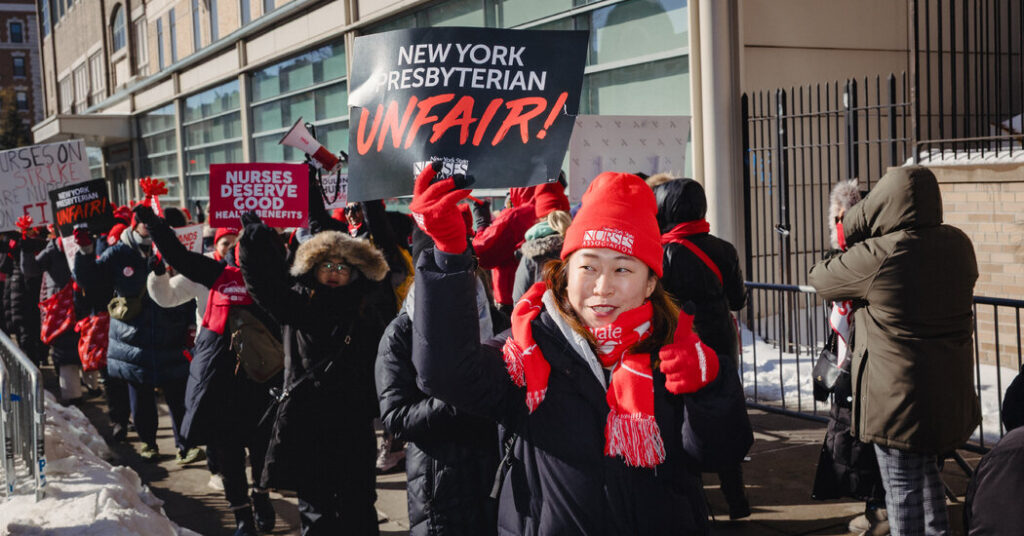
As a strike involving nearly 15,000 nurses in New York City enters its fourth week, the strikers’ union and the major hospitals affected by the walkout have made only halting progress at the bargaining table.
But late Saturday, both sides re-engaged in negotiations on pay and economic issues, a promising sign.
A few tentative agreements had been forged previously, including on issues related to artificial intelligence and health care coverage. And there seemed to be hints of progress on issues related to workplace safety and security protocols, which the nurses’ union had identified as a key issue driving the strike.
But the union and the hospitals — NewYork-Presbyterian/Columbia, Montefiore Medical Center and the main campus of Mount Sinai Hospital along with two other hospitals within the Mount Sinai system — had made little headway on the other core issues, including pay and staffing levels.
Pay
Until Saturday, negotiators had spent little time discussing compensation. Starting pay for nurses at the hospitals targeted by the strike typically is $117,000 or more. But many nurses make well above that. According to the hospitals, nurses on average make $150,000 or $160,000, after factoring in overtime, seniority and other pay differentials. The average salary is also nudged upward by lumping in several categories of nurses — nurse practitioners, for instance — who have more training and responsibilities than registered nurses.
The last time that the nurses negotiated a contract, in late 2022 and early 2023, they received raises of nearly 20 percent over three years. After initially asking for higher raises this time — 10 percent a year for three years — the union has pared back its request. In the second week of the strike, the union proposed that it receive the same raises as in the last contract: 7 percent the first year, 6 percent the next year and 5 percent in the third year. The hospitals are offering far less. On Saturday, both sides submitted new proposals regarding pay increases and agreed to resume negotiations on Monday. Neither side has disclosed the details of the new proposals, itself a change.
The hospitals have sought to cast the union’s wage demands as unrealistic. Mount Sinai has asserted that the nurses’ initial proposals could send average pay soaring to $250,000 or $275,000, numbers that the union rejects as false. On the picket line, nurses expressed resentment toward the hospital’s efforts to frame the strike as a money grab.
“We’re angry at how management has tried to twist this into ‘nurses are greedy,’ ” Michelle Gonzalez, a Montefiore nurse who is on the union’s bargaining committee, said.
In a telephone interview from the picket line at Mount Sinai, Margit Anderegg, a labor and delivery nurse, said that she believes that sexism tinges the reaction to the proposals. “If we weren’t mostly women, people wouldn’t have a problem with what we want,” she said.
Kenneth E. Raske, the president of the Greater New York Hospital Association, a trade group, said that the earlier wage proposals from the union ignored economic constraints. Hospitals anticipate lean years ahead as many million New Yorkers lose health insurance and as federal health care subsidies to the state are cut by billions of dollars — a result of the domestic policy bill that President Trump signed in July.
“The union leadership has, for all practical purposes, ignored the impact” of that law, Mr. Raske said.
Staffing
Another key sticking point is workload. Nurses have long said that many units in hospitals across the city are chronically understaffed, leading to lower quality care. In past years, according to the union, an emergency room nurse at Montefiore might have up to 20 patients to care for at once. Following a short strike in 2023, the union won minimum staffing ratio guarantees and an agreement that hospitals would pay extra wages to nurses if hospitals left units insufficiently staffed.
Nurses at Mount Sinai and two other hospitals in the same system were awarded more than $6 million in awards from arbitrators since the start of 2024 after providing evidence that units didn’t have enough staff, according to the union.
The hospitals have chafed at the arbitration awards. NewYork-Presbyterian has gone to federal court to appeal some of them, though judges have mostly found the hospital’s arguments unconvincing.
The question is whether these staffing rules — and the cash awards for violations — will continue in a new contract. In negotiations, the hospitals have sought to dismantle the current system, according to union officials.
Ms. Gonzalez, the Montefiore nurse, said that enforceable staffing ratios have improved working conditions and patient care.
She said the union wanted to build off the last contract’s successes and further reduce the number of patients receiving care from a nurse.
Safety
The nurses’ union has demanded safer working conditions, claiming that the hospitals need to do more to address workplace violence and reduce the risk of a mass shooting.
In 2017, a doctor went on a rampage at a Bronx hospital with a rifle, killing another physician and wounding six other people before setting himself on fire and shooting himself, the authorities said. More recently, in November, a gunman threatened to shoot up Mount Sinai, an episode that underscored nurses’ concerns.
Ms. Anderegg, the Mount Sinai nurse, said that she wanted metal detectors and armed police officers or guards at hospital entrances, something that some other hospitals have. She said that since the strike began, police officers have been present outside Mount Sinai. “What do they think we are going to do, storm the hospital?” she said.
A state law will go into effect this year that requires hospitals in New York City and the surrounding counties to have trained security personnel or an off-duty police officer present at all times in the emergency department. The law notes that about 70 percent of emergency room nurses say that they have been assaulted at work.
The hospitals have taken steps in line with some of the nurses’ demands. In a Dec. 11 memo, a Mount Sinai official wrote that the hospital was hiring additional security guards and was purchasing a weapons detection system that is produced by a company called Evolv Technology, which says it uses artificial intelligence and sensors to detect concealed guns and knives.
Other hospital systems, along with more than 800 schools and sports stadiums, including the Mets’ Citi Field, have deployed Evolv detection products. But the Federal Trade Commission has previously accused the company of deceiving users about its system’s effectiveness, declaring that Evolv’s scanners sometimes failed to detect weapons, while flagging ordinary items such as water bottles and laptops.
Evolv settled the trade commission’s inquiry, without admitting wrongdoing. “This inquiry was about past marketing language and not our system’s ability to add value to security operations,” the company’s interim president said at the time.
Montefiore says it has placed “advanced screening systems” for weapons at several main entrances to hospital buildings and has begun using wands to screen patients who arrive by ambulance, according to a memo that the hospital’s chief nursing official, Maureen Scanlan, wrote to nurses on Dec. 31. Nurses now wear badges that allow them to activate an alert with three rapid presses.
Separately, the nurses’ union has pushed for behavioral response teams that can intercede when patients or visitors turn violent. Montefiore has such teams in its emergency departments, a measure that the nurses’ union wants enshrined in the next contract. Ms. Gonzalez, the Montefiore nurse, said that the union wants such teams elsewhere in the hospital.
At Mount Sinai, the union wants these teams in the emergency department.
Hallway Patients
Other issues present a sticking point at one hospital, but not others. At Montefiore, the union has demanded an end to overflow patients being placed in beds in hallways, according to Ms. Gonzalez.
“Let’s give patients care with dignity and respect,” Johnaira Dilone-Florian, a Montefiore nurse, said. “They deserve that. We don’t want our grandmas and grandpas in the hallways.”
Olivia Bensimon contributed reporting.
Joseph Goldstein covers health care in New York for The Times, following years of criminal justice and police reporting.
The post Pay, Staffing, Safety: The Divisive Issues in the Nurses’ Strike appeared first on New York Times.