Times Insider explains who we are and what we do and delivers behind-the-scenes insights into how our journalism comes together.
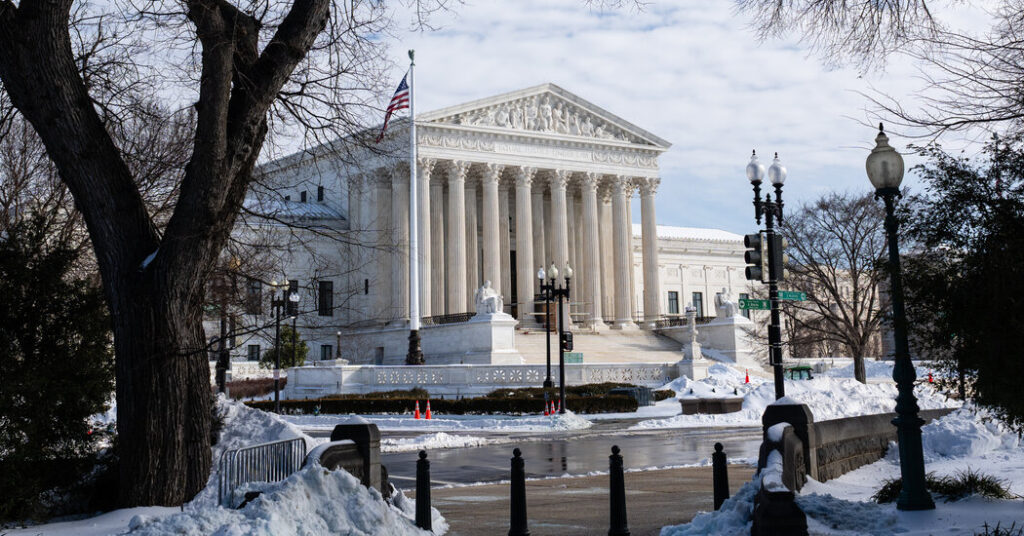
For decades The New York Times assigned one reporter to cover the Supreme Court, focusing chiefly on legal arguments and decisions. Now The Times has expanded that aperture to look further at the incredible power of the nine justices and how the least transparent branch of government operates.
Think about the reporting on the closed-door discussions on Trump presidential immunity or the Dobbs abortion case or on the private splits among the liberal justices. Or the reporting on Justice Clarence Thomas’s ties to wealthy conservatives, the questions surrounding the justices’ lucrative book deals or the controversial flags outside Justice Samuel A. Alito Jr.’s homes. Tracking the cases before the court remains a major part of our coverage, but we are going more deeply behind the scenes, into the heart of how the justices use their influence and shape the law.
To do this work, The Times has built out its Supreme Court reporting team.
Adam Liptak, who practiced law for 14 years, has been the dominant and authoritative voice on the beat since he began covering the court in 2008. He has just taken on a new role, chief legal affairs correspondent, and will soon start writing a weekly newsletter, The Docket, about the most pressing legal questions of the day.
Nearly four years ago, Jodi Kantor, an investigative reporter with a track record of telling difficult stories, began taking readers inside the institution and delivering telling portraits of how the justices exercise their power, often working with Adam. In 2023, The Times added an investigative reporter and lawyer, Abbie VanSickle, to the team. Last summer Ann E. Marimow, who previously covered the court at The Washington Post, took over Adam’s role writing about major cases.
I recently spoke with the four reporters about how they cover the court and why they’re delving more into what goes on behind the scenes.
What we’re doing more of is piercing the secrecy of America’s most secretive branch of government. That’s not easy. It also might not be clear to readers why it matters, since it’s the legal decisions in cases that shape society.
JODI KANTOR: Our coverage of cases is essential. The court’s arguments and decisions are hard to understand — unless you’re a lawyer, the words can feel more like Latin than everyday English. People all over the world have relied on explanations of cases by Adam and now Ann and Abbie.
But in recent years, we’ve also started to assemble a behind-the-scenes portrait of the court, for a simple reason: In journalism, scrutinizing the powerful is Job 1.
You’re referring particularly to the nine justices — or to paraphrase President Trump, the nine unelected judges.
KANTOR: They’re making decisions that affect all of our lives. The justices hold these seats for decades — imagine having that much power for 20, 30 years. And yet the court is a locked box. The justices are subject to few of the accountability measures that other high government jobs have — elections, visitor logs, public access to internal records.
They might argue that their transparency comes via arguments and opinions. But they retain total control over what we learn, with no opportunity for citizens or reporters to ask questions about decisions or understand what shapes the rulings. I just reported, in fact, that the chief justice recently tightened the court’s secrecy even further, imposing nondisclosure agreements on employees.
ANN E. MARIMOW: And it’s not only the justices. We’re aiming to explain to readers how and why certain cases reach the court, to reveal the powerful interests behind those efforts and to take readers inside the courtroom. Abbie and I recently explored the high turnover at the Justice Department in the elite unit of lawyers who argue before the justices. Despite the mass exodus, the office has had a ton of success pressing President Trump’s agenda, particularly on the court’s emergency docket.
KANTOR: We’ve shown that there are startling things to be learned. Abbie recently made a telling discovery. The justices appear to be on the cusp of striking down the last leg of the Voting Rights Act — and Abbie, you figured out that one of the plaintiffs is a 78-year-old who had no idea he was even part of the lawsuit.
ABBIE VanSICKLE: That story helped readers to understand that some of the court’s biggest cases are carefully crafted by lawyers and advocacy groups. These blockbuster rulings often don’t just happen organically. As journalists, we think it’s important to help demystify the process as much as we can, especially since these decisions — and the people who are making them — often lead to enormous changes in American life.
Adam, for years you’ve combined writing about arguments and decisions with deep pieces burrowing into how the court works. Has it gotten harder or easier over the years?
ADAM LIPTAK: The court is in one sense a hard target, with much of its work hidden from view. In another sense, though, the court compares favorably to the other branches. The justices debate cases in public at oral arguments and issue elaborate decisions, often accompanied by concurrences and dissents, in argued cases. Those public acts, by able judges engaged in intellectual combat, can yield a ton of insights.
Covering the court got harder over the years in large part thanks to the absence of those elements in many cases decided on the court’s emergency docket, including the recent run of victories for the Trump administration. The absence of oral arguments and reasoning in much of the court’s recent work are among the reasons critics refer to its cursory treatment of emergency applications as the shadow docket.
How do you get people inside an institution as heavily cloaked as the court to share important but confidential information?
KANTOR: We can’t talk about our sources, full stop. Even an innocuous comment from us could be mistaken for a clue, and we have pledged to protect their privacy.
But the behind-the-scenes stories we’ve been able to tell often have public hints and markers. I recently wrote about the split in strategy among the liberal justices, based on conversations with people who know and understand them. But the differences in approach between Justice Elena Kagan and Justice Ketanji Brown Jackson, and the strains between Justice Jackson and Justice Amy Coney Barrett, are right in the text of opinions. This world is very decorous; we’re not talking about the screamathons we see in other areas of public life. That means that even a word or two can pack a punch.
MARIMOW: The court is a particular kind of workplace — highly insular and steeped in reverence for the justices, the law and the court’s traditions. The young lawyers who land coveted clerkships at the Supreme Court, for instance, have impeccable credentials and rely on trusting relationships with their justices for career advancement. So they may be worried about saying or doing anything that would jeopardize that important relationship. Many of the justices say that they think of their clerks as family.
Adam, you now have this new role digging into legal affairs more broadly and writing the weekly newsletter. What are some of the questions and ideas you want to explore?
LIPTAK: The entire justice system — not just the Supreme Court — is being tested by the Trump administration. I want to help readers make sense of the cacophony of Trump-related developments that seem to arrive almost hourly and to answer some of the big questions: Can he do that? Can the courts stop him? Should they? Will they?
But a newsletter is not just one thing, and I hope to look at lots of legal issues, some weighty and some quirky. I’ll answer readers’ questions, and I’ll do my best to translate legal jargon into conversational English. The Docket will launch in a couple of weeks.
You wrote an analysis piece recently about how the Supreme Court has swung from being wary of partisan gerrymandering to embracing it in the Trump era. What did that piece convey about our approach to the beat?
LIPTAK: One of the strengths of The Times’s coverage of the court over the decades, which has included such towering figures as Anthony Lewis and Linda Greenhouse, has been its engagement with the justices’ actual work with unapologetic intellectual rigor grounded in unmediated knowledge of its decisions. Authoritative analysis of the court’s public acts has long been our distinctive contribution, one that does not attribute everything the justices do to personalities and politics.
I’m curious about what’s different now about the court and news coverage today compared to past decades. For one thing, there is more attention on the ethics and financial disclosures of the justices and the broader legitimacy of the court. Does this mean issues around ethics and legitimacy have gotten worse with the current court? Or is there another reason that shapes news coverage?
MARIMOW: There is certainly more attention being paid to these stories, but they have been covered in the past. Back in 2004, David Savage of The Los Angeles Times disclosed that Justice Thomas had accepted expensive gifts and private jet flights that were paid for by the Texas billionaire Harlan Crow. But after that reporting, the justice appeared to stop disclosing free trips until ProPublica’s recent revelations.
LIPTAK: Our own Mike McIntire did terrific work in 2011 exploring the relationship between Justice Thomas and Crow.
MARIMOW: The information the justices are required to report is still far less than what members of Congress have to list in their disclosures, so it makes it difficult to decipher who is being paid how much, for instance, to travel to speaking engagements.
VanSICKLE: Even with the court’s ethics code — adopted in the months after the revelations about Justice Thomas — the justices aren’t required to tell the public many details about the gifts, travel and conflicts they may have. One example: When justices recuse from cases, they are not required to say why, leaving us to try to piece it together.
That’s where deeper reporting comes in.
VanSICKLE: In September 2024, Justice Alito disclosed $900 concert tickets. He listed the donor’s name but gave no further information. I ended up flying to Germany to meet with the donor, a princess whose ties to right-leaning political parties had made her a controversial figure there. It takes journalists and resources to do that kind of digging. There’s nothing requiring justices to provide more information.
Jodi, you’re a veteran investigative reporter who has broken many stories. Is your role in this coverage aimed at getting scoops on how the court is going to rule, the way Politico did when it got the leaked early draft of the Court’s big Dobbs abortion rights decision? Or is it more about the nine justices?
KANTOR: Trying to reveal decisions before they’re published is not my goal. That’s all going to come out anyway. I want to illuminate an institution that’s at the center of our public life and yet very hidden.
Americans across the ideological spectrum want to know more about the court. I noticed that a prominent conservative legal analyst wrote online how much he learned from your piece on the liberal justices, for instance.
KANTOR: That story does get to the heart of this work — who are the nine human beings who inhabit these roles, and how do they approach their work? How do lifetime appointments and the extreme way people tend to treat the justices — obsequiousness, attack — affect them? What is this institution — the holy of holies of American law — actually like inside, and how does power flow there? How partisan are the justices, and how do they interact with one another? Those are the kinds of questions I’m interested in discussing. (And if anyone with knowledge wants to help, you can reach me securely through nytimes.com/tips.)
Ann, do you think greater media scrutiny affected on the court, the justices or their performance?
MARIMOW: I do think the scrutiny of the justices’ off-the-bench activities and unreported travel sparked interest and concern from Congress and led the justices to eventually adopt an ethics policy specific to the Supreme Court for the first time. Even though it took awhile, the justices much preferred creating their own policy than having Congress impose one on the court.
We saw Justice Thomas amend some of his financial disclosure forms to reflect some of the previously undisclosed trips. And we’ve observed some of the justices explaining their reasons for recusing instead of leaving the public in the dark about why they are not participating. Justice Elena Kagan, for instance, listed her prior government employment as the rationale for not recusing herself in a 2023 case.
KANTOR: Ann, I agree with you. Beyond that, it’s hard to say. But I just want them to know we’re watching them.
Adam, Ann, in what ways has the court changed the most over the decades that you have covered it? Or is it Americans’ opinions about the court, or news media coverage of the Court, that has changed more than the court itself?
LIPTAK: The key changes were the retirement of Justice Anthony M. Kennedy in 2018 and the death of Justice Ruth Bader Ginsburg in 2020. That created a six-justice conservative majority, leading to Dobbs and a host of other transformative opinions. News coverage has changed, too. Our first takes on arguments and decisions are published much faster than when I started covering the court in 2008. The introduction of live audio in 2020 was a mixed blessing. I used to attend a majority of the arguments in person. Since the court allows only pen and paper in the courtroom — no electronics — I paid close attention. These days I often listen on my laptop and don’t always succeed in avoiding distractions.
MARIMOW: I think there are a lot of factors. The justices themselves have in some ways become celebrities, with many of them embarking on multicity book tours, TV interviews and speaking to huge crowds. That’s sparked interest in their personal stories. The explosion of the court’s emergency docket also means the public is hearing more about decisions from the court that affect their lives in a rapid-fire way instead of just the usual blockbuster opinions at the end of the court’s term in June. It’s also possible that the livestreaming of arguments and live coverage from outlets like ours and podcasts about the court means more Americans can hear directly from the justices.
Let’s talk about what it’s like covering major oral arguments at the court. Ann, you had two especially important cases in January — one about barring transgender athletes from girls’ and women’s sports, and one about presidential power and President Trump’s attempt to fire a Fed governor, Lisa Cook. What goes into reporting on big days like that?
MARIMOW: For the trans athlete case, I spent time talking with the high school shot-putter behind the West Virginia lawsuit and interviewed the state’s attorney general who is defending the law. We also recorded an explainer video that drew on those interviews.
The dynamics in the Fed case changed quickly ahead of arguments when the Justice Department opened a criminal investigation into Jerome Powell, the Fed chair. That became a new backdrop to the case that we explored in an analysis.
For both cases, we had live online coverage of the arguments as they unfolded. It’s incredibly helpful to collaborate for those cases with Times colleagues who are subject-matter experts and provide deep context beyond the legal wrangling. As the arguments were winding down, I was writing my quick assessment of how the justices appeared to be leaning with the goal of publishing a first take soon after the session wrapped up. Once our live coverage ended, I turned to writing a more comprehensive story that could stand alone online and in print the next day.
LIPTAK: Our stories about oral arguments can be challenging for other reasons, too. The only actual news in them is informed speculation about how the court is likely to rule. We often signal that (“the justices seemed skeptical”) or come close to a prediction (“the court seemed poised to rule”). Beyond that, we try to give readers a sense of the dynamics of the argument and the interactions among the justices, who are discussing the case with each other for the first time. But it’s not easy to distill what can be two hours of questioning into even a longish article, much less to impose a satisfying narrative frame.
Take us inside what a day is like when the court hands down a historic decision, and you have editors like me breathing down your neck.
LIPTAK: When the Obamacare decision came down in 2012, I took a little longer than some other news organizations. I wanted to be fast but, more important, I wanted to be right. Some other news organization in their haste reported that the court had struck down the law. Our story was correct, and I think about that experience sometimes when I take an extra minute or two to double-check my stories before I file them.
MARIMOW: One day that stands out is the decision granting presidents immunity from prosecution for their official acts. This was key to the question of whether prosecutions of President Trump would go forward. You want to get the news out quickly, but you also want to be absolutely sure you’ve got it right. We had prepped a file with background on the case and written several versions of possible ledes — the first paragraph of a story. I always find it helpful to quickly flip through the opinion booklet to the end of the summary to find the holding.
Generally, I avoid including a vote count in the first draft and then quickly update after I’ve had a chance to more thoroughly digest the opinion. But in this case, the vote was clear: 6-3, with the three liberal justices dissenting.
A final question. What’s a reporting judgment call or a thorny editorial issue that you’ve wrestled with on this beat that perhaps helps us understand better what goes into your job?
VanSICKLE: I’ve struggled with how to characterize emergency orders from the court. Readers, understandably, want to know how the justices voted and why. But these emergency rulings don’t include a vote count. And many of them don’t include any reasoning. Even the most robust ones often only give a few paragraphs. The justices are typically weighing in on temporary rulings by lower courts, rather than a case where the evidence on both sides has been fully explored. And yet, these cases can have huge, lasting consequences. I try to include reminders in the stories that we often don’t know how the justices vote in these cases, and I also try to flag that we don’t get much reasoning from the court. But that feels sort of unsatisfying, as I hear from readers all the time. I feel that frustration.
MARIMOW: Last fall we made the unusual decision to write about a case that the justices did not take — whether to revisit the court’s landmark decision that legalized same-sex marriage nationwide.
We didn’t want to mislead readers into thinking that the court was likely to take the case, but took the opportunity to trace the evolving legal landscape since the court’s 2015 decision in Obergefell v. Hodges. I was inundated with messages from readers who were grateful to have a better understanding of the timing and mechanics of any decision and legal analysis from experts.
KANTOR: Pat, your question goes to something I love about covering the judiciary, which is that the aspirations of judging and journalism are very similar. The best judges — and journalists — are independent, unafraid to say what’s right, committed to transcending their (our!) own backgrounds, and in a suspicious world, constantly striving to earn and retain trust.
Jodi Kantor is an investigative reporter currently focused on the Supreme Court. Her work has spurred cultural and legal shifts in the United States and across the globe.
The post Why The Times Is Expanding Its Supreme Court Coverage appeared first on New York Times.