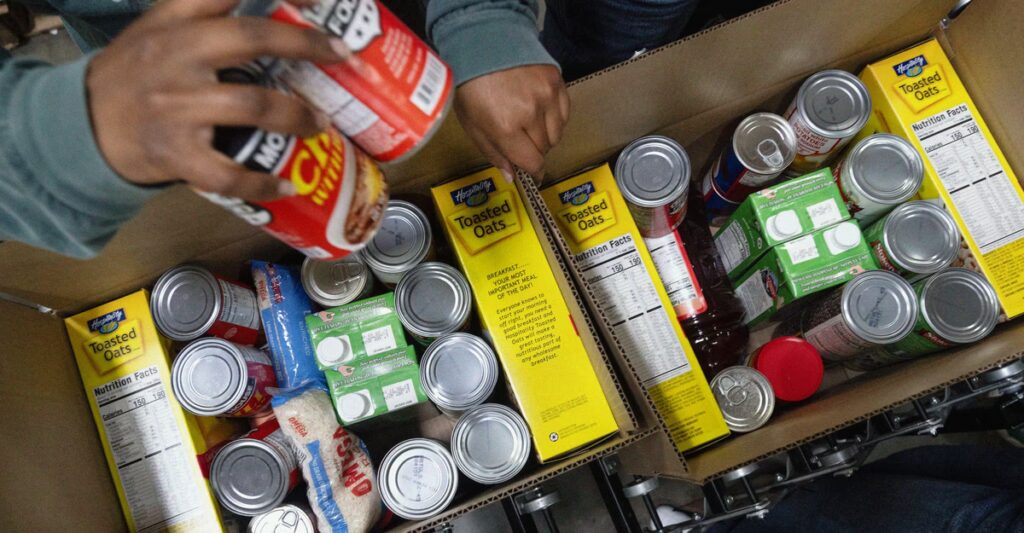
At the federal level and on down, American government has come to rely heavily on nonprofits to deliver public services. This dependence is in many ways understandable, but it comes with serious risks. Feeding our Future, the Minnesota nonprofit whose employees were caught billing for services they didn’t provide, was not the first instance of an NGO stealing from taxpayers, nor will it be the last.
NGOs—private nonprofits that receive government funding—theoretically offer a nimble, targeted way to put policy into effect. Progressives like their grassroots nature; conservatives like that they might offer something closer to private-sector efficiency. Some NGOs perform admirably. Many others don’t, and evidence is scant that this system overall delivers services better than the government. Despite this record, in the past several decades, NGOs have become not so much a policy instrument under democratic control as a sprawling, semi-autonomous administrative system with little accountability.
[James Surowiecki: Welfare fraud is a problem—for Democrats]
NGOs emerged as an alternative to direct government services during the latter decades of the 20th century. The first growth spurt came in the 1960s. President Lyndon B. Johnson’s War on Poverty saw NGOs as a means of fusing big-government spending with localistic sensibilities. According to the then-influential philosophy of “community action,” top-down solutions to social problems ran the unacceptable risk of race- and class-based discrimination. What’s more, adherents believed, if the government truly wanted to address poverty’s root causes, the poor needed to be involved in leading and running organizations meant to help them.
From the outset, this system was flawed. The Community Action Program sent federal funds to organizations and gave them broad leeway to determine how best to use those funds. The program foundered on spectacular failures, which were chronicled in works such as Daniel Patrick Moynihan’s Maximum Feasible Misunderstanding (1969) and Tom Wolfe’s “Mau-Mauing the Flak Catchers” (1970). Poverty pimp entered the vernacular as shorthand for a nonprofit leader who became expert at accessing federal money while deflecting oversight demands as anti-poor.
The “social-service industrial complex,” as this model came to be pejoratively known, proved somewhat more useful in reforming existing social services than launching new ones. Public mental-health and housing programs, run by state governments and local housing authorities, respectively, predated the War on Poverty. In both, centralized government bureaucracies were responsible for the lives of hundreds of thousands of vulnerable Americans. Both also boasted poor outcomes; public housing perpetuated intergenerational poverty, and many patients confined to mental asylums for years seemed worse than when they had been committed. Over time, more than 90 percent of public psychiatric-hospital beds in the United States were cut, and resources shifted to community-based mental-health programs, many of which were operated by private NGOs. At the local level, nonprofit affordable-housing developments became standard as cities across the nation demolished their public-housing projects.
Both of these changes fell short of expectations, however. Deinstitutionalizing the mentally ill left many of them homeless or incarcerated. And many of their family members or caregivers have said that the community-based mental-health system is too fragmented, making it hard to navigate. As for housing, few people outside socialist circles want to bring the projects back. But affordability concerns are now more acute than ever. And communities with high concentrations of modern forms of affordable housing still struggle with poverty and dependency.
Support for the NGO model became bipartisan during the “reinventing government” era of the 1990s. Republican governors as well as the Clinton administration urged public systems to seek inspiration from private industry. Although privatization (also sometimes called “not-for-profitization”) had several applications, the most famous was public charter schools. Much as with asylums and housing, urban school districts faced criticism for their dismal outcomes and top-heavy organization. Reformers proposed schools that would be taxpayer funded but run by independent organizations, typically nonprofits, and that would be academically accountable, up to and including facing closure. The idea proved wildly popular and led to many excellent new schools. But the promised accountability remained elusive; closing underperforming charters proved easier said than done.
Conservative-led welfare- and pension-reform initiatives helped fuel the expansion of NGOs in government. The 1996 Personal Responsibility and Work Opportunity Act imposed time limits and work requirements on cash welfare; it also made block-grant funds available to states for work-promoting activities such as job training and counseling. Cash handouts don’t require NGOs, but delivering these employment services did. As the political scientist Steven Rathgeb Smith has pointed out, the 1996 law actually made the NGO workforce larger.
In the years immediately following the Great Recession, most states passed legislation reforming their pension systems. Conservative analysts convinced officials that trimming public workers’ payouts would help avoid catastrophes such as bankruptcy, which befell several cities at the time. Another solution to the pension crisis was simply to rely more on workers who were ineligible for pensions in the first place and, therefore, were cheaper to hire—namely NGO employees. Two priorities of city progressives in the 2010s were expanding homeless services and developing alternatives to incarceration. According to public financial filings, some New York–based NGOs in those sectors have, this century, seen their workforces grow by 500 percent or more. During that same period, New York City’s municipal workforce has grown only 12 percent. New York City’s new mayor, Zohran Mamdani, says he will prioritize subsidizing child care and reducing the role of for-profit landlords in the housing market. Both will likely mean new or expanded lines of business for the NGO sector.
As this model expands at every level of government, it carries serious downsides, beginning with a lack of accountability. Because they are private entities, NGOs aren’t subject to public-records requests. Their leaders are neither elected nor appointed by an elected official, and their head counts don’t show up in municipal-workforce numbers, meaning that using NGOs to enact policy conceals the government’s true size. In public administration, lack of transparency can sometimes be justified. But it always comes at a cost.
When public services are administered at arm’s length from duly constituted public authorities, organizations like Feeding Our Future can better obscure corruption. A June 2024 report published by the Minnesota Office of the Legislative Auditor argued that “inadequate oversight” by state government abetted the fraud. Prosecutors claimed that although state agencies held ultimate power, Feeding Our Future intimidated them by wielding “accusations of racism.” More than 50 individuals have been convicted; $250 million was stolen. Minnesota Governor Tim Walz last month ended his 2026 reelection campaign, and possibly his nearly two-decade political career, because of the scandal.
Instances of outright criminality can distract from NGOs’ subtler corruption issues. NGO CEOs earn salaries that exceed those enjoyed by public-agency heads and even mayors or governors. They are not subject to term limits. Their titles confer status in certain circles. Government officials who yearn for those kinds of jobs might, in turn, be incentivized to avoid making enemies with the nonprofits whose work they are supposed to monitor. Clean-government advocates harp on the unseemliness of public officials overseeing industries that they hope to work in someday. The criticism is valid whether the industry in question is banking or mental-health services.
[Ezekiel J. Emanuel: The great big Medicare rip-off]
Conservatives who encourage the outsourcing of government work to NGOs should be wary for ideological reasons. When more progressives get elected, budgets grow, and so do NGO revenues and personnel. NGO workforces tilt leftward, meaning the government sometimes ends up putting public services in the hands of people with a distinct political agenda. For example, some progressive have turned to NGOs that encourage decarceration or push for social workers to handle certain law-enforcement tasks. Those kinds of investments can shift resources away from correctional and police officers, who are more expensive because of their union-protected health and retirement benefits. Governments might end up hiring more politically progressive NGO employees while reducing head counts of more politically conservative law-enforcement employees.
The conflicts of interests and lack of transparency that attend NGO governance can be justified if they are outweighed by the benefits. But as government dependence on NGOs has grown over the decades, it’s been hard to see how contracting out government functions has cut costs or made service delivery more effective. At this point, NGOs might be too entrenched in federal, state, and local governments for Americans to roll back their influence. NGOs are used in countless policy contexts, and they still enjoy bipartisan support. Even if the model cannot be replaced, we should aspire to a better version of it. Reformers should focus on systematic, careful oversight. Every so often, public officials should consider yanking contracts, if for no other reason than to reestablish their authority. After all, they’re the ones we voted for.
The post How NGOs Took Over Government appeared first on The Atlantic.