
The recent announcement that California led the nation in losing domestic migrants may seem like another nail in the Golden State’s coffin.
It’s just another piece of bad news for a state that, despite having the most billionaires in the world, suffers the nation’s highest poverty rate, per recent Census data.
The state’s young people are faring poorly: Among teenagers, the unemployment rate tops 21%, just short of twice the national average.
And for those under 30, California’s jobless rate exceeds that of every other state except for Mississippi.
So, is the onetime capital of the future finished?

If it stays on the current path, with ever-expanding government, poor job creation, miserable schools, and growing inequality, it could well be game over.
But decline is not inevitable, if the state can reform itself.
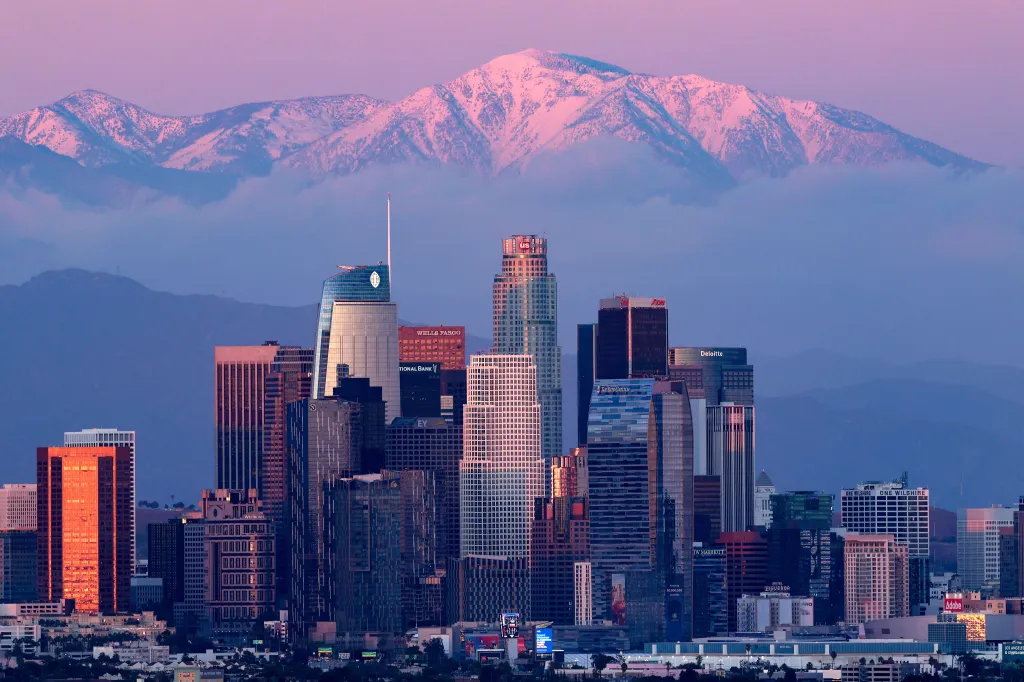
After all, no state in the union –– and maybe no place on Earth –– intrinsically has more going for it than California.
Besides its splendid climate (it’s OK to gloat) and magnificent scenery, the state retains unmatched human capital: From super-geeks and rocket scientists, to artistic talent and innovative entrepreneurs in everything from agriculture and food to architecture and fashion.
But today, this brilliance mostly enriches a few.
Instead, our innovative spirit needs to be deployed more broadly, in ways that offer opportunity for the vast, and slowly ebbing, middle class.
This means a shift from the ephemeral economy epitomized by firms like Google and Facebook back to making real products.
This can be done, as evident in places like El Segundo and Long Beach, both leaders in the burgeoning space industry.
It is also reflected in ambitious plans such as Forever California, an oligarch-backed plan for a 400,000-person city in Northern California.
The latter project seeks to provide more affordable homes for tech manufacturing, along with the first new large-scale American shipbuilding facility in many years.
At the same time, California’s prospects are clouded by high housing and energy prices, mostly caused by the state’s draconian green policies.
California has been losing jobs this year at the highest rate outside of Washington, D.C., and now suffers the country’s highest unemployment rate.
But this is nothing new. Outside of government, the state has been hemorrhaging jobs for some time.
In the past decade, California bled 1.6 million above-average-paying jobs, more than twice as many as any other state. In the past year, just about the only jobs created in California were in government-financed health care and government.

Many educated young people –– faced with the prospect of remaining permanent renters in small apartments –– are simply leaving. We are eating our seed corn.
The push for a wealth tax on billionaires has underscored the state’s bloated government and dependence on ever-larger exactions from the affluent.
Whatever the virtue of taking money from the ultra-rich, the state is totally dependent on the money of the top 1%, who contribute some 40% of the state’s income taxes.
In 2021 alone, the departure of wealthy people cost the state an estimated $20.4 billion in taxable income.
The key problem lies not so much with the oligarchs, who until recently largely embraced the political status quo, but with Sacramento and in dysfunctional municipalities like Los Angeles.
Yet we know that Californians can do better, as we see in several small, mostly minority cities in south Los Angeles.
Go past the border of LA city and you find far fewer homeless, little graffiti and spruced-up main streets.
Californians still make good things happen when government is more focused on results than on rhetorical excess.
Unfortunately, rather than govern effectively, Democrats instead spend their energy fighting President Donald Trump or ICE.
Gavin Newsom’s anti-Trump posturing grabs headlines and may save the career of the inept LA Mayor Karen Bass.

But it won’t solve our problems with water or the nation’s highest energy prices.
It will not fix our sad public schools, which particularly hurt their lower income, largely minority students.
Today, the default approach among Democrats has been to address inequality and lack of opportunity by building an ever-larger welfare state funded by the tech oligarchy and inflated real estate prices.
Although Newsom brags endlessly about presiding over the world’s fourth-largest economy, that status is mostly due to the enormous wealth of a few tech firms, along with the exorbitant cost of California real estate.
The reality on the ground shows that many tech and other firms are shifting operations to other states — or are already gone. The middle class is departing, too, and incomes for most have declined.
The Newsom fantasy world is beginning to look more like a horror movie.
Spending is hitting guardrails in the form of large budget deficits predicted by the Legislative Analyst’s Office through 2028.
To recover, California needs to stop spending ever more on giveaways and boondoggles.
Instead of former Gov. Jerry Brown’s ever-more-expensive bullet train, we need to draw on the legacy of his father. Former Gov. Pat Brown built the water, freeway, university, and power systems that we still rely on today.
Necessary change is unlikely to come from Republicans.
Gubernatorial candidate Steve Hilton may have some good ideas, but the GOP can count on barely one in four voters, while Democrats own close to half.
Change has to come within the Democratic Party.
The welcome entrance into the governor’s race of San Jose’s pragmatic Mayor Matt Mahan could be a turning point.
He’s more interested than other Democrats in curbing massive levels of fraud, and dealing effectively with homelessness.
Californians are down, but they are not out.
Intelligent policies at the state and local levels could restore the dreamscape that once drew so many here.
Joel Kotkin is a presidential fellow in urban futures at Chapman University and a senior research fellow at the Civitas Institute at the University of Texas-Austin. His Substack is @jkotkin.
Download The California Post App, follow us on social, and subscribe to our newsletters
California Post News: Facebook, Instagram, TikTok, X, YouTube, WhatsApp, LinkedIn California Post Sports Facebook, Instagram, TikTok, YouTube, X California Post Opinion California Post Newsletters: Sign up here! California Post App: Download here! Home delivery: Sign up here!Page Six Hollywood: Sign up here!
The post California: A lost cause? appeared first on New York Post.