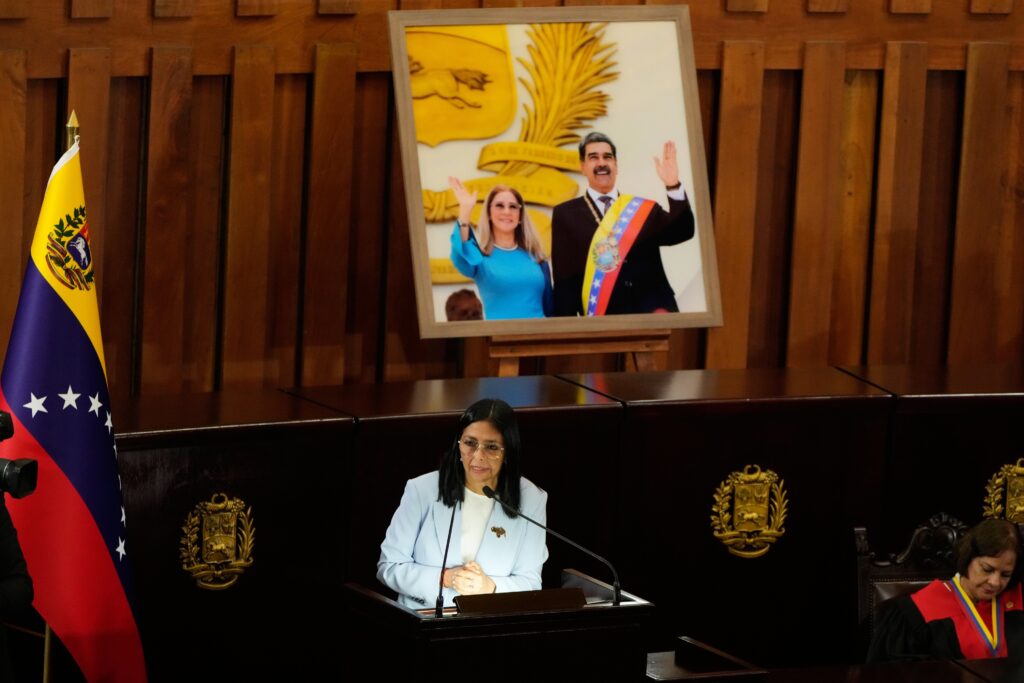
Delcy Rodriguez must not like the color orange, because the Chavista is doing lots to avoid ending up in the same prison garb as her old boss. One month after the successful operation to capture Nicolás Maduro, his vice president continues playing ball with the United States. That’s positive, but the Trump administration cannot let up pressure to schedule elections.
On Friday, Rodriguez announced support for a law to extend amnesty for political prisoners and promised to shut down the county’s most notorious prison, El Helicoide, where the regime has savagely tortured its critics. On Thursday, Rodriguez signed a bill that will end the state’s monopoly over the oil industry, opening it up for more U.S. investment.
The United States has rewarded these concessions. A delegation of diplomats arrived Saturday in Caracas to reopen the diplomatic mission seven years after it closed. President Donald Trump announced Thursday that he will reopen the country’s airspace, and American Airlines said it plans to resume service. The Trump administration is also allowing India to resume its purchases of Venezuelan oil.
Secretary of State Marco Rubio describes his regular conversations with Rodriguez as “respectful,” even as she strikes a defiant tone for domestic consumption. Rubio testified last Wednesday to the Senate that the current behavior by members of the regime “would not be acceptable to us in the long term,” but he declined to offer a timeline for a democratic transition except to say that it will follow stabilization and recovery. “It can’t take forever,” Rubio said.
It’s safe to assume Rodriguez is buying for time to stay in power, taking steps that will keep the U.S. at bay until either Trump loses focus or Democratic victories in the midterms constrain his ability to threaten sustained military operations. Considering the uneven success of U.S.-led regime change in the region historically, proceeding carefully is understandable, especially while Chavistas control the police and military. Yet Trump has the leverage, if he chooses to use it, to secure a date certain for free and fair elections.
If they happen, opposition leader María Corina Machado likes her chances. Last week, she said that she “will be president when the time comes.” Trump has expressed doubts about Machado’s ability to manage a country where the security apparatus is controlled by socialist thugs, but that’s all the more reason to hold an election to confer legitimacy.
Ultimately, it’s hard to see Rodriguez fully dismantling the infrastructure of oppression that she and her family helped create. The human rights organization Foro Penal greeted the announced amnesty “with optimism, but with caution,” which sounds about right. Venezuela has the largest number of estimated political prisoners in the Western Hemisphere.
So long as Rodriguez remains in power, Americans will need to be wary of her cooperation with adversaries like Russia, China and Iran. U.S. officials have pressed her to sever those ties, but the interim president has yet to take any public action, and the intelligence community does not think she will be willing to do so.
No serious multinational is going to sink billions and multiple years of investment into a socialist dictatorship that could confiscate it again. Reviving Venezuela’s oil industry would take an estimated $90 billion of capital expenditures. Shortly after Maduro’s capture, the CEO of ExxonMobil said the country is “uninvestable.” On Friday, he said Venezuela will need to transition to a “representative government” before investment can resume.
The post Scheduling new elections for Venezuela appeared first on Washington Post.