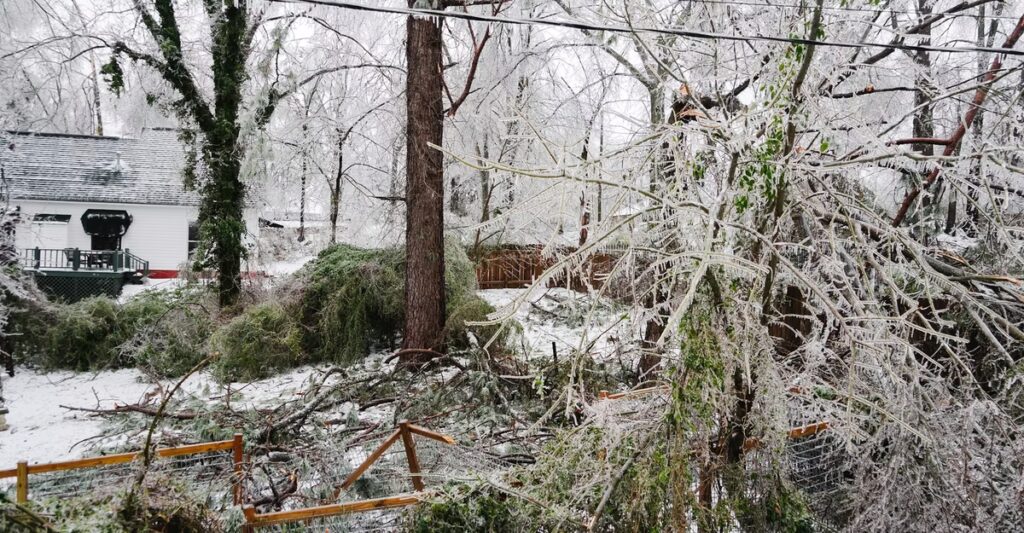
On the Saturday night that the storm hit Mississippi, we had dripped our faucets for the temperature drop and stockpiled flashlights, groceries, extra blankets. By 11:30 p.m., my husband was pulling on his rain boots and heading outside to tarp our heating unit: “A branch has already fallen onto a power line in our backyard,” he told me. Three hours later, I was shaken awake. “Mom, I think a tree just fell on our house,” my 13-year-old son said. I stumbled around, looking for any sign that tree branches had breached my home. As I searched, I saw the pine tree behind our home drop a giant branch into the neighbor’s yard.
Crack. Boom. For the next six or so hours, every few minutes, we heard tree branches cracking, encased in ice and barreling to the ground like meteorites, exploding on contact with the earth. At each crack, we thought, Will this be the one that hits our house? Or our neighbors’? Will we lose our giant oak tree? Under the weight of five blankets and three sleeping bags, we waited for the storm to pass, for daylight to break, and for the fate of our town to become clear.
We know warm-weather storms in the South. Tornado sirens and weather alerts send us to shelter in our bathtub from spring into summer, when hurricane season begins and then runs into fall. We rarely get a break, yet something keeps us in place. My family and I live in Water Valley, a small town of about 3,400 in the Hill Country, just under 20 miles from Oxford, where I grew up. As a young child, often surrounded by oaks, pines, sycamores, cedars, and more, I found comfort and beauty in the trees. Many of the old trees in Mississippi have been preserved simply because no one had reason to cut them down. So much of the state is undeveloped, and that has allowed nature to be still and simply continue to live. My childhood house backed up to Bailey’s Woods, which connects the University of Mississippi to Rowan Oak, the home of William Faulkner. I’d build forts hidden deep in the woods or follow a shortcut to campus to get a milkshake from the cafeteria. I knew the trails so well that I could walk home at dusk without a flashlight.
Last Sunday morning, I began to assess the damage. I opened the front door, and the undeniable smell of pine trees hit my son and me in the face. My neighbors, whose home is flanked by pines, were now trapped by them. Their driveway was impassable, with broken branches everywhere. I heard the sound of a chainsaw down the street: Someone was already working to clear downed branches covering the road. A few neighborhood kids had wasted no time and were at the top of the hill in front of my house, hopping on bright green disc sleds, hopeful that the ice on the road would be as fun as snow.
In the backyard, two neighbors were looking up at the pine and its scattered branches. Another neighbor’s fence was now mangled metal covered in tree parts. I saw that we had lost a smaller tree, too, and a pine tree branch had pierced its fallen body, now split in half. When I fed the birds on our deck, as I normally do, I counted as many as 40 birds feasting, having just been displaced from the trees. I decided to feed them twice as much.
My mom, who lives a couple blocks away, and my friends were all okay. We were among the more than 150,000 homes and businesses in the state without power. With nothing else to do, exhausted from the long night, I went back to sleep under my pile of blankets. This became a new pattern: sleeping more than 12 hours each night, just trying to stay warm, eating dinner at 3:30 or 4:00 before the sun set and the quiet of the town began. I stayed close to the house, while my husband volunteered overnight at the town warming center.
Our power returned after five and a half days, at 11:30 in the morning. That Thursday was the first day that the count of utility customers without power dropped below 100,000, but only barely. In my town, the Water Valley Electric Commission and its volunteer chairman, Brandon Presley, had worked hard to execute mutual-aid agreements with other municipally owned utilities and to engage private contractors and suppliers before the storm. That diligence paid off, and on Main Street, businesses were quickly up and running, providing us with resources and sustenance. The storm that we just lived through is the type that comes around every few decades, but dealing with dangerous ice here is starting to feel like a new routine. Not so long ago, another ice storm had trapped us atop our slippery hill. My neighbors are discussing their lists of winter needs for the future: ice cleats, hard warmers, a good pair of gloves, a snow shovel, a power bank, a camping stove.
Even if they are rare, storms like these teach us what we can tolerate. I lived in Memphis during the summer storm of 2003—a derecho that was affectionately called Hurricane Elvis. For 10 long days, I had no air conditioning in 90-plus degrees, and I thought that was the worst I could feel, living in air so thick you’d think you could cut it with a knife. Winter Storm Fern changed my mind. Losing power in the cold, living in air so frigid I could see my breath inside my home, is much worse than the heat.
As of Friday, almost a week after the storm, tens of thousands of households still didn’t have power. Some families, in the more rural parts of an already rural state, have no idea how long the wait will be for their power to return. In my neighborhood, a warmer day melted some of the snow and ice away on the roads, but cold has set in again, and this weekend, temperatures dropped below freezing. I thought I might have a level of resilience to endure that kind of challenge, but I quickly learned that I really don’t.
The trees have their own kind of resilience, and they, too, will return—although that will take much longer than the power. Whereas pines grow relatively fast, oaks are slower. Thankfully, our 133-year-old oak tree was spared and will, I hope, continue to be a towering beacon, reminding us of the beauty of trees, but also of the danger they can quickly create during storms. Especially when they’re covered in ice.
The post What the Ice Storm Did to Mississippi appeared first on The Atlantic.