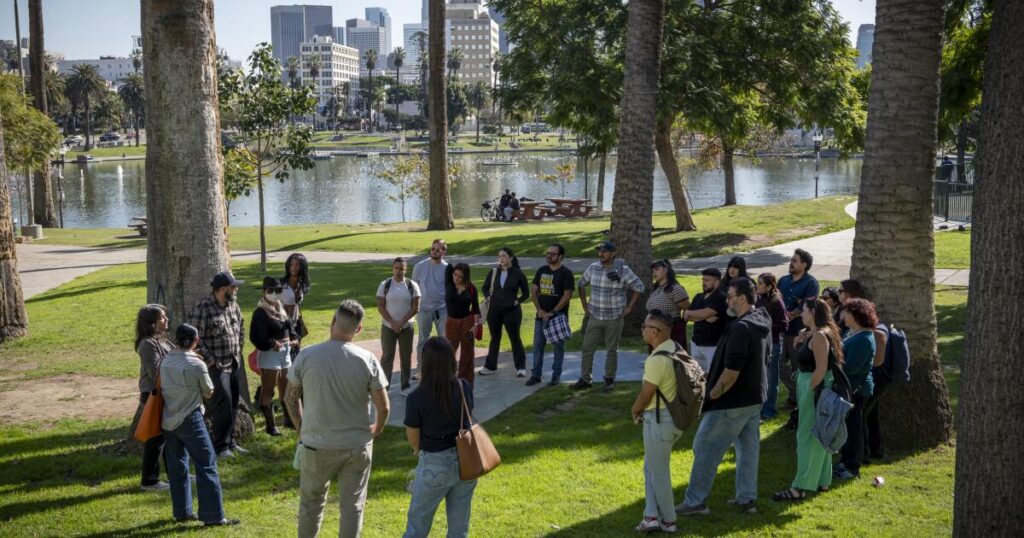
On a warm Friday morning, a group of organizers, academics and public officials stood in MacArthur Park, peering at an empty soccer field.
They came from as far away as Florida, Georgia and Chicago as members of the steering committee for Mijente, a national grassroots group that organizes activism within Latino and Chicano communities.
Mijente’s Leadership Circle, meets in person once a year to discuss strategic planning for the Phoenix-based organization.
But this year’s gathering was unlike any other. It came as immigration raids were taking place in each of the members’ cities. They were curious to learn how each of their towns were responding to the Trump administration.
So they met in Los Angeles, where the administration first launched its violentand indiscriminate raids.
Among the places hit hard by the sweeps were neighborhoods in L.A. City Councilmember Eunisses Hernandez’s first district. Hernandez is also a member of the steering committee.
Standing in the northern section of the park, she and her staff recalled the day in July that park goers and children attending summer camp were forced out as California National Guard troops and federal immigration agents arrived in vans and heavily armored vehicles.
Federal agents in tactical gear, carrying firearms, moved in on the park, walking in a straight line, side by side, some on horseback, as news helicopters hovered above and nearby demonstrators jeered at them.
L.A. Mayor Karen Bass, Hernandez and other California lawmakers condemned the incident, which was mostly used for a Border Patrol promotional video.
Joseline Garcia, who has led immigration defense efforts in the district by helping coordinate and train volunteers on how to respond to raids, said word of the agents’ presence spread quickly within a network of organizations and residents.
“One of the things we try to do is create a very sophisticated network of communication to get people out of the area,” she said.
Although no one was taken, the incursion spread fear of immigration sweeps across the densely populated neighborhood, already grappling with homelessness, drug use and crime.
At the park Friday, Hernandez spoke about her efforts to help address the problems, flooding the area with mobile home response teams, ex-gang members who try to de-escalate gang violence, otherwise known as peace ambassadors.
“That’s what we’ve been trying to do, is beef up the public safety system, not with police but with everything else,” Hernandez said. “We’re trying to figure it out. There’s no pathway.”
She said the park serves as a community gathering place, akin to a large backyard for thousands of working-class families who live in the area, many of whom are immigrants.
Last year, a new problem emerged for the area — immigration raids.
The park was just one of several stops the community organizers made that day. They visited the UCLA James Lawson Jr. Worker Justice Center, an advocacy and research institution that partners with labor unions and community groups to address labor rights and social justice.
Saba Waheed, director of the center, said the institution produces “know your rights” materials and other resources for local groups assisting immigrants.
“The mission of the center has always been to provide research by and for the community,” she said.
The group also visited the headquarters of Central American Resource Center, or CARECEN, a nonprofit established in 1983 by Salvadoran refugees fleeing civil war. The U.S. at the time was providing military assistance and training for counterinsurgency battalions that later terrorized and killed Salvadoran civilians.
In the basement of the headquarters, amid columns wrapped with green vines and yellow flowers, center director Martha Arevalo spoke about the hardships her organization has faced.
They include loss of federal funding and letters from Congress threatening investigations into the use of those funds.
Arevalo said the nonprofit was forced to make cuts, including 10 staff positions, a significant loss in Los Angeles County where nearly half of the population is Latino and 33% are foreign born, according to the U.S. Census Bureau.
“It’s been a tough year,” Arevalo told the group. “Never did we think the second term of the Trump administration was going to be this evil.”
By noon, the group headed to Los Angeles City Hall where they discussed issues from homelessness to immigration policy.
Among the more than dozen visiting members was Latin American studies professor Rafael Solorzano from Florida.
He said the gathering highlighted how communities from across the U.S. must respond differently. In Florida, for instance, local police work directly with ICE.
“In Georgia and Florida, you don’t have ICE patrols, you have state troopers. So what type of community defense strategy do you create to fight patrol state police?”
Chicago Alderperson Rossana Rodriguez made a similar observation.
“There are things that we have done in Chicago because of how hard we were hit. We had to develop our own systems that make sense for our city,” Rodriguez said.
In the face of such diverse challenges, Mijente Executive Director Marisa Franco said nonprofits and grass roots must find strength by working together.
“Despite our desire to have the one thing to stop this politically [or] the one training that’s going to help us prepare — there isn’t,” Franco said. “That’s where the networking and ability for people to exchange [ideas] with each other is really valuable.”
As the group left City Hall that afternoon, hundreds of demonstrators had gathered in the streets, carrying signs calling for the end of the immigration raids. It was one of many protests held across the country.
The post Amid immigration raids, a coalition of U.S. leaders gather in L.A. to share resistance strategies appeared first on Los Angeles Times.