A company might lay people off for any number of reasons: It didn’t meet financial targets. It overhired. It was rocked by tariffs, or the loss of a big client.
But lately, many companies are highlighting a new factor: artificial intelligence. Executives, saying they anticipate huge changes from the technology, are making cuts now.
A.I. was cited in the announcements of more than 50,000 layoffs in 2025, according to Challenger, Gray & Christmas, a research firm.
Amazon said on Wednesday that it was cutting 16,000 corporate jobs, in addition to the 14,000 it announced in the fall. In a June blog post, Andrew Jassy, the chief executive, said: “As we roll out more generative AI and agents, it should change the way our work is done,” adding that “in the next few years, we expect that this will reduce our total corporate workforce.” (He later walked back the connection between layoffs and A.I., and the company has since said the reason for most of the cuts was reducing bureaucracy. Most analysts, however, believe Amazon is cutting jobs to clear money for A.I. investments, such as data centers.)
How it’s pronounced
/ā-ī wȯ-shiŋ/
Pinterest said last month that it would cut about 15 percent of its work force, partly because it would be “reallocating resources to A.I.-focused roles.” And Hewlett-Packard’s chief executive, Enrique Lores, said on a November investor call, “We see a significant opportunity to embed A.I. into HP,” which would lead to as many as 6,000 job cuts in the coming years.
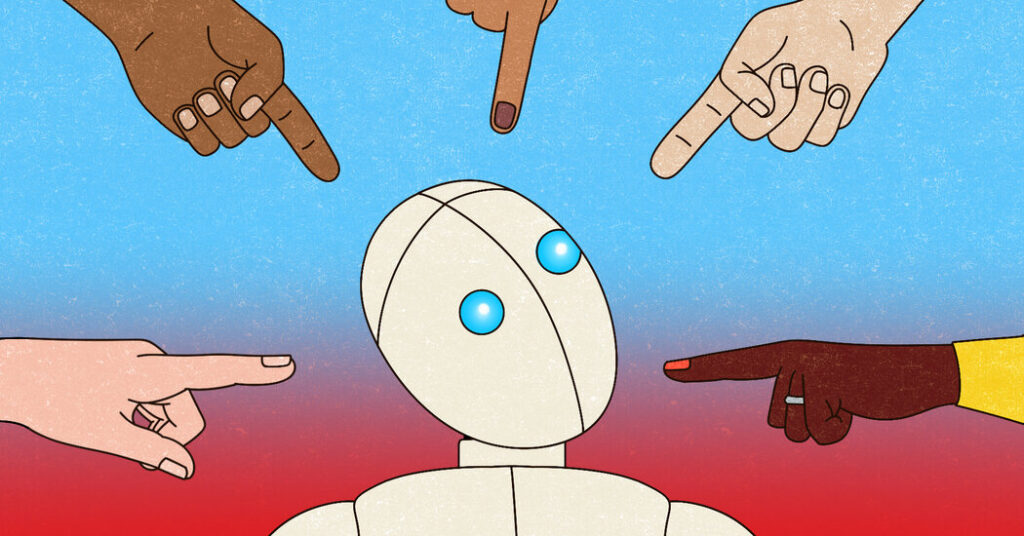
Investors may applaud such pre-emptive moves. But some skeptics (including media outlets) suggest that corporations are disingenuously blaming A.I. for layoffs, or “A.I.-washing.” As the market research firm Forrester put it in a January report: “Many companies announcing A.I.-related layoffs do not have mature, vetted A.I. applications ready to fill those roles, highlighting a trend of ‘A.I.-washing’ — attributing financially motivated cuts to future A.I. implementation.”
The term echoes popular descriptors of misleading marketing practices, such as greenwashing and ethics washing. It started bubbling up a few years ago, mostly to call out companies that claimed to be using A.I. when they weren’t. But lately, it has been used more broadly to gesture at companies emphasizing A.I. to explain things like layoffs when the picture may be more complex.
“Companies are saying that ‘we’re anticipating that we’re going to introduce A.I. that will take over these jobs.’ But it hasn’t happened yet. So that’s one reason to be skeptical,” said Peter Cappelli, a professor at the Wharton School.
This type of anticipatory layoff, said Molly Kinder, a senior research fellow at the Brookings Institution who studies A.I. and work, allows executives to signal to the market: “I’m cutting-edge, I’ve adopted A.I., and I’ve figured out savings.” It’s a “very investor-friendly message,” she said, much more so than “the business is ailing.”
Of course, A.I. may well end up transforming the job market, in tech and beyond. But a recent study Ms. Kinder worked on for the Yale Budget Lab found that artificial intelligence has not yet meaningfully shifted the overall market. Tech firms have cut more than 700,000 employees globally since 2022, according to Layoffs.fyi, which tracks industry job losses. But much of that was a correction for overhiring during the pandemic.
As unpopular as A.I. job cuts may be to the public, they may be less controversial than other reasons — like bad company planning. And in the current environment, where criticizing policies like tariffs could trigger the wrath of the president, it’s “not as risky to frame layoffs as A.I.-related,” Ms. Kinder said, “even if potentially the real culprit is something else.”
The post Did A.I. Take Your Job? Or Was Your Employer ‘A.I.-Washing’? appeared first on New York Times.