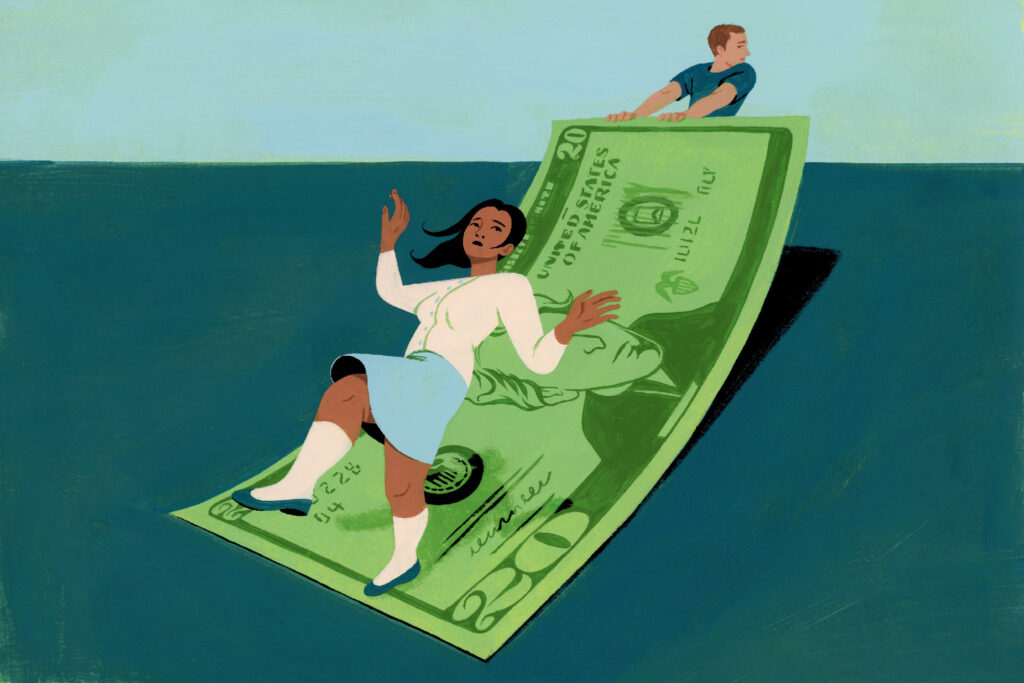
My husband is a good guy and a sensitive soul. He does have one really annoying habit: He constantly buys things we don’t need. I understand having hobbies and wanting to spend money on things you care about, and honestly, if that were the case, I’d be fine with it — even if it stretched our budget. But half of what he buys ends up unused in a closet or the garage. No matter how many times we agree on a budget, he has a new explanation for why he bought something. He grew up poor, so part of me feels like he should know better — but apparently he doesn’t. It’s really bugging me, and I don’t know how to get him to stop.
When a partner’s behavior hurts us materially or emotionally, it’s tempting to only focus on stopping the behavior. While that’s understandable, it’s usually more productive to first understand what’s driving it.
People buy things they don’t need for many reasons, but a few come up again and again.
Some people buy things such as expensive cars or jewelry to broadcast wealth, status or success. Others may be influenced by peer pressure and keeping up with friends. Still others may be convinced that they’re going to use the things they buy, even when they haven’t in the past. Marketing strategies such as “Buy now, pay later” installment plans also can be alluring and appeal to those affected more by impulse than rationality.
Regardless of cause, conflicts over money and purchases are extremely common. About one in four U.S. couples in serious relationships say they argue about money. More in-depth studies of couples’ interactions show that nearly one in five everyday disagreements involve money and that these arguments tend to feel more emotionally charged and harder to resolve than conflicts about other topics.
Recurring fights about spending aren’t a sign that your relationship is uniquely broken; they’re one of the most common ways deeper anxieties, values and power struggles show up between partners.
You should keep in mind that in some cases, overspending may be driven by a desire to soothe anxiety or insecurity. That relief tends to be short-lived, which helps explain why the buying continues even when the items go unused.
Chronic overbuying sometimes turns into hoarding, which research suggests affects about 2 to 6 percent of adults. Hoarding is often driven less by materialism than by anxiety, emotional attachment to possessions and difficulty tolerating loss or uncertainty. The research also shows that hoarders frequently overestimate the future usefulness of items and experience distress at the idea of discarding them, even when the objects remain unused.
Another problematic form of consumption is compulsive buying where people feel driven to shop, not for needs but for emotional relief, experiencing tension before purchases and a brief sense of calm afterward, even when the spending causes distress or problems. Studies estimate that roughly 5 percent of adults show symptoms consistent with compulsive buying behavior. While it isn’t listed as a “shopping addiction” in the Diagnostic and Statistical Manual of Mental Disorders (DSM-5), it is recognized in other clinical frameworks as an impulse-control behavior with real consequences for relationships and finances.
You mentioned that your husband grew up poor. That may explain some of his attitudes and behavior around purchases. Early experiences with scarcity can leave a lasting imprint. For some, growing up poor may lead to thrifty behaviors in adulthood because they have a fear of never having enough. For others, it may lead to excessive spending as a way to reassure themselves that the era of deprivation is over: “I can afford this now, so why shouldn’t I buy it?” (Even when they really can’t.)
On the other hand, it’s possible that his buying isn’t about the objects at all. Once you’ve made your displeasure clear, continued spending may function — unconsciously — as a way for him to assert his independence. If he tends to avoid conflict or “go along to get along,” buying things without your approval may feel easier than openly saying, “I know this bothers you, but it matters to me, and I plan to keep doing it.” That’s not great communication on his part, but it’s more honest than repeatedly agreeing to limits he doesn’t intend to follow.
Whatever the reasons, the two of you need an agreement that reduces the tension.
Aim for understanding
When couples reach a stalemate, it’s often because the deeper issues haven’t been addressed. Shaming or repeated criticism won’t change his behavior — at least not for long — and may push it further underground.
Given that, start with a conversation aimed at understanding, not persuading. Consider what the overspending signals to you about his behavior. Do you feel disrespected or rejected? Does it make you lose respect for him that he can’t better control his spending? Do you worry it may get in the way of other goals that matter to you?
Choose an appropriate time
Pick a time to discuss your concerns when you’re feeling relaxed and not upset. You might say something like: “I want to talk again about our budget. I’m not bringing this up to criticize you; I’m just aware that we keep agreeing on a budget, and whatever we’re doing doesn’t seem to be working. Can you help me understand what these purchases mean to you, how you feel when you’re making them or how you feel after you’ve bought them?”
Then listen without judgment, and ask him to do the same for you.
Set boundaries
Understanding, however, doesn’t mean unlimited tolerance. Practical boundaries still matter. Many couples find it helpful to agree on:
- A set amount of discretionary spending each partner can use without explanation.
- A waiting period for nonessential purchases.
- Limits around storage space so unused items don’t continue to pile up.
The goal isn’t to eliminate disagreement but to prevent it from turning into chronic resentment. If the spending is modest and doesn’t jeopardize your financial stability, this may be a matter of negotiating differences rather than correcting a problem. But if purchases are frequent, secretive or tied to mounting debt, it may signal deeper anxiety or avoidance that warrants professional help for you as a couple or for him individually.
Money conflicts rarely end when one partner “wins.” They end when couples can talk honestly and sometimes frequently about what money represents — security, freedom, pleasure — without turning each other into the problem. Clearer agreements, grounded in mutual respect, are far more effective than ultimatums in protecting both a relationship and the people in it.
Joshua Coleman, PhD, is a clinical psychologist in the Bay Area, keynote speaker, author, and senior fellow with the Council on Contemporary Families. His newest book is “Rules of Estrangement: Why Adult Children Cut Ties and How to Heal the Conflict.” His Substack is Family Troubles.
If you have a question for a therapist about mental health, relationships, sleep, dating or any other topic, email it to [email protected], and we may feature it in a future column.
The post How to get your partner to stop spending money you don’t have appeared first on Washington Post.