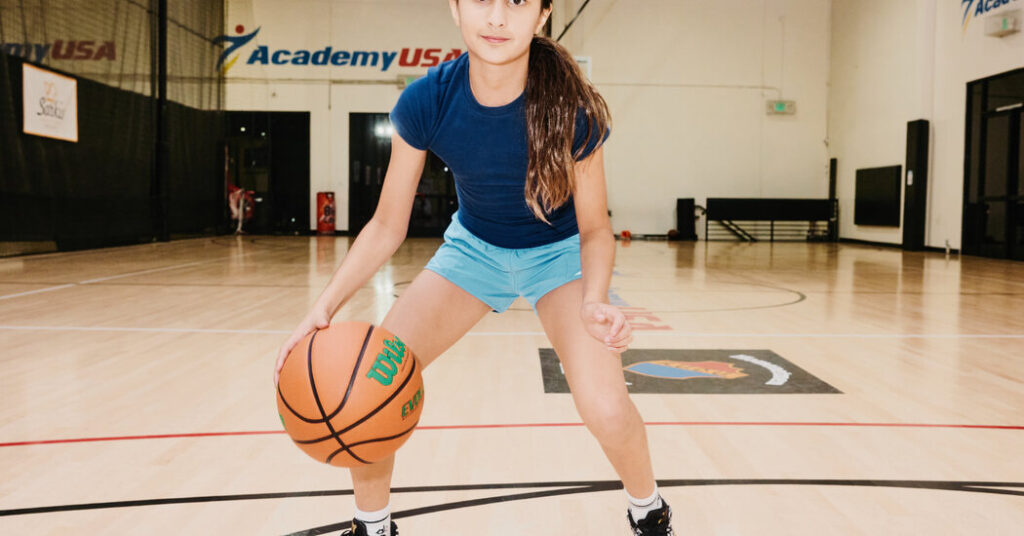
It was a Friday evening at Academy USA, a training facility in Glendale, Calif., and the courts were full of kids running shooting drills and sprints. On one court, Lyla Megeredchian, a 10-year-old fourth grader, practiced alone with her personal coach, Shaun Gerardo.
After making a three-pointer, Lyla ran over to her parents, her ponytail swishing.
“Did you see that?” Lyla said. “The corner shot is my shot!”
Lyla and her siblings are part of a growing cohort of preteen athletes who are booking sessions with personal sports trainers. Professional-level sports coaching has long been available for elite high school athletes; coaches like Mr. Gerardo are bringing that ethos to elementary schoolers, both for specific sports and for general fitness.
American youth sports have grown into a $40 billion business. In 2024, the average family with kids who play sports spent $1,016 on their child’s primary sport, nearly twice what they spent in 2019, according to surveys from the Aspen Institute.
That has presented an opening for coaches like Mr. Gerardo, who has built a business privately coaching basketball players as young as 7. “I usually get kids who are very obsessed with the sport,” said Mr. Gerardo, whose rates start at $80 an hour, “and the parents are just as obsessed as the kids are.”
Harrison Elias, a strength and conditioning coach, started to offer small group and one-on-one weight training for children after noticing growing interest in training for younger clients over the past decade. (He also works with adults and college athletes.)
“There was a big gap in the market for 9- to 15-year-olds,” said Mr. Elias, who coaches in Glastonbury, Conn.
In addition to personal training, Lyla already plays on three basketball teams, for her school, her club and the local Armenian cultural center. The same goes for her sister London, 12, and brother Luka, 9.
Inevitably, that means forgoing some other plans, as when Luka had to skip a close friend’s birthday party for a club game. Asked how that made him feel, he didn’t hesitate. “It made me feel good, because I love basketball,” he said, in spiked hair and basketball goggles foggy with sweat. “I need to stay focused and practice every day.” Besides, Luka added as he opened an electrolyte drink, most of his friends were doing the same thing.
On that particular Friday, Lyla was working on spin moves and corner shots. During a break, her father, Alex Megeredchian, pulled Mr. Gerardo over.
“Isn’t it too early for her to start practicing threes?” asked Mr. Megeredchian, who just finished coaching Luka’s club team on the court next door. As Mr. Gerardo reassured Lyla’s dad about the workout plan, she didn’t break focus.
Families like the Megeredchians are investing heavily in their kids’ athletic careers for a few reasons. For some, it’s about admission to elite universities with slim acceptance rates. Others are recognizing how, thanks to the landmark N.C.A.A. settlements last June, elite teenage players can now earn serious money. “If kids didn’t want to play D1 sports before, now they do, with deals in the six figures,” said Mr. Gerardo.
But many families are doing it for the age-old reason: Because everybody else is. “Anybody that plays travel basketball has some kind of private coaching on the side,” Mr. Megeredchian said.
Parents often find trainers through word of mouth or platforms like Athletes Untapped, which connects youth personal coaches with clients. Gene Williams co-founded the platform with his wife, Elaine, in 2022; since then, he said, approximately 10,000 families have signed up for one-on-one training. Many of their coaches still work other jobs, Mr. Williams added, but some are making it work full time.
The intensity of kid athletes’ training regimens has led to an increase in some serious injuries, said Dr. Neeru Jayanthi, a co-director of the Youth Sports Medicine Program at Emory University.
He has seen more children with tendon degeneration and stress injuries in the low back, elbow and shoulder. These are injuries he expects to see in college athletes, he said, adding: “This shouldn’t be happening to 14- or 15-year-olds.”
Dr. Rebecca Carl, an associate professor of pediatrics at Northwestern University and chair of the American Academy of Pediatrics Council on Sports Medicine and Fitness, said she had seen increasing rates of A.C.L. tears and Tommy John surgery for youth athletes.
Dr. Jayanthi’s rule of thumb is that kids should train for fewer hours a week than their age — a 7-year-old shouldn’t be formally training more than seven hours a week, for example.
In one study he led, young athletes who spent at least twice as much time in organized sports as in free play were more likely to have serious overuse injuries. When kids casually play a sport together, they’ll likely stop before they get hurt, Dr. Jayanthi reasoned, while strict regimens of high-intensity coaching might push them further than they would go on their own.
The American Academy of Pediatrics has found that overuse injuries and overtraining often lead to burnout, too; another AAP study found that 70 percent of kids drop out of organized sports by age 13.
Dr. Carl and Dr. Jayanthi, both parents to young athletes, sympathized with the trade-offs and pressures parents face.
“I’m a much better sports doctor than a sports parent,” said Dr. Jayanthi, whose 10- and 12-year-olds play competitive tennis. He helped establish general guidelines, including that kids should not compete in two sports at once and that they should take a month off from competitive sports every year.
Yet, he said, on “Saturdays in the fall and spring, I’m still picking my kids up from baseball, they’re changing in the car, and we’re going straight to a tennis match.”
Laurie Tuohey started sending her oldest son, Ryan, to train with Mr. Elias three years ago, when he was 11. Now, Mrs. Tuohey’s two younger kids train with him, too.
“When we started, it was about injury prevention and getting stronger, but I realized it’s a life skill as well,” said Mrs. Tuohey, who lives in Wethersfield, Conn. “Maybe they won’t still play soccer when they’re older, but if they can know how to go to the gym, that’s important to me.”
Mr. Elias’s workouts focus on building overall strength and conditioning, regardless of which sport an athlete plays. A typical 45-minute session for 9-year-olds, he said, includes vertical jumps, five-yard sprints, squats and chin-ups.
Sometimes, when Mrs. Tuohey is driving her kids between practices and trainings, she thinks about how different their athletic experiences are from when she played after-school soccer in the late 1990s. “Now it’s like a nonstop competition of who can get the most work in,” she said. “If you’re not putting touches on the ball every day, you’re behind.”
For many kid athletes, the sacrifices, both physical and social, feel entirely worth it. Lyla Megeredchian can reel off a litany of all the body parts she’s injured while playing basketball: her ankle, her knee, her pinky, her toe, her kneecap. She’s missed sleepovers because of practice; her dad said that sometimes, when Lyla’s friends are over, he has to tell her to go play with them rather than go play basketball.
But as she led a tour around their backyard court, she lit up, boasting that once, her parents let her play until midnight. Not on this Friday night, though. Tomorrow morning, she’d start another tournament.
The post Personal Training for 11-Year-Olds? It’s Happening. appeared first on New York Times.