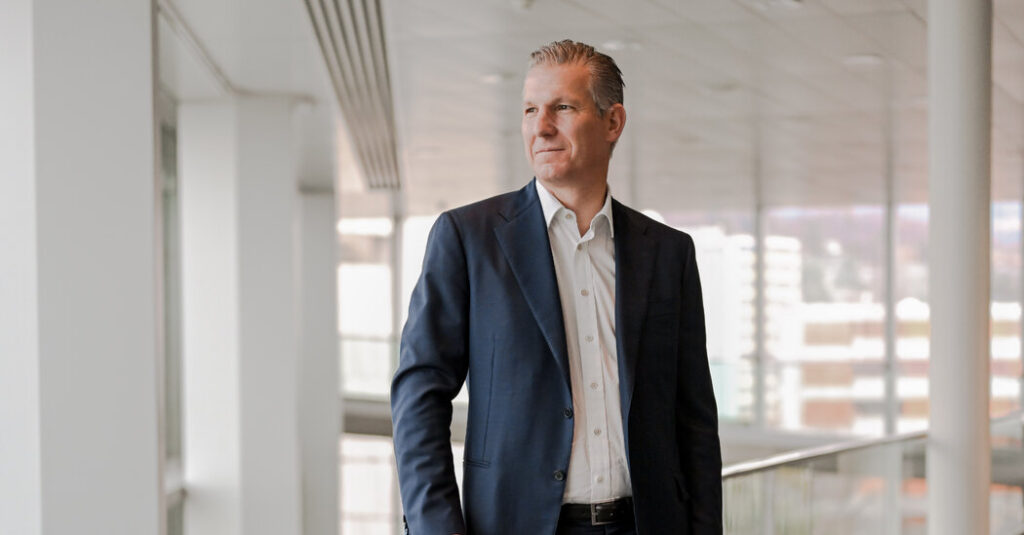
Inside Nestlé’s headquarters, products from its extensive array of brands sold around the world are lined along a hallway, organized by the role they serve in a person’s life — products for infancy, for old age, for healthy eating and satisfying cravings.
Nestlé, a 160-year-old Swiss conglomerate, is the world’s largest food company, with around $120 billion in annual sales. In the United States, its largest market, the company’s brands include Nespresso, Gerber, DiGiorno and, for the pets, Purina.
The company’s sales have been sluggish in recent years, as it has struggled to respond to consumers’ changing tastes. And as competitors like Unilever and Kraft Heinz slim down by spinning off units, many analysts are skeptical of Nestlé’s sprawling portfolio.
Nestlé’s stock has shed roughly half of its value from its peak in 2022.
Philipp Navratil, the company’s new chief executive, says he is taking a hard look at all of those brands. Nestlé’s water business, which includes Perrier and S. Pellegrino, is on the chopping block.
Mr. Navratil’s predecessor, Laurent Freixe, was dismissed after just a year over an undisclosed relationship with a subordinate, a breach of the company’s code of conduct. It’s left Mr. Navratilto not only gain the trust of customers and investors but also, perhaps most importantly, that of the 270,000 Nestlé employees who are adjusting to an abrupt change in leadership.
But can Mr. Navratil, who has worked for more than 20 years at Nestlé, including a stint on its board, bring a fresh perspective?
“I can distance myself enough to look at things with different aspects and from different angles,” Mr. Navratil, 49, said.
This interview, conducted at Nestlé’s headquarters in Vevey, Switzerland, has been edited and condensed.
You’re the third C.E.O. in a less than two years. Your predecessor left after investigation into misconduct. What were the first steps you took to gain trust after that situation?
Nestlé is not used to such turbulent times. We’re a company that should be steady and just deliver what it promises. The most important thing is that when the C.E.O. changes, it doesn’t have to disrupt the whole company.
When I got into my job, I thought, “Let’s take what works, make sure we do more of that, and make sure we communicate really transparently what happened and what we will do.”
How are you ensuring that Nestlé is prepared to catch ethical lapses in the future?
We had a C.E.O. change but also we had a change of chairman. That is liberating in a sense, because normally at Nestlé you would have the previous C.E.O. becoming chairman. Now we have a new C.E.O. and a new chair. What that gives us is license to look at things without preconceived ideas. Everything is on the table.
Definitely something we need to do is also have less surprises.
While you’re trying to regain trust with employees, the company is going through massive layoffs. You’ve announced 16,000 job cuts.
We created an organization that was just too big, with too many layers. Today, when you look at A.I., there is a way of working that can be much more clear, fast and agile.
This way of working will obviously require less people, but it will also speed up the company. It will be a growth story about how we use A.I. to grow faster, to make decisions better, to plan throughout the supply chain to have less stock and less waste.
In recent years, we’ve seen food conglomerates sell off units. Is there still value for Nestlé to be in so many different businesses?
We’re not as complicated as it seems. It’s coffee, pet food, nutrition, and then what we call food and snacking. Size matters because we can really have good discussions with our big customers — take Walmart or Amazon — about different product lines. It also gives you a hedge if anything happens to one of the businesses.
Don’t confuse size with bureaucracy and complexity.
Nestlé has many beloved, well-known brands. It must be tough to think about getting rid of any of them.
You have to take a step back.
For example, in the U.S. we sold our confectionery business — brands like Butterfinger and Crunch. These were nice brands to have, but nostalgia as a decision maker is not good.
What I’m more emotional about when you sell businesses is taking care of the people.
Let’s turn to the coffee business, where you spent most of your career at Nestlé. It has been hit hard by climate change. What does that mean for Nestlé in the future?
There is data that says if you don’t do anything, 50 percent of coffee-growing regions are in danger of not being able to produce coffee.
If raw materials become scarce, then affordability is at risk.
What we do is drive regenerative agriculture, not because it is fancy or it is philanthropy. It is really strategic to the future of Nestlé.
Nestlé has raised coffee prices, in part because of supply chain challenges. How much more do you think you can raise prices before consumers balk?
They’re stretched on their budgets, obviously. Not just in the U.S. but across the world. Raising prices is the last resort.
In many ways, we were able to not raise prices to the level we should have, given the commodity price increase, because we have savings that mitigate some of that.
We care about affordability big time. We have experience here because we are in so many emerging markets.
So you can take lessons from emerging markets to figure out the U.S. consumer right now?
I think so. It has to do with affordability. In the U.S., some consumers are well off — the ones that have less debt, and money in the stock market — and you see their consumption holding up. We see that for brands like Nespresso, for example, that are still driving good growth.
But then you see on the other side a consumer that obviously is more stretched. They struggle to make ends meet. There, we have to adapt the portfolio.
In the U.S., in the past you would have products in a multipack, because per kilo it might be more economical. Now, you have to adapt how many servings you have in a pack to make sure it fits budgets.
Let’s talk tariffs. What have you learned in the past year about navigating them?
You have to take a step back from some of that noise and just look at it in a very long-term way.
We tend to stay put when there is a crisis. We don’t just pull out. We adapt the business.
When you look at tariffs, Nestlé has always been such that 95 percent of what we sell in a country is produced in that country. We have 55 factories in the U.S. and 95 percent of what we’re selling in the U.S. is produced and manufactured in the U.S.
There is a growing conversation driven by Robert F. Kennedy Jr. and some states, like California, about what should be in Americans’ food. As the head of a big food company, how are you managing that?
We really welcome it. We have always been a company that sells nutrition and not calories.
For example, 99.8 percent of our products are without artificial colors or any of those ingredients that the U.S. is now acting on. For years, we have taken out salt, sugar and trans fat out of products without losing the taste preference, which is not an easy task.
What consumers want to see is ingredients they can recognize and not stuff that is numbers or letters.
Even for processed food?
There is this discussion about processed food and is it good for you or not good for you? That’s a good discussion to have because not all processed food is bad. It’s just how it’s processed.
Soluble coffee is processed, but it’s coffee. It’s one ingredient.
How is that nuance received in discussions?
Food processing has brought availability of affordable, durable food to the world.
Now, obviously, if food processing is seen as those items that are high in saturated fats and salt and sugar, that is one thing. If you think about fermentation, that is food processing, but it’s a very healthy way of processing food.
We proudly sell chocolate and pizzas, but you obviously cannot have a diet that only consists of pizzas or chocolate. What the U.S. government is saying is, “What does a healthy diet look like?”
There are disagreements and there are different ideas, but I’m really happy this discussion comes to life.
Tell me about your upbringing. You’re from Zurich.
I was born in Zurich to an Italian mother who grew up in Latin America and an Austrian father. I always lived in Zurich, went to school in Zurich and then studied business administration and capital markets.
You’ve held different posts at Nestlé, in countries like Honduras, Panama and Mexico. Tell me about a “sliding doors” moment in your career.
When we were offered Honduras, we had a four-month-old baby. We went there and on the way back, I was sitting next to my wife and I said, “It’s a complicated place, let’s not do this.” We had a discussion and basically she convinced me that “if you don’t do it, you will regret it.” Family is important for an expat career because it anchors you.
At that time it was a dangerous place, in a sense, to live. That taught me resilience.
What’s the best piece of advice a mentor has given you?
Be patient. Don’t be sitting on a hot chair. Sometimes one has the urge to move very fast, and sometimes it’s for a good reason that you don’t.
It’s time for the lightning round. What’s your favorite Nestlé snack?
A Nespresso espresso. That’s a snack for me.
How many cups of coffee do you drink a day?
Seven or eight.
How do you take your coffee?
Just black. Sometimes with a KitKat.
Is there a cutoff hour when you’ll stop drinking coffee?
No, not yet.
What’s your best advice for when you need to focus?
To not have any screen — just a piece of paper and a pen.
What’s something you’ve learned from your youngest employees?
Be learning constantly. When you stop learning, then it is the moment to move on to another job.
What’s something you’re trying to learn right now?
To be more patient.
If you could switch careers, what would you do?
I would be running a farm and selling the stuff in a restaurant. I might do that later on at some stage. That idea sometimes gives me peace of mind.
Jordyn Holman is a Times business reporter covering management and writing the Corner Office column.
The post Nestlé’s Chief Is in Turnaround Mode. He Drinks 8 Cups of Coffee a Day. appeared first on New York Times.