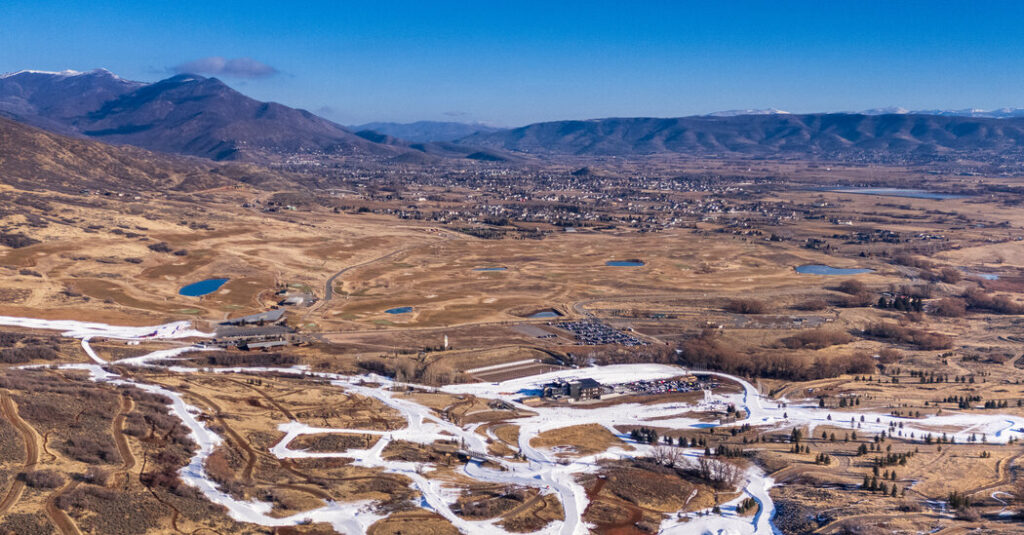
While record snowfall and single-digit temperatures pummel much of the United States, an extreme snow drought and unusually warm weather are keeping skiers off the mountains, snowmobilers off the trails and water out of the rivers across much of the West.
In many places famed for deep natural snow, including Park City, Utah; Vail, Colo.; and central and eastern Oregon, much of the ground is bare or blanketed with mere inches rather than feet of snow.
The extent of snow-covered ground is at a record low. Instead of the typical winter sports, people across the West are still hiking and biking in 50- and 60-degree weather.
Many are closely watching snowpack measurements because snow in the mountains provides natural storage for water in the arid West. The runoff will be slowly released in the coming months, acting as a primary water resource for millions of Western residents and for irrigating farm fields and filling trout streams and reservoirs.
The stunning decline in snowpack in the Colorado Rockies and the Colorado River basin adds to the 26-year-long megadrought in the region, which has led to extremely low levels in the two largest reservoirs on the Colorado River. And the assessments represent the latest backdrop for tense negotiations this year between Upper and Lower Basin states on how the river will be managed in the future.
What’s occurring across the region isn’t easily explained. Scientists have found that it is difficult to attribute the snow drought entirely to climate change. But the changes are striking.
From Dec. 1 last year to Jan. 15, temperatures were up to 15 degrees above normal in the Rockies, the Cascades and the Sierra Nevada. Colorado is having its warmest winter since 1895. Precipitation that normally would have arrived as snow in many places instead appeared as rain and caused widespread flooding.
The mountains of Oregon are one of the hardest hit. “We are struggling with the lack of snow,” said Presley Quon, a spokesperson for Mt. Bachelor, a ski resort near Bend, Ore. “It’s been a really rough season for ski resorts.”
Last year at this time, Mt. Bachelor had 109 inches of snow at its base; this year it has 27 inches. Snow on the runs is so thin that the resort has closed two of its 12 ski lifts.
Elsewhere, cross-country ski events, snowshoeing and snowmobile tours have been canceled. In Montana, the annual Race to the Sky sled-dog event was called off in January.
“Trail conditions — bare ground, icy and rock‑hard sections, unseasonably warm temperatures, and no measurable snow in the forecast — left us without a safe route for the race,” event officials wrote on their Facebook page.
The Salt Lake City airport may set a new record this winter for low snowfall. So far, only one-tenth of an inch has fallen; the previous low, in 1933-34, was 14.3 inches.
The snow drought has taken a toll on Colorado’s $5 billion-a-year ski industry. Vail Resorts said that in December, just 11 percent of the terrain at its sites in the Rockies was open and that snowfall in November and December was 60 percent below normal.
“We experienced one of the worst early season snowfalls in the Western U.S. in over 30 years,” said Rob Katz, the company’s chief executive, in a recent statement.
In Utah, ski areas at higher elevations have received adequate snow, but those lower down have little natural snow. Although the ski areas at lower elevations usually depend on artificial snow at the beginning of the year to build a base, they have been forced to continue making it all season.
“Made snow is smaller particles and it’s icier, and skiing is not the same,” said McKenzie Skiles, director of the Snow Hydrology Research-to-Operations Laboratory at the University of Utah.
“You don’t get powder days from man-made snow and that’s hard, especially when you live in a state where the motto is ‘The Greatest Snow on Earth,’” she said.
In Colorado and Oregon, researchers said the snowpack in mid-January was the lowest it has been since the 1980s.
Scientists say that it’s difficult to attribute this winter’s dry season and others to climate change alone. But the weather models suggest the pattern will continue.
“The predictions are we will get less snow because the precipitation base will be rain rather than snow, and the line at which snow accumulates will keep creeping up,” Dr. Skiles said.
“We have had multiple rainstorms rather than snows,” she added. “We’ve had rain up to 10,000 feet, which is pretty abnormal here.”
Still, some ski areas in the Northern Rockies are reporting good snowfall. “Montana and western Wyoming are the only ones in decent shape,” said Michael Downey, drought program coordinator for the state of Montana. “High up, above 6,000 feet, snowpack is great. At medium and low elevations, it’s as bad as I have ever seen it.”
But he added that “there’s plenty of time to make it up,” given that February, March and often April are the months when most of the snow usually falls in the mountains.
A major concern in the West is how the snowpack levels affect water resources for the coming year. Most of the runoff originates from the middle and lower elevations, which cover a far greater area than the land at higher altitudes.
In the Pacific Northwest, unusually heavy rains from what was called the “pineapple express,” an atmospheric river that flows in from the Pacific Ocean, brought torrential rain and extremely damaging floods to Washington, Idaho and Montana, washing out roads and bridges. The rain melted a lot of the snow, decreasing the snowpack by 50 percent in one drainage.
Utah gets 95 percent of its water from snowpack, but just 5 to 15 percent of the runoff comes from high elevations there, Dr. Skiles said.
Last year drought caused low flows for irrigation in the farm fields of northern Montana and resulted in water rationing. Experts worry that could happen again this year.
Moreover, a lack of snow can leave winter wheat — planted in the fall to grow in the spring — at risk.
“What snow does for winter wheat is insulate the ground and the seed,” said Colter Brown, the Ag director for Northern Ag Network, which broadcasts agricultural news on some 60 radio stations in rural areas. If temperatures drop without snow, the seed could die. “If that happens, they have to buy seed and replant, and that would be expensive with today’s commodities prices.”
With so much in the West dependent on ample snowfall, the ski industry, states and other entities are investing a lot in cloud seeding to improve the amount of wintertime precipitation. Researchers report that while it’s not a guaranteed process, sometimes dropping silver iodide into clouds can increase the amount of snowfall up to 15 percent.
Snowpack in the Colorado Rockies is closely monitored, with about 40 million people in seven U.S. states and about two million in Mexico relying on the Colorado River for their water. Snowpack is a natural reservoir that, ideally, releases its water slowly as temperatures rise in the spring. Some 70 percent of the river’s flow comes from snow.
“It’s pretty bad and looks like runoff is going to be terrible,” said Kathryn Sorensen, director of research for the Kyl Center for Water Policy at Arizona State University.
But the situation appeared similarly bleak at this point in 2015, she said.
“Then we had that weird miracle May,” she said. “Snowpack was awful, but then for some reason there was a ton of rain. Weird things can happen, so let’s hope weird things happen. Otherwise it’s going to be pretty awful.”
The post Snow Drought in the West Reaches Record Levels appeared first on New York Times.