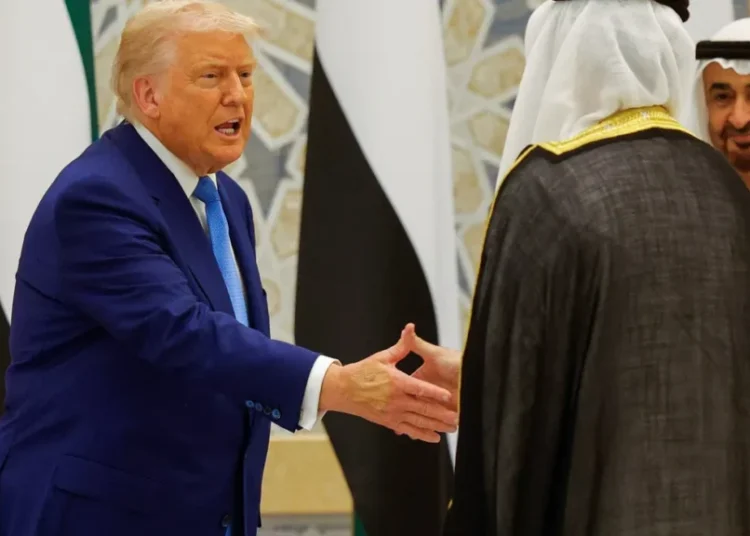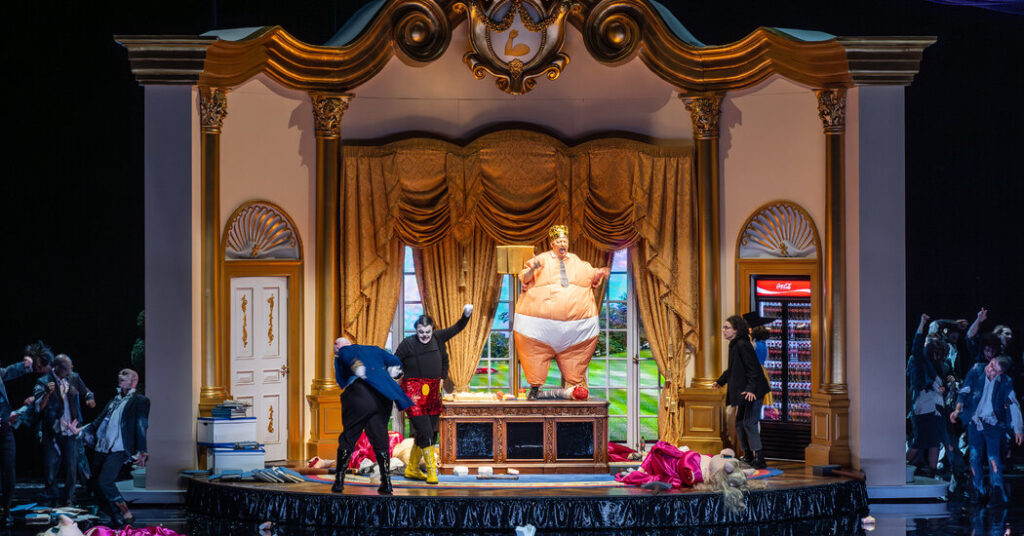
In “Monster’s Paradise,” a new opera by Olga Neuwirth, the baritone Georg Nigl plays a character called the King-President. Before rehearsals started, he asked the director if he should model his performance on President Trump.
Last year, Nigl played a convincing Vladimir Putin. But for this new piece, the director, Tobias Kratzer, wanted to examine the phenomenon of the strongman without limiting himself to a single person.
The opera argues that “inside every populist ruler,” Kratzer said in an interview, “there’s a kind of gigantic, fecal baby.” It also shows that such characters are no less dangerous for being absurd.
“Monster’s Paradise” is Neuwirth’s seventh full-length stage work and her first opera in over 20 years, with a libretto by the Nobel Prize-winning author Elfriede Jelinek, who uses intricate language to expose the interwoven banality and brutality of our times. Their work premieres on Sunday at the Hamburg State Opera, then travels to the Zurich Opera House on March 8.
Neuwirth, 57, has spent her career composing music seeped in the fractious absurdity of contemporary life. Her compositions blend dizzying references to the classical repertoire and various popular traditions with eerily inventive — often electronic — sounds. The result is music that reflects a disorienting reality.
Her 2019 opera “Orlando, ” an earnest work that updated the Virginia Woolf novel, was the first piece by a female composer ever performed at the Vienna State Opera. “Monster’s Paradise” is a different beast.
In the new work, Nigl’s King-President, supported by sycophantic advisers and a choir of zombies, faces down an avenging monster called Gorgonzilla. Two vampires, standing in for Neuwirth and Jelinek, use virtuosic wordplay to lament the state of their world — one that, despite its undead beings, is close to our own.
“Reality is not graspable anymore, because it’s too brutal, and the misery of humanity is too big,” Neuwirth said. The only way she felt she could tackle that in an opera, she said, was with “exaggerated humor.”
“Monster’s Paradise” is both a tragedy and a farce, though the exact mixture is a matter of interpretation. Neuwirth described it as “a dark political satire which is camouflaged as a tragedy.” Kratzer said it “begins as a farce but then drills its way into other worlds.”
Neuwirth is among the rare contemporary composers who writes effectively in such a bitterly comic register. She has a unique “ability to express irony and humor, up to sarcasm,” Jelinek, 79, said in an email. (The Nobel Prize winner has declined most interview requests for over 20 years.) She added that Neuwirth “does that through the musical material itself, not through the text — not grafted onto it from outside, but intrinsic to the music.”
Neuwirth and Jelinek both grew up in the Styria region of southeastern Austria. Both were raised amid the fallout from fascism and influenced by their country’s great ironists. Their collaboration, which dates back over 30 years, is based on a shared interest in “quotations, found objects, montage,” Jelinek said. “These are old artistic techniques. I use them in my literature and Olga in her music.”
Their collaboration has produced radio plays, film works, a “mini opera” and two full-length stage works. In their first major opera together, “Bählamms Fest,” from 1999, Neuwirth used frostily remote textures, electronically modified voices and fragments of sentimental music to place the listener inside a nightmare. In “Lost Highway,” their 2003 opera based on the David Lynch movie, lonely fragments of popular music come and go in an ominous soundscape, evoking the wreckage of the American dream.
In the early 2000s, Neuwirth and Jelinek started work on a new piece for the Salzburg Festival. Based on the true story of an Austrian child psychologist who sexually abused dozens of his patients — and got one of them to murder his wife — it was meant as a satirical response to Mozart’s “Don Giovanni.” But the Salzburg Festival rejected the libretto, and despite interest from other opera houses, the project was never realized.
Jelinek, frustrated with the industry’s conservatism, told an Austrian news outlet that she would slap the next person who mentioned opera to her and swore off the medium.
Until now. Kratzer said he had had to be patient and persistent as he persuaded her to take on another libretto. “After our first meeting, she said, ‘No, I don’t feel like doing an opera libretto,’” he recalled. “And then I remained friendly and tenacious, and Olga wanted to do it, too.”
Neuwirth came up with the subject, and she and Jelinek began to toss ideas back and forth, the same way they have always worked together. “What results is a common product,” Jelinek said, “by the time the libretto is written.”
Both artists work in a style where low and high collide. In Jelinek’s libretto, there are references to farts as well as allusions to the poetry of Paul Celan. Neuwirth’s score makes distorted references to musicals, film scores, waltzes and Styrian folk music, as well as Bruckner and Schubert.
The cumulative effect of all these references is “funny, of course, but sometimes disturbing as well,” said Titus Engel, who is conducting the premiere.
And Nigl, the baritone, noted that Neuwirth “plays a lot with motives from famous pieces that are like memories, at times like hopes” — though he added that they were “constantly being consumed by reality.”
At times, the opera even feels prophetic. Written during the Biden administration, it portrays the King-President as obsessed with fecal imagery. This was before Trump posted an A.I.-generated video of himself wearing a crown and bombing protesters with a brown liquid that looked like excrement.
The piece also bears the marks of a painful time for Neuwirth. As she composed it, she was confronted with the destructive mechanisms of power on an intimate scale. Her mother was seriously unwell, and Neuwirth said the doctors who treated her lacked humility and empathy. When she died, in March, it “was a really horrible death, without dignity,” Neuwirth said. “That is a part of this opera, this libretto, because the destructions of power are everywhere.”
Still, she found inspiration and comfort from the rich history of artists mocking the powerful, she said. Her piece, for example, draws on Charlie Chaplin’s “The Great Dictator” and Stanley Kubrick’s “Dr. Strangelove.”
In “Monster’s Paradise,” she tries to turn political and personal pain into a specific form of catharsis: cutting the powerful down to size.
“Despots are always afraid of humor,” Neuwirth said. “They’re afraid to be laughed at. It’s an incredible weapon.”
The post The ‘Gigantic, Fecal Baby’ Inside Every Populist Ruler appeared first on New York Times.