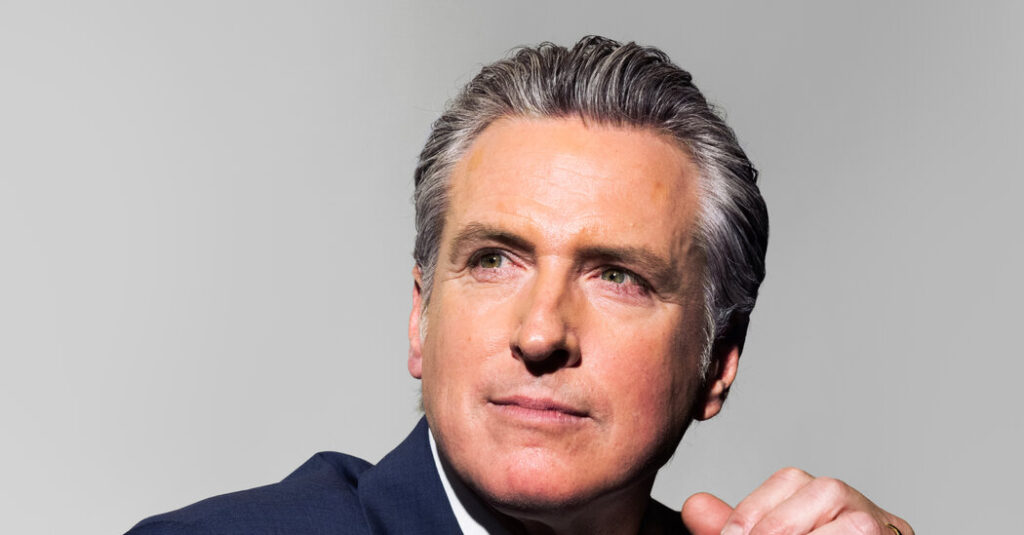
The world may see Gavin Newsom as a smooth politician with slicked-back hair who hobnobs with San Francisco billionaires and dines at the finest restaurants in the Napa Valley (even during a pandemic). His good looks and beautiful family accentuate the image of a man whose life has been easy.
But Mr. Newsom, the California governor, looks back at his life at age 58 and sees a different figure. An awkward kid with a bowl cut and a lisp, tormented by a bully who called him Newscum, the same insult now used by President Trump. A teenager who delivered newspapers because money was tight at home. A young man who overcompensated for his dyslexia by memorizing a list of pretentious words that remain in his lexicon today.
That’s the tale Mr. Newsom unspools in his new book, “Young Man in a Hurry: A Memoir of Discovery,” in which he explores the schisms that defined his upbringing. It is set to arrive Feb. 24 amid his ascension as a likely Democratic presidential contender and a prominent critic of Mr. Trump in a pivotal midterm election year.
Despite those circumstances, Mr. Newsom spends almost no time in the book discussing the president or recent politics, based on an early copy provided to The New York Times. And, for the most part, he ends his introspection in the weeks before he becomes governor in 2019.
Instead, the book seems intended to serve as an introduction to the American public on his own terms, dissecting his family history and challenging the presumption that he grew up with a silver spoon in San Francisco’s high society.
His parents’ divorce serves as a foundational event, the effects of which he continues to process. In the aftermath of their split, his traumatized young mother worked several jobs to scrape together a middle-class life, while his well-connected father brought him into a circle of political power brokers and spectacularly wealthy oil heirs.
Mr. Newsom emphasizes in his memoir, through various anecdotes, that it was his work ethic that led to success in sports, business and politics. But he does not deny that his father’s friends were helpful along the way.
Mr. Newsom comes from a long line of figures who built and shaped San Francisco, and his family is so entwined with the power structure that Nancy Pelosi’s nieces and nephews were young Gavin’s cousins. John Burton, a former congressman who would become one of the state’s most powerful politicians, sat in the bleachers to watch Mr. Newsom play basketball in high school. A close friend of his father’s was the oil magnate Gordon Getty, who took Mr. Newsom and his sister on a safari in Africa and on a visit to the king and queen of Spain.
Those ties helped Mr. Newsom start a business that grew from a corner wine shop to a collection of wineries, restaurants and bars and an alpine resort. And they nurtured a political career that began when he was appointed as a parking commissioner in San Francisco at age 29.
Mr. Newsom expresses a sense of psychological turmoil about his origins. As he describes how his father’s friends opened doors for him, he also writes that he eventually realized his “entry into the Getty world would rob me of my own hard-earned story.”
As a high school athlete, he writes, he was “the first guy at practice and the last guy to leave.” He showed so much hustle as a busboy that a restaurant customer rewarded him with a $20 tip. When his uncle hired him to deliver orthotic shoe inserts — paying him by the piece, not by the hour — customers marveled that they had “never had a delivery boy who showed such speed and politeness.”
Is it any surprise that a Democrat considering a presidential run would publish a book emphasizing that he didn’t have everything handed to him? Of course not. Overcoming family hardship has been a quintessential origin story for the last three Democratic presidents.
What’s different, perhaps, is the way Mr. Newsom blends the Gatsby-esque tales of his life with passages that plumb his messy feelings about his parents.
Part history lesson, part psychotherapy session, the book serves as Mr. Newsom’s clap back to years of local news coverage that dwelled on his elite connections — stories he acknowledges stoking with a roster of highbrow donors, regular attendance at society galas and a wedding reception at the Getty mansion. It was the same mansion where he posed for a magazine spread lying down on an Oriental rug with Kimberly Guilfoyle, his wife at the time, their bodies intertwined between two towering golden candelabras.
“And yet the press’s one-dimensional portrait of me pissed me off because I knew the way I grew up, the struggles my mother had to endure, the hard times that made my life a duality that never seemed to get its due, a duality I would spend years trying to comprehend,” Mr. Newsom wrote.
Kate Kenski, a professor at the University of Arizona who teaches political communication, said that Mr. Newsom might be known only on a superficial level by American voters outside of California. He needs to provide a deeper portrait of himself if he wants to run for president, she said.
Mr. Newsom’s memoir may also have the effect of pre-empting some personal attacks on the campaign trail by laying bare his own story.
“Candidates know that there is very little about their past, if they have any transgressions, that won’t be uncovered by the opposition,” Ms. Kenski said.
In researching the book, Mr. Newsom discovered an oral history of his father, William Newsom, who was an appellate judge in California. (He was appointed by the former Gov. Jerry Brown, whose father was close to William Newsom’s father.) In it, Justice Newsom says that his marriage ended when he had a nervous breakdown after losing two local elections and running out of money.
“It was the first time I’d ever heard why he left my mom and two kids,” Mr. Newsom said in an interview with The Times. “He was broke and broken.”
The book describes the younger Newsom’s resentment at his father for leaving the family and being emotionally unavailable. As he made his way into adulthood, other men stepped in with life lessons: An uncle taught him how to use a condom; Mr. Getty encouraged him to take risks in business; Willie Brown, the former mayor of San Francisco, schooled him in the code of political loyalty.
His feelings about his mother are fraught in different ways.
Mr. Newsom was serving on the San Francisco Board of Supervisors when his mother’s breast cancer spread to her bones in 2002. She decided, at age 55, to have an assisted suicide, which was not legal in California at the time.
Mr. Newsom writes that he had been avoiding his mother until she left a voice mail message that he could not ignore: “‘Gavin, if you want to see me, you should probably do so before Thursday. Because that’s going to be my last day on earth.’”
Mr. Newsom describes holding her hand and sobbing as she took her final breath.
Mr. Newsom wrote that he learned his mother’s family had kept secrets and had been investigated by the F.B.I. for suspected Communist ties in the McCarthy era. Mr. Newsom remains wracked with guilt about not being more loving toward his mother “in the time that it mattered.”
Mark Arax, a journalist known for lyrically chronicling California history, was the book’s ghostwriter. He drew out Mr. Newsom’s stories through long interviews and historical research.
“I remember telling him in the beginning, ‘There’s no place to hide in a memoir, and if you do try to hide, the reader is going to know it,’” Mr. Arax said.
Mr. Newsom’s marriage with Ms. Guilfoyle lasted four years. After they broke up, he had an affair with Ruby Rippey-Tourk, a staff member who was married to his deputy chief of staff, which Mr. Newsom called “the worst betrayal of my life.” He dated Sofia Milos, an actress, but wrote that they broke up after Mr. Getty told him he did not think she was right for him.
He omitted from the book his relationship during that era with Brittanie Mountz, who was 19 when he was 38. Mr. Newsom said in the interview that he had not included her because they had gone on only a few dates. “That one was always colored in as something that it wasn’t,” he said.
He fell in love with Jennifer Siebel, a registered Republican at the time, soon after their first date in 2006. They married on her parents’ ranch in Montana and began a family that has two sons and two daughters. She is now a Democrat and a documentary filmmaker, and she calls herself the first partner of California.
Mr. Newsom writes that he was admitted to Santa Clara University only because he had received a partial scholarship to play baseball.
But he never mentions that he received letters of recommendation from Mr. Brown, the former governor who had attended the university, and from a member of the institution’s Board of Regents, both of whom were friends of his father’s.
“I don’t think it’s relevant at all,” Mr. Newsom said when asked why he hadn’t mentioned the letters. “The ticket to Santa Clara came through the baseball, not anything else. And that was the point I was making in the book.”
Sports were a huge part of Mr. Newsom’s identity at Redwood High School in Marin County. But he had another side, too. After becoming obsessed with the television show “Remington Steele,” he decided to give himself a glow-up. He figured out how to slick his hair back with gel and started wearing a suit to school some days.
Mr. Newsom was no longer tormented by the bully who called him Newscum. And his classmates came up with a new nickname: El Presidente.
Kirsten Noyes contributed research. Shane Goldmacher contributed reporting.
Laurel Rosenhall is a Sacramento-based reporter covering California politics and government for The Times.
The post With New Memoir, Newsom Wants Americans to Know He Struggled Growing Up appeared first on New York Times.