Jacob Kornbluh, a 44-year-old Brooklyn grandfather who cajoles his political sources in a British-Yiddish-fuhgeddabout-ish accent, begins many mornings getting heckled in shul.
“People say, ‘Oh, go back to covering Zohran,’” he said of his peers in the Hasidic enclave of Borough Park. “They tease me as if I am the one enabling him.”
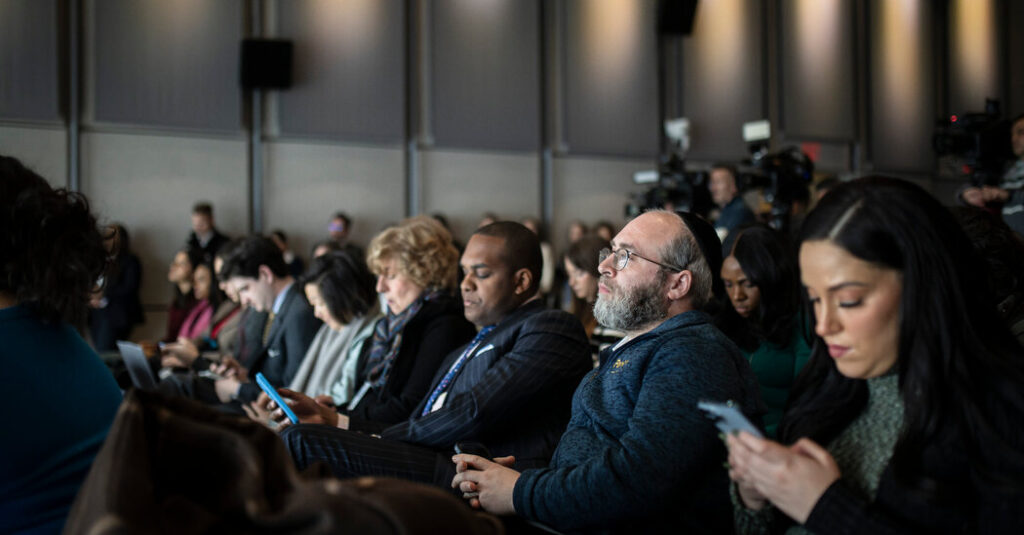
Mr. Kornbluh is the senior political reporter for The Forward, the 129-year-old Jewish publication based a short walk from Mayor Zohran Mamdani’s new office. He is the only Hasidic journalist who trails the mayor daily, his yarmulke and curled sidelocks unmissable in the crowd.
And across his Mamdani-averse neighborhood and well beyond it, Mr. Kornbluh has found that his beat is of particular interest lately.
His scoops travel widely, from the insular centers of Brooklyn Hasidic power, to Reform congregations that despise Benjamin Netanyahu almost as much as Mr. Mamdani does, to the offices of national politicians who feel neglected by Mr. Kornbluh’s recent hyper-attention to his hometown. (“I thought you forgot all about us,” Gov. Josh Shapiro of Pennsylvania told him, performatively wounded, before an interview last year.)
Workaday social media updates from Mr. Kornbluh can amass millions of views, reflecting the zealous reaction to Mr. Mamdani from all directions.
A strategic kvetcher even by the relentless standards of the City Hall press corps, Mr. Kornbluh, a London-born expat, does not take kindly to being snubbed.
Summarily ignored at a recent event in Brooklyn, where mayoral aides limited “off-topic” questions from assembled journalists, Mr. Kornbluh posted a message afterward to his nearly 54,000 followers on X, a club that includes most anyone who is anyone in city politics.
“Apologies,” he wrote, “if my beat is off-topic.”
With any new administration comes a roster of ascendant power players unaccustomed to high influence. Mr. Mamdani’s New York has elevated beanie-wearing socialists, aspiring rent-freezers, backbench lefty legislators who knew Mr. Mamdani, until quite recently, as a backbench lefty legislator.
But as Mr. Mamdani seeks to reassure skeptical Jewish constituents that someone openly disdainful of Israel amid the war in Gaza can be their mayor, too, his rise has conferred uncommon significance on another only-in-New-Yorker staring back at him each day.
Here is a former professional lox-slinger who describes himself as the proud holder of a degree in nothing, keeps two mugs at his desk with his own face on them and follows what colleagues call a Shabbat-compliant 24/6 work schedule.
And he can feel like more of an outlier in his own community, as an insistent mainstay in the secular world, than he does at City Hall.
“It’s sort of a very interesting time for me,” Mr. Kornbluh said. “Not off topic.”
The potential value of Mr. Kornbluh’s platform to Mr. Mamdani is also clear — and not lost on his administration. The mayor’s relationship with Jewish voters remains a signal political vulnerability in a city long considered the capital of American Judaism.
Over the past year, Mr. Mamdani and his advisers have taken care to cultivate Mr. Kornbluh, sensing he is someone with whom they can do business.
In a statement, the mayor praised him as “a thoughtful, enterprising reporter who doesn’t just cover the conversation across the five boroughs. He helps to drive it.”
Last spring, after a lengthy interview with Mr. Kornbluh over a bowl of chicken soup on the Upper West Side, Mr. Mamdani seeded a curious compliment with an aide: Mr. Kornbluh looked just like Tom Hardy, the British actor once rated by The Sun as the country’s sexiest man alive. Mr. Mamdani wondered aloud about calling Mr. Kornbluh “Tom” at his next news conference.
This comparison invariably made its way back to Mr. Kornbluh, who strained to see the resemblance, as there is no resemblance.
“Picture Tom Hardy in a method actor role,” said Andrew Epstein, the aide to whom Mr. Mamdani made the remark, consciously reaching. “Really, really going for it as Jacob Kornbluh.”
The post-election dynamic between mayor and journalist has been cordial, but perhaps more complicated.
After Mr. Kornbluh’s complaint on X weeks ago about not getting to ask his question, the mayor’s team relayed privately that he would have his chance later that day at a news conference at Gracie Mansion, Mr. Mamdani’s new residence.
Mr. Kornbluh used the opportunity to invite himself inside for a future meal.
“Since you won’t be serving pork,” he told the mayor before the cameras, gesturing at their faiths’ shared dietary restrictions, “it will be my honor to be hosted in your kitchen.”
Mr. Mamdani giggled, grandly extending an arm toward him, as if to accept the terms.
Mr. Kornbluh went on.
“Two-part question …”
Mr. Mamdani had been slower than many in government to condemn a Queens protest that included pro-Hamas chants and antisemitic slurs, Mr. Kornbluh noted.
“Do you think that it’s fair to criticize the timing?” he asked the mayor.
Mr. Mamdani nodded along, waiting his turn.
“Many had condemned it in the morning …”
The mayor kept nodding.
“And second …”
The mayor clasped his hands patiently. The smile was gone.
It makes some sense that Mr. Mamdani and Mr. Kornbluh might understand each other — and a little more sense that they might not always.
Both men spent much of their early lives outside the United States before finding their way, sometimes haltingly, through New York political spaces where few shared their backgrounds. (Mr. Kornbluh, the fifth of seven children raised in a Belzer Hasidic family, grew up in the Stamford Hill area of London, 10 minutes from the home stadium of Arsenal Football Club, Mr. Mamdani’s favorite pro soccer team.)
Both have sometimes seen it as their professional duty to tweak President Trump.
In December 2020, while reporting for Jewish Insider, Mr. Kornbluh received a tip that Mr. Trump had skipped his own White House Hanukkah party, angering some prominent invitees.
After Mr. Kornbluh’s scoop gained notice inside the president’s orbit, according to a person with direct knowledge of the matter, Mr. Trump made a face-saving appearance at a second party the same day. He briefly acknowledged the holiday before setting off on a gusher of notable lies about his election defeat. Mr. Kornbluh obtained and posted video of the speech.
The next month, Mr. Kornbluh was hired at The Forward, which was founded in 1897 as a socialist paper, a fact well known to Mr. Mamdani’s circle.
Its residual editorial tilt, to the left of some Jewish publications, has often made it a more hospitable venue for the mayor, probably part of the reason that Mr. Kornbluh has retained strong access.
During the recent blizzard, when Mr. Mamdani helped shovel out a snow-swamped vehicle in a Hasidic area of Brooklyn, it was little surprise that the video spread widely in a post from Mr. Kornbluh — or that Mr. Mamdani’s account quickly boosted its visibility by responding (“Happy to lend a hand”).
Days later, Mr. Kornbluh published a warm exclusive about Mr. Mamdani’s private visit with a Holocaust survivor on International Holocaust Remembrance Day.
“People like Jacob can help demystify a bit,” said former Mayor Bill de Blasio, who first encountered Mr. Kornbluh before his own 2013 election.
Mr. Kornbluh, a bit adversarial by trade and constitution, describes himself as a “bridge” between Mr. Mamdani and readers who might view the mayor with suspicion and confusion.
To a point.
“This is my Zionist picture,” Mr. Kornbluh said during a recent tour of his newsroom, where a photograph of him from a reporting trip to Israel after the Oct. 7 attacks — wearing gear intended to be donated to soldiers with the Israel Defense Forces — hangs above his desk. “Sorry, Mamdani.”
Mr. Kornbluh traces his interest in news to the 1995 assassination of the Israeli leader Yitzhak Rabin and to his own adolescence in London, where the tabloids breathlessly covered President Bill Clinton’s impeachment. At 16, he was sent to yeshiva in Israel, growing fascinated with the country’s 40-something prime minister, Mr. Netanyahu.
During the 2000 American election, Mr. Kornbluh tracked primary results overnight on his parents’ radio, becoming something of a town crier for Orthodox friends with limited exposure to outside news sources.
“The next day, I would go to yeshiva and give all of that news to my colleagues,” he said. “I was sort of reporting.”
After moving to New York at age 20 and meeting and marrying his wife, Mr. Kornbluh spent five years behind a deli counter in Williamsburg, Brooklyn, cutting lox and sable. During down times, he found political manna through a phone line he called to inhale Israeli news.
In the late 2000s, as Facebook and Twitter converged with the early blogosphere, Mr. Kornbluh edged into a life of letters while running a pizza shop in Borough Park. He published a janky chronicle of Israeli affairs, bibireport.com.
“My English was horrendous,” he said. Google helped.
Mr. Kornbluh sold the pizza place to his brothers and eventually made a run at life as a proper reporter, attending events for local candidates, getting to know their aides, going anywhere he could semi-credibly show up without a credential.
“Oh, the Jewish guy, Jacob Kornbluh, live-tweeting stuff,” Mr. Kornbluh said, appraising his reputation then, accurately.
He covered New York’s 2013 mayoral election for Yeshiva World News, memorably capturing video of a shouting match inside a Borough Park bakery between Anthony Weiner, sinking in the polls and clutching a cheese Danish, and a voter who called Mr. Weiner a “scumbag.”
In 2015, Mr. Kornbluh joined Jewish Insider as it sought to build a bespoke competitor to Politico Playbook (“Playbook but just Jewish,” he said) with a dishy newsletter and a “SPOTTED” list.
Mr. Kornbluh became ubiquitous on the forever-circuit of Jewish politics: welcome parties, send-offs, election post-mortems, Sukkot celebrations, boozy meet-and-greets.
“I see Jacob,” said Amy Spitalnick, the chief executive of the Jewish Council for Public Affairs, “more than I see some of my own family members.”
By the time Americans prepared to elect a new president in 2016, Mr. Kornbluh was chasing Mr. Trump and his doomed also-rans across the early-voting states.
“I was everywhere,” he said. “I was seen everywhere.”
Some neighbors wanted to see less of him.
It had often been an uneasy arrangement — the roving reporter becoming the community’s external face, wittingly or not; the community members quite certain that they needed no face representing them like this.
In many ways, Hasidic areas have long existed apart from the wider city, with separate emergency services and school systems and businessmen who still use flip phones. Their history of voting as a bloc, steered by leaders who are explicit about their transactional calculations, have made them especially politically powerful.
There is also an inward-facing Yiddish-language media ecosystem in which Mr. Kornbluh does not participate, placing him in natural conflict with the preferred order.
“In our community, if you’re Orthodox, you remain in your Orthodox circle, with the garb, with the same people,” Mr. Kornbluh said.
And yet, his job meant mingling among center-left J Street lobbyists, secular Manhattanites, female rabbis.
“I got flak for having pictures with women and all these things,” he said. “‘Hey, I’m a professional journalist.’ ‘What’s a professional journalist? We don’t need it.’”
Hostilities crested in 2020, after Mr. Kornbluh persistently drew attention to ultra-Orthodox residents defying Covid safety measures.
While covering a protest that fall against new restrictions, spurred by spiking local caseloads, Mr. Kornbluh was swarmed by a group of men and teenagers, called a traitor and a Nazi, shoved against a wall, punched, kicked and chased for two blocks.
Mr. Kornbluh said that recent years had been less distressing. But the episode helped prepare him for the seething reaction to Mr. Mamdani, and to some of those covering him.
The Anti-Defamation League has introduced a “Mamdani Monitor” to track the mayor’s words and doings, citing his “long, disturbing record on issues of deep concern to the Jewish community.”
Mr. Kornbluh’s reporting on Mr. Mamdani’s outreach to Hasidic voters, who broadly broke for former Gov. Andrew M. Cuomo, sometimes inspired as much contempt for the messenger as the candidate.
“Lemme guess … you wrote this for him,” read a typical message after Mr. Kornbluh highlighted an open letter from Mr. Mamdani in Yiddish newspapers.
There is a Yiddish word that Mr. Kornbluh invokes to describe why Mamdani has so unsettled some Jewish New Yorkers.
His success “proved that you don’t have to be part of the chevra to be elected as mayor,” Mr. Kornbluh said at a Forward event in October. “You don’t have to be either Jewish or pro-Israel to represent the largest city in the nation and the largest concentration of Jews outside of Israel.”
Since 1951, every New York City mayor has made pilgrimage to Israel. A proclamation honoring The Forward’s centennial, signed by Mayor Rudolph W. Giuliani, hangs in its newsroom.
Mr. Mamdani’s predecessor, Eric Adams, planned for a time to seek re-election on an “EndAntiSemitism” ballot line and recently introduced a bewildering crypto venture nominally aimed at combating the scourge.
“And you come here and you see Zohran Mamdani with a smile saying, ‘I’ll arrest Prime Minister Netanyahu,’” Mr. Kornbluh said. “He’s this typical pro-Palestinian protester that people are very wary about, and suddenly he becomes mayor.”
Julie Moos, Mr. Kornbluh’s editor during the campaign, noted that polls showed large numbers of Mamdani supporters, including some Jews, backing him not despite this posture but because of it, galvanized by his reaction to the war in Gaza.
“Would have there been such a polarized response to Mamdani before Oct. 7?” Ms. Moos asked. “And would he have won before Oct. 7?”
As Mr. Kornbluh considers this tension, some activists have questioned how much power Hasidic voters really have anymore — Mr. Mamdani is mayor, after all — while emphasizing a procession of politically volatile scandals in the community, where the education network has come under fierce scrutiny and some leaders have stood accused of sexual abuse.
In a 2020 interview with The Forward (before his hire), Mr. Kornbluh said he hoped at times to “shine a positive light” on his neighbors amid “the stories you read in The New York Post, the sex abusers and the slumlords.”
At minimum, for all the turbulence that has trailed him, he has no plans to leave Borough Park.
“Welcome to my rent-controlled apartment!” he joked on a recent Friday, greeting guests as he prepared Shabbat dinner hours before sundown.
A live feed of Mr. Mamdani’s pre-snowstorm briefing blared from Mr. Kornbluh’s laptop in the kitchen, where he tended to chicken soup and a tahina dip.
A portrait of his sect’s grand rabbi blessed the dining room from an otherwise bare wall.
A copy of Governor Shapiro’s memoir, dog-eared with paper clips, rested on the windowsill, overlooking the streets where Mr. Kornbluh has prayed, where his five children have attended school, where he was menaced by his co-residents not so long ago.
“I’m a member of the community, and I have a profession,” he said, disclaiming any contradiction.
He stared out the window — the host this time in his pork-free kitchen — and permitted himself a two-part answer.
“I’m not this Hasidic journalist,” he said. “I’m a journalist who’s Hasidic.”
Matt Flegenheimer is a correspondent for The Times focusing on in-depth profiles of powerful figures.
The post This Hasidic Reporter Has a Few Questions for Mayor Mamdani appeared first on New York Times.