In the final years of his career as a Chinese Communist Party official, Ma Ruilin lived two lives.
During the day, he carried out policies that were used to control Muslims. In the evening, he visited a mosque to pray. To hide his identity from surveillance cameras, he wore a motorcycle helmet when he entered.
Mr. Ma knew exactly how China’s surveillance systems worked — he helped design them.
“By day, my face looked exactly like one of my colleagues,” he said. “At night, I knelt on the prayer mat and became a different human being.”
For two decades, Mr. Ma was a midlevel party cadre in China’s religious affairs bureaucracy. A technocrat, he managed policies for Muslim communities and led hajj delegations to Mecca.
About 10 years ago, when the party intensified a crackdown on Islam, Mr. Ma, a member of China’s Hui Muslim minority, found it increasingly difficult to reconcile his conflicting identities.
Now 50 and living in New York, Mr. Ma is determined to tell his life’s story despite the risks to himself and his family.
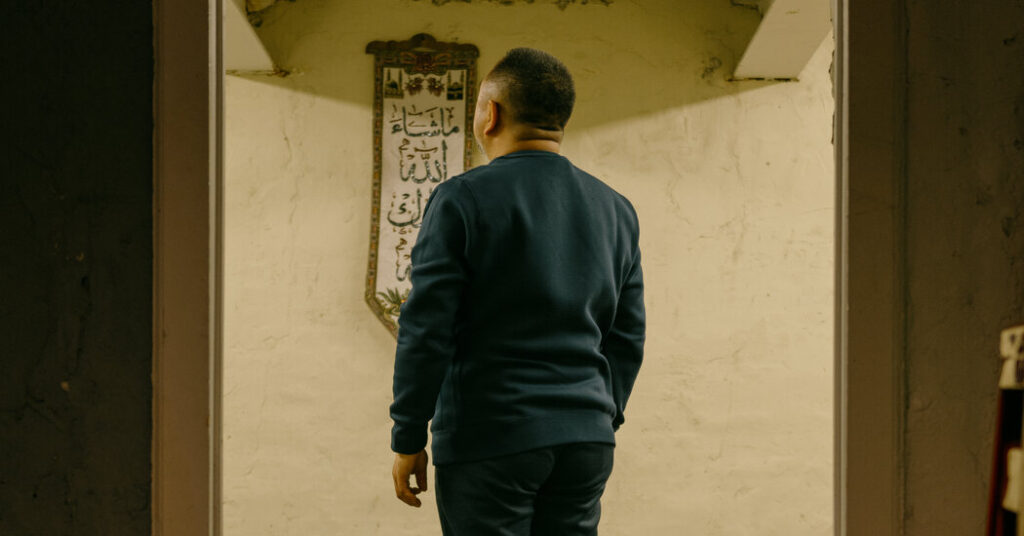
Sitting in the Midtown Manhattan halal restaurant where he now works as a manager, he was at ease with his new life.
“I’m free,” he said. “Finally I’m at peace with myself.”
It is highly unusual for a Chinese party official — a member of the country’s ruling class — to emigrate to the United States. It is rarer still for someone like Mr. Ma to speak out against the system he served. His journey from cadre to critic, which he shared in a series of interviews with me, opens a window to the inner workings of how China controls religion.
The turning point came in 2015.
Mr. Ma was leading a hajj delegation as the head of the Islamic affairs division of the Gansu Provincial Religious Affairs Bureau. He experienced what he called a spiritual enlightenment. It was his fifth time to Mecca. Until that trip, he had been what he described as a cultural Muslim, not a religious one. To fit in with the party officials he worked with, he drank alcohol and rarely went to mosques.
But something shifted inside of him that year, he said. He quit drinking and smoking and started praying regularly.
He also started seeing his world, especially his work, differently.
“To be a successful cadre, you must have strong party loyalty but no humanity,” Mr. Ma said. “You are trained to view other human beings as objects to be managed or dictated over.”
He came to recognize what he called his “original sin” in assisting the party’s impulse to dominate Chinese society: He was one of many officials who helped Xi Jinping’s government develop a comprehensive mechanism of control, surveillance and exclusion directed at Muslims.
For example, in 2008, Mr. Ma helped design a database to track the locations and contact information of mosques, the names of their clerics and the size of their congregations, he said. No one had done this before, so he thought he could help give the government a better idea of religious institutions and activities in his vast province, which covers 1,000 miles from east to west. Plus, as a young, ambitious cadre, he wanted to show how smart and diligent he was.
Only later, as religious policy hardened, did he see how that system was weaponized.
Worshipers were tracked by surveillance cameras installed at the entrances of mosques that used facial recognition software to collect data on who came, how often and with whom. The data was logged and analyzed, he said, with consequences that could include police interrogations, job loss, travel bans or even ideological re-education.
“I realized that the very systems I helped build in 2008 had become shackles for Muslims,” he said. “I had handed a demon’s whip to the state to use against my own community.”
Around 2015, a wave of hate speech against Muslims filled the Chinese internet. Mr. Ma believed it was tolerated or even encouraged by the state, he said. He knew the government could easily shut down any online account or conversation with a single phone call. Yet anti-Muslim vitriol flowed freely.
The government’s objective, he believed, was to foment animosity and create a foundation of public support for policies like those that sent more than a million Uyghur Muslims in Xinjiang to re-education camps and prisons.
What pained him the most was a popular social media line that told Chinese Muslims to “go back to your ancestral home in the Middle East.”
“As far as I know,” Mr. Ma said, “my blood is entirely Chinese.” For the first time, he confronted his identity as a Hui official inside the system.
China has 11 million Hui Muslims, who descend from Han Chinese and Silk Road immigrants who arrived in China over 1,000 years ago. They have a big presence in the northwest but also live in enclaves around China. The Hui look similar to the Han, who make up 91 percent of China’s total population and are largely secular.
During the Mao era, all Chinese lived under strict ideological controls, so few dared to be outwardly religious. During the 1980s, the party relaxed its control over religion. Muslims built bigger mosques, and more went to services and pilgrimages. Under Mr. Xi, the party has tightened its control significantly, clamping down on Islam out of fear of terrorism and open defiance of its rule.
In the small town in Gansu Province where Mr. Ma was born in 1975, Hui Muslims made up three-quarters of the population. His grandfather had been an elder in a local Islamic sect, but by Mr. Ma’s childhood, the family’s religious practice had weakened.
When he was in high school in the early 1990s, several of his teachers were college graduates who had been banished from cities to rural areas for participating in pro-democracy protests in 1989. They taught him to question things, and their criticism of the party planted seeds.
In 1999, he graduated from university with a business degree and was assigned to a job as a low-level bureaucrat in a township outside Lanzhou, the capital city of Gansu Province.
Five years later, he was transferred to the provincial Ethnic Affairs Commission, a significant career jump. He was ambitious and worked hard, becoming a deputy division head in 2011.
His social circle was almost entirely Han Chinese. He rarely went to mosques.
In 2016, Mr. Ma was appointed the head of the hajj office for Gansu Province. He was in charge of screening candidates for pilgrimage and leading delegations to Mecca. The trips were demanding, but Mr. Ma enjoyed going, he said, because he felt he was serving his people.
In a country with 25 million Muslims, only some 10,000 are allowed every year to go on the hajj — a mandatory religious duty for Muslims who are physically and financially able. In China, Mr. Ma said, the wait could be many years. He said he had created a queuing system to make the process fairer and more transparent.
But the authorities used the digital records to filter out pilgrims deemed unqualified, he said, such as those considered troublemakers, members of the party or recipients of welfare assistance.
In 2016, after Mr. Xi called for the “Sinicization” of all religions at a national conference, the authorities intensified the campaign against Islam. They dismantled domes and minarets and banned public displays of Arabic script. That was also when mass detentions of Uyghur Muslims started.
Mr. Ma struggled with the role he was playing in these policies.
When the government decided to demolish a historic mosque in Lanzhou in 2022, he tried to argue internally that it could provoke a backlash from the Muslim community. On the trips to Mecca, he did not discourage pilgrims from visiting stores owned by Uyghurs in Saudi Arabia, ignoring a rule mandated by Chinese state security officials. He sometimes shopped at those stores, and he would even hire a Uyghur driver.
For nearly a decade, he lived two lives.
He developed a lunchtime prayer routine at work. Around 1 p.m., when most of his colleagues were taking naps, a ritual in many Chinese government agencies, he would perform wudu — the ritual washing before prayer. Then he would lock his office door, spread a towel on the floor and pray.
It got riskier to go to the mosque, however. By 2020, surveillance cameras had been installed at the entrance of every mosque in Gansu Province. Party members caught on camera at mosques would be reported to their work units and disciplined. That was when Mr. Ma started hiding his face behind a motorcycle helmet.
Finally, in 2023, after his wife took their two daughters to upstate New York, where she would work as a visiting scholar at a university, Mr. Ma saw a way out. He arrived in New York in February 2024.
For 10 years, he’d had a recurring nightmare. He was standing in a landscape covered in filth, like an outdoor squat toilet. The bad dream stopped the day he arrived in America, he said.
Mr. Ma worked briefly as an Uber Eats delivery driver. Last year, he moved to New York City to work at two halal restaurants owned and operated by Chinese Muslim immigrants.
He said he had decided to speak up because he wanted other Hui Muslims who were despairing in darkness to know that they were not alone.
He compared their experience to a memory of driving in the desert in Saudi Arabia at night, calling it hopeless. “There was no light, no stars, no landmarks, no reference points, just the small beam of your car’s headlights,” he said.
“Even if someone at the roadside lit a single match, just that flicker of flame could make me feel hope,” he said. “I want to be that match.”
Li Yuan writes The New New World column, which focuses on China’s growing influence on the world by examining its businesses, politics and society.
The post ‘I’m Free’: A Muslim Official Who Lost Faith in China Gains a Voice appeared first on New York Times.