There were still eggs, baby snacks and two small generators at Kwadwo Som-Pimpong’s house on Saturday in Asheville, N.C., where a winter storm last weekend threatened to potentially knock out power and trees. In the end, his home and much of the state were spared from those icy hazards.
Now, Mr. Som-Pimpong and his 1-year-old son once again had on their thickest jackets and gloves, watching fluffy snow drape the mountains, as another winter storm coated their world in white. But as cold, puffy flakes fell on the toddler’s cheeks, his reaction reflected the opinions of Carolinians fed up with their unusual burst of frigid temperatures.
“His face was just neutral,” Mr. Som-Pimpong said. “It’s like he’s saying, ‘Get me out of here.’”
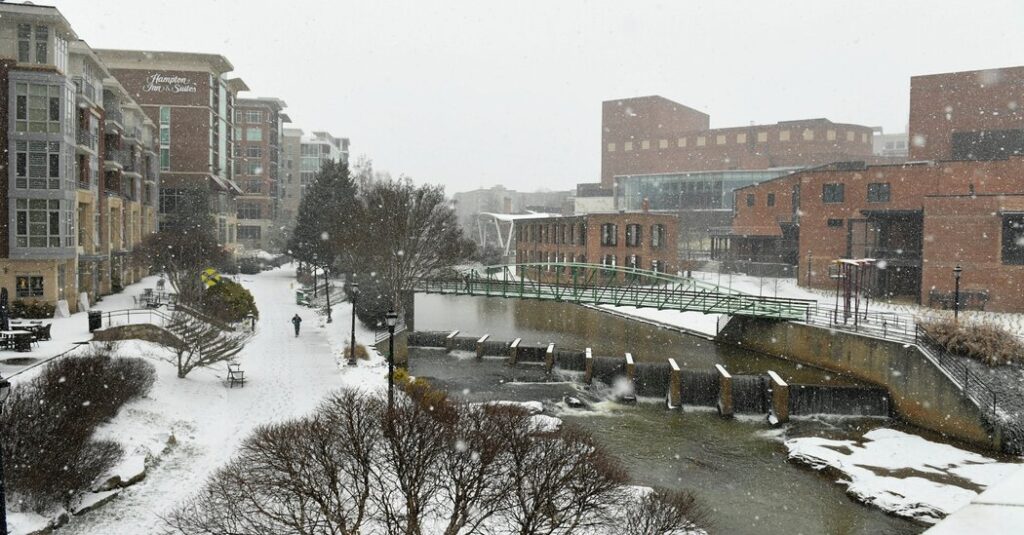
No matter the winter fatigue, especially after many people’s fruitless search for dwindling supplies of salt, another round of bitterly cold weather was settling across North and South Carolina on Saturday, bringing several inches of snow, gusty winds and dangerous road conditions. For many, it was also spurring excitement about statewide snow days.
From the mountains out west to beach towns along the eastern coastline, officials in the Carolinas warned residents about the latest burst of Arctic temperatures that threatened to cause blizzard-like conditions in some areas over the weekend.
Power outages were possible, especially with a second band of snow expected to hit both states on Saturday afternoon. Strong tides and powerful winds could cause flooding in some parts of North Carolina’s coast, especially the Outer Banks, officials said. And temperatures were expected to sink to below 20 degrees or into the single digits on Saturday night for much of North Carolina and persist through Sunday morning, meaning the snow will most likely stick around through at least early next week.
“Our greatest concern is unsafe travel,” said Gov. Josh Stein of North Carolina, noting that the state’s Department of Transportation employees had been working up to 100-hour weeks to keep roads clear since last week.
Every county in the Carolinas was under a winter storm warning through at least early Sunday morning.
The National Weather Service said that as of Saturday afternoon, there was nearly 4 inches of snow in the Greenville, S.C., area; about 6 inches in Charlotte, N.C.; and in Lexington, N.C., a small city of about 19,000, there was almost a foot.
Emergency management officials in both states have warned residents that driving conditions had deteriorated by Saturday morning. After sunset, many slushy or wet roads were expected to quickly become solid ice, causing dangerous travel conditions.
The North Carolina State Highway Patrol said that there had been 340 collisions from midnight through 12 p.m. on Saturday, and that none of them were fatal.
In South Carolina, the Highway Patrol said that a collision was affecting traffic on I-85, a major interstate. The agency shared a photo of the accident showing nearly whiteout conditions, with vehicles packed in tight rows.
In Greenville, the authorities were contending with waves of traffic crashes on Saturday, as officials pleaded with residents to stay home.
Brian Horton, the chief of the Greenville Fire Department, said in a news conference Saturday that road conditions were worsening as temperatures dropped, and that too many people were on the road for nonessential travel.
“We’ve had more wrecks in the last hour than we had all of last weekend,” Mr. Horton said, noting that crews were also responding to injuries from people slipping on ice. “Stay home and enjoy your time with your family at home.”
Because of the volume of calls, the Greenville Police Department said on Saturday evening that it would not dispatch officers to single-vehicle collisions that do not involve injuries. The department shared a photo of a vehicle that swerved off the road, and wrote in the caption: “#WentOutForMilk #NonEssentialAdventure #PleaseStayHome.”
Jaime Micciche said that she and her husband had ventured out for a walk on Saturday in the midst of the swirling snow that covered their neighborhood. But they quickly turned back because they “didn’t want to take the risk.”
“It’s really windy and cold,” she said, noting that she had canceled a dinner party that evening. “It feels colder than when we go skiing. But it’s just beautiful — clean and fresh — and so cozy when you look out at it.”
During the sprawling storm last weekend that paralyzed a huge stretch of the country, officials were most concerned about accumulating ice, which can easily down trees and power lines.
This storm does not pose as great a risk of ice accumulation, and it is a more focused threat to the East Coast. But it still carries the potential to lash the Northeast with strong winds and additional snow, and to create treacherous road conditions. Its primary target appears to be the coastal areas of the Carolinas, where significant, and possibly historic, amounts of snow could fall.
In the afternoon, light snow had started falling in parts of Wilmington, N.C., and was expected to become heavier through the evening. The coastal city is predicted to receive five to eight inches of snow in the storm. The last time the city recorded more than five inches of snow was in December 1989.
In Wilmington, N.C., Bryan Sparks was wearing a fleece jacket and a beanie emblazoned with the logo of the Super Bowl-bound Seattle Seahawks. He was waiting for the snow, and letting his son play among the gathering flakes.
“It’s nice to share this type of weather with my children,” said Mr. Sparks, an Idaho native used to this kind of weather. “I’m excited to build a snowman.”
At Bert’s Surf Shop on Carolina Beach, near Wilmington, Joel Avery was managing the store, taking things easy on “a very quiet day.”
He had not rushed out to buy food and emergency supplies this week, as plenty of others had, filling grocery aisles with carts and forming lines at hardware stores. Instead, he was curious whether the waves would strengthen and attract surfers in wetsuits. That sight, along with an expanse of snow-covered sand, would be “awesome to go out and look at,” he said.
All of this snow is from a storm that was intensifying Saturday afternoon off the coast of the Carolinas.
The storm is expected to stay offshore, moving to the east-northeast over the Atlantic Ocean through the weekend. By Sunday evening, it will be several hundreds of miles off the coast of Massachusetts.
“It won’t bring snow to any of the major cities in the Northeast, like New York or Boston, it’ll just be cold,” said Bob Oravec, a meteorologist with the Weather Prediction Center. “There may be a little snow in Cape Cod, Martha’s Vineyard, Nantucket.”
The storm has been referred to as a “bomb cyclone,” a term used by meteorologists to assess the strength of a storm by its barometric pressure. When the pressure drops 24 millibars in 24 hours, it’s generally considered a bomb cyclone. This is likely to occur with this storm.
“It’ll be a windier day on Sunday because of it,” Mr. Oravec said. “It’ll mean blizzard conditions in eastern North Carolina Saturday night into early Sunday morning.”
Other parts of the South were still paralyzed by the damage done by the previous swath of snow and ice last weekend. In Mississippi, parts of two major highways were closed to clear off ice, dozens of tree branches were still ensnarled in power lines and the death toll had risen to 16.
And in Nashville, tens of thousands still remained without power, as officials scrambled to provide discounted or free lodging, as well as to raise money for families still displaced or trapped in cold homes without heat or power. Nashville Electric Service officials said on Saturday that 90 percent of customers would have power restored by Sunday, and nearly all customers by Feb. 8.
Back in Asheville, Mr. Som-Pimpong, a custom furniture maker and woodworker, was looking out the window with his family, seeing the tops of branches frosted white like a pastry.
“It’s the same window we saw the trees being torn apart and falling down during Hurricane Helene two years ago,” he said. “So now we’re looking at it and seeing this peaceful scene.”
Soon, they would unwrap themselves from blankets and get ready to take out their winter treat: chai spiced bread.
Emily Cochrane contributed reporting from Nashville.
Eduardo Medina is a Times reporter covering the South. An Alabama native, he is now based in Durham, N.C.
The post Winter Storm Hits the Carolinas, Bringing Dangerous Ice and Snow appeared first on New York Times.