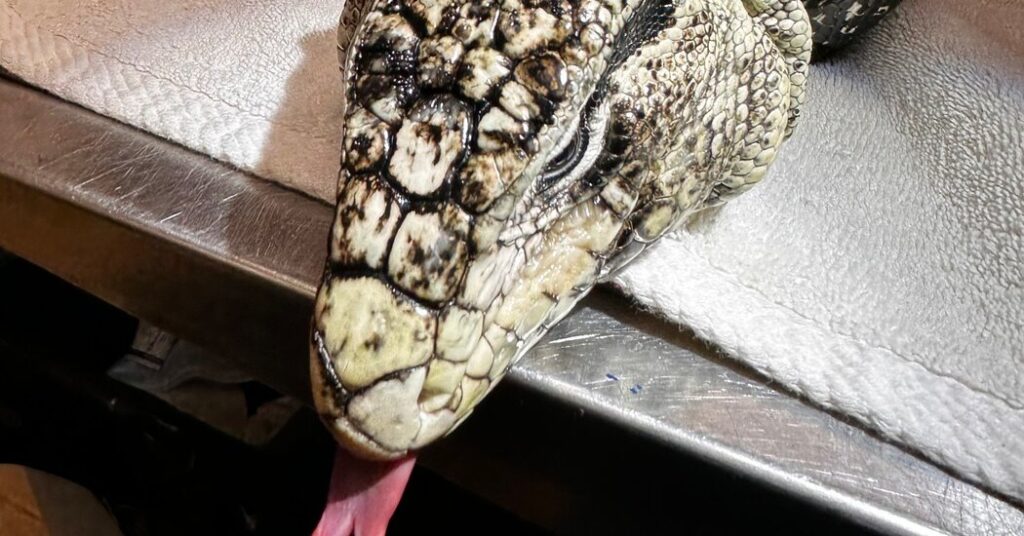
A Rhode Island man digging out his driveway this week discovered a large lizard thousands of miles from its natural habitat buried in nearly 20 inches of snow, leaving the animal weakened but on a slow path to recovery.
The lizard, a tegu, which is found in South America, was suffering from frostbite to its tongue and “showed signs of significant muscle weakness after prolonged exposure to the cold,” the New England Wildlife Center, an organization that provides veterinary care, said on Facebook.
The man who found the animal was not publicly identified, but his quick thinking helped save it, as he brought it into his home and wrapped it in a T-shirt “to help conserve heat,” the center said.
He then contacted the owners of ET Reptiles in Warwick, R.I., which responded immediately and retrieved the animal to give it the best chances of survival.
Tegu lizards, like all reptiles, are ectotherms (more commonly called coldblooded) and, as a result, their body temperature rises and falls with that of the environment.
“When temperatures drop too low for too long, their metabolism slows, blood flow is compromised, and cells begin to fail,” the center said. “In this case, the cold likely led to tissue damage and a cold-induced myopathy, essentially muscle injury caused by inadequate circulation and energy at low temperatures.”
It’s unclear where the lizard came from, the center said, but it was found “extremely weak, underweight, and not moving well.”
After the lizard was taken from the man, it was “gradually warmed at room temperature and closely monitored,” until an animal hospital visit could be arranged, the center said.
Two of the center’s doctors treated the lizard for its injuries, which included amputating “nonviable tissue” from its tongue and providing steroids to “help address inflammation and generalized weakness,” the center said.
Kevin Torregrosa, the curator of herpetology at the Bronx Zoo, said the lizard is a South American species that’s “certainly not well adapted to the winters of the Northeast.”
While there are different tegu species, one type, known as black-and-white, has been increasingly found in the wild in southeastern states like Florida, Georgia, and South Carolina because they are released by pet owners.
They can grow several feet long, weigh up to 10 pounds and live up to 20 years.
ET Reptiles, the shop that helped with the lizard’s rescue, referred to the animal as Frankie on Facebook on Thursday.
Calling the lizard a “fighter,” the shop reported seeing “small but encouraging changes.”
“Frankie is more alert and more active than she was initially, which gives us so much hope,” ET Reptiles said, before cautioning that the animal was not “completely out of the woods just yet.”
The shop said that the lizard was starting a course of antibiotics for an upper respiratory infection and that it would continue to closely monitor its health.
“Recovery will take time, patience, and a lot of support,” the shop said. “But Frankie is showing us just how strong she can be!”
Aimee Ortiz covers breaking news and other topics.
The post Large Lizard Is Rescued After It’s Found Buried in Rhode Island Snow appeared first on New York Times.