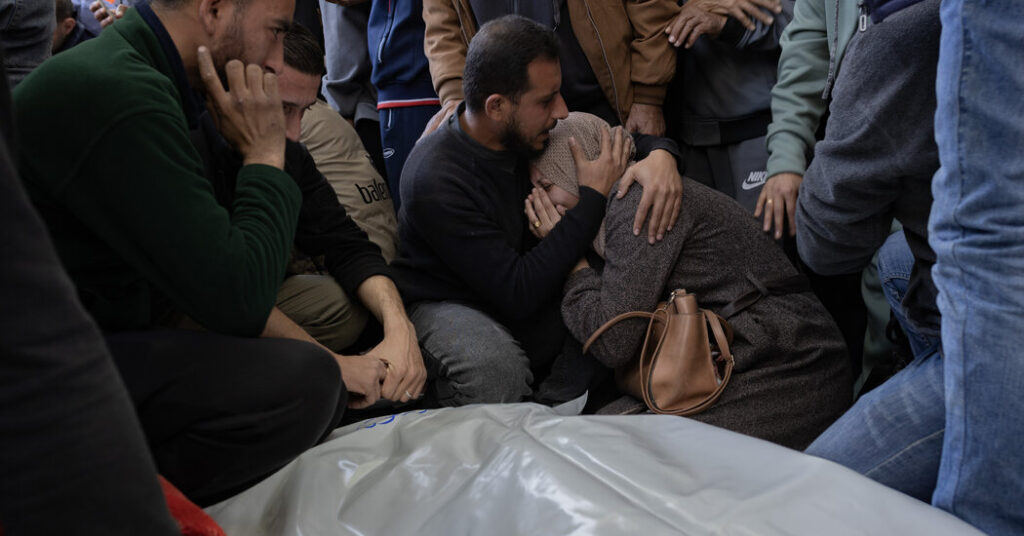
The Israeli military launched a series of airstrikes on the Gaza Strip on Saturday, an attack that local health officials said was the deadliest in weeks and that comes as the cease-fire between Israel and Hamas was set to move into its next phase.
Zaher al-Waheidi, an official at the Gaza health ministry, said at least 26 people had been killed in the strikes, which hit several locations, including Gaza City and a refugee camp near the city of Khan Younis, according to Mahmoud Basal, a spokesman for the Civil Defense rescue service.
Several children were among those killed, according to Mr. al-Waheidi and Mohammed Abu Salmiya, the director of Al-Shifa Hospital in Gaza City, who said his hospital had received some of the injured and dead on Saturday.
The Israeli military said in a statement that the airstrikes had targeted commanders and fighters from Hamas and another militant group, Palestinian Islamic Jihad, as well as weapons facilities. It said the strikes were a response to activity the day before, when it said militants had emerged from a tunnel in Rafah, in an Israeli-controlled area. The military described that as “a violation of the cease-fire agreement.”
Hamas described the Israeli attacks themselves as a violation of the cease-fire.
The strikes came before the expected reopening in the coming days of the crucial land crossing at Rafah between Gaza and Egypt, a long-delayed part of the cease-fire agreed in October.
Samer Abo Samra, 27, a resident of Gaza City, said in a phone interview that his apartment building had been hit during the strikes and that, in the aftermath, he had seen the bodies of three children. The Israeli military said it did not immediately have a comment on the incident.
The opening of the border crossing would allow Palestinians who had fled the two-year-long war between Israel and Hamas to return home for the first time.
An Israeli defense official, speaking on the condition of anonymity to share sensitive information, said on Saturday that Israel still plans to reopen the Rafah crossing in the coming days.
As part of the cease-fire deal, Hamas released the remaining hostages held in Gaza in exchange for nearly 2,000 Palestinian prisoners, while the Israeli military withdrew to an agreed-upon line inside Gaza that left it in control of about half of the enclave. On Monday, Israeli forces recovered the body of the last Israeli captive held in Gaza, setting the stage for the cease-fire to advance to its next phase.
But there have been several outbreaks of violence in Gaza since the truce came into effect, with each side accusing the other of breaching the terms of the agreement.
Gaza’s Ministry of Health says Israel has killed more than 500 people in Gaza since the truce was announced. The health ministry’s figures do not distinguish between civilians and combatants.
Israel has previously said that its strikes in Gaza were in response to Hamas’s violations of the cease-fire, including attacks on Israeli troops.
Natan Odenheimer is a Times reporter in Jerusalem, covering Israeli and Palestinian affairs.
The post Israel Launches Deadly Strikes in Gaza, as Rafah Border Is Set to Reopen appeared first on New York Times.