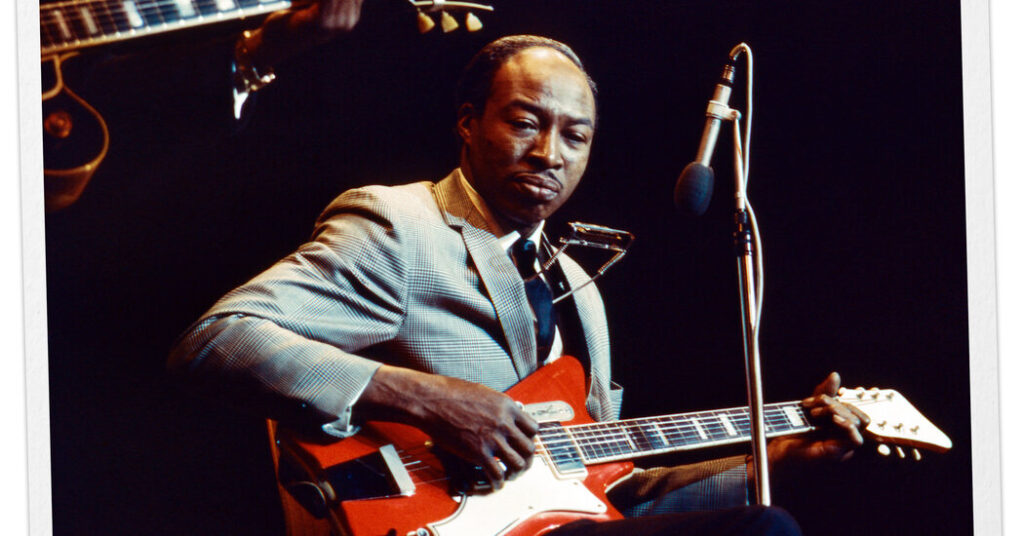
This article is part of Overlooked, a series of obituaries about remarkable people whose deaths, beginning in 1851, went unreported in The Times.
When the swamp blues pioneer Jimmy Reed sat down in the recording studio, he was rarely alone. A few feet away, his wife and songwriting partner, Mary Lee Davis Reed — better known as Mama Reed — would whisper lyrics in his ear.
Whether because of his excessive drinking or a long undiagnosed case of epilepsy, Reed typically needed help remembering the words to the songs the couple had written. Were it not for Mama’s prompting — audible on some recordings — the world might have been deprived of hearing “Bright Lights, Big City,” “Going to New York” and other originals that became staples of the blues and rock ’n’ roll canons of the 1960s and beyond.
Reed was by no means the most dynamic or virtuosic blues musician of his era. His slurred, lackadaisical vocals and trebly harmonica accompaniment were not as mesmerizing, for example, as the reverberating braggadocio of Muddy Waters or the otherworldly moaning of Howlin’ Wolf.
Nor did he possess the rhythmic flair and fiery stage presence of Buddy Guy and other blues guitarists. But maybe more than any of his contemporaries, Reed built a bridge between rock and the blues, placing 12 singles on the pop chart as well as 18 in the R&B Top 20, more than either Waters or Wolf.
“He was as popular with white audiences in the South as he was with anybody,” the bluesman John Paul Hammond said of Reed’s crossover appeal in a 2008 interview on YouTube. “I mean he sold records. Everybody loved him.”
Reed put it this way, months before his death in 1976, in a feature for Guitar Player magazine: “I don’t play no rock ’n’ roll stuff, but my records made it on the rock stations because the background just had some kind of a beat to it that just got everybody to moving.”
His most enduring material — “Brights Lights, Big City,” “Baby What You Want Me to Do,” “Honest I Do” — was recorded by the likes of Elvis Presley, Aretha Franklin and British invasion rock bands like the Animals, the Rolling Stones and the Van Morrison-led Them.
The crooner Sonny James had a chart-topping country hit with “Bright Lights, Big City” in 1971. Even songs Reed didn’t write but made his own like “I Ain’t Got You” and “Big Boss Man” inspired famous cover versions by the Yardbirds and the Grateful Dead.
Steeped in echo and reverb described as “swampy” by critics, Reed’s performances were never flashy or rushed but instead seduced listeners with their churning grooves and down-home charm. Reed’s squalling harmonica playing was credited as an influence on Bob Dylan and Stevie Wonder.
Dylan wrote the song “Goodbye Jimmy Reed” about him — an arcane tribute, to be sure, but one whose mythologizing of the bluesman, replete with a nod to his 1958 single “Down in Virginia,” reveals a deep appreciation for Reed’s cultural impact.
You won’t amount to much, the people all said
’Cause I didn’t play guitar behind my head
Never pandered, never acted proud
Never took off my shoes, threw ’em into the crowd
Goodbye, Jimmy Reed, goodbye, goodnight
Put a jewel in your crown and I put out the lights
Mathis or Matcher James Reed — sources cite both first names — was born on Sept. 6, 1925, in rural western Mississippi, one of 10 children of Joseph and Virginia (Ross) Reed, who were sharecroppers. He had only three years of formal education before abandoning school to work in the fields to help feed the family. He began singing in church as a boy, learning the basics of guitar from Eddie Taylor, a lifelong friend who went on to play on his biggest records.
Reed left home as a teenager, moving to Chicago before serving two years in the Navy. In 1945, after completing his military service, he returned to Mississippi, where he and Mama were married.
The couple moved to Gary, Ind., in 1948 as part of the Great Migration north of Black Southerners, with Jimmy finding work in the steel mills — and later, at the Armour meatpacking plant — in nearby Chicago. After hearing bluesmen like Waters and Wolf in a tavern near their home, he began busking on the streets with another aspiring blues musician, Willie Joe Duncan, who played a single-string guitar known as a Diddley bow.
In 1950, Reed quit his job at Armour to pursue a career in music full time. He was initially denied a record deal by Chess Records but was offered a contract in 1953 by Vivian Carter, a popular Gary disc jockey and record store owner who had just launched Vee-Jay Records with her husband, Jimmy Bracken, who had heard Reed’s demos while working at Chess.
Reed’s breakthrough single, a slow-drag blues called “You Don’t Have to Go,” was a Top 5 R&B hit in 1955. “Ain’t That Lovin’ You Baby,” a widely covered Reed original — including versions by Etta James and the Everly Brothers — reached No. 3 on the R&B chart the next year. But it was with “Honest I Do,” a 32-bar ballad more akin to Tin Pan Alley pop than the blues, that his career really took off.
“Honest I Do” reached the pop Top 40 in 1957 and has since been recorded by scores of musicians working in various genres. A series of hits followed, but the Reeds never profited from them, having been persuaded to sell the royalty renewal rights to their songs for a meager flat fee of $10,000 (about $98,000 today).
Compounding their financial troubles, earlier in the decade Reed had begun having epileptic seizures that were mistakenly diagnosed as delirium tremens until he started receiving care at a V.A. hospital near Chicago in 1969.
“I gave up music for about four or five years,” he told Guitar Player. “I didn’t cut no records or do nothing.” He performed live and recorded in California in the early ’70s but never had another hit despite enjoying a resurgence of popularity among blues-rock aficionados like the Steve Miller Band and the Youngbloods.
Broke and in debt, Reed died of an epileptic seizure after a show in Oakland on Aug. 29, 1976. He was 50.
He was posthumously enshrined in the Blues Hall of Fame in 1980 and inducted into the Rock & Roll Hall of Fame in 1991.
Twelve years after Jimmy Reed’s death, Mary Lee Reed and eight Reed children filed a multimillion-dollar lawsuit against Arc Music, the Reeds’ publishing company, claiming that Jimmy and Mary Lee had insufficient education to comprehend the particulars of their royalty agreement. The suit was settled for an undisclosed sum in 1990, 13 years before Mama Reed died.
The post Overlooked No More: Jimmy Reed, the Bluesman Everyone Covered, Then Forgot appeared first on New York Times.