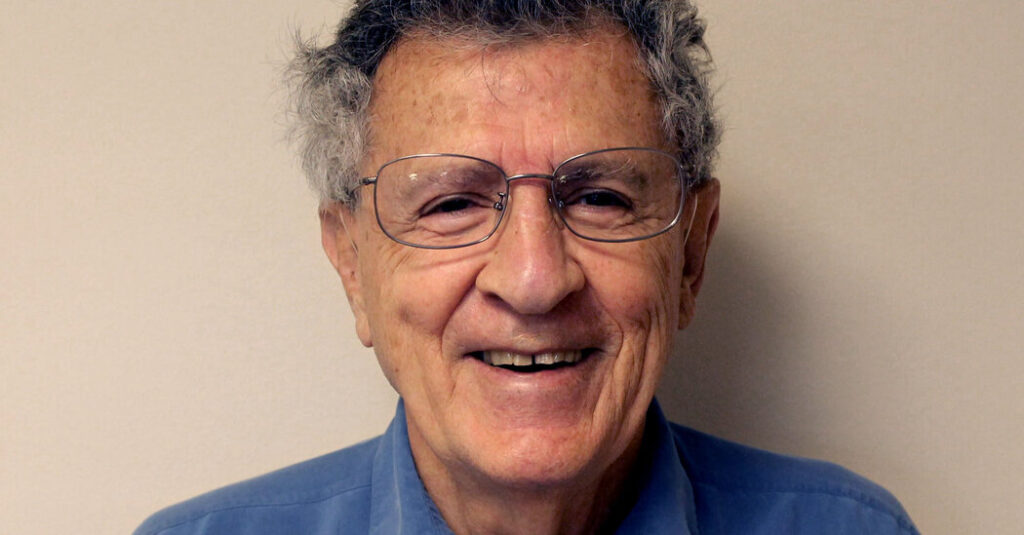
Dr. Morris Waxler, who as a federal health official was instrumental in approving laser eye surgery as a quick fix to replace eyeglasses or contact lenses, then reversed himself a decade later after concluding that the operation could actually impair a patient’s vision, died on Jan. 2 in a hospital in Madison, Wis. He was 88.
The cause was a stroke, his wife, Carolyn Zahn-Waxler, said.
From 1996 to 2000, Dr. Waxler managed a government team that evaluated and toughened engineering and clinical standards imposed on laser devices marketed for surgery. In 1999, he oversaw the original approval of those devices, which were subsequently used for Lasik surgery in the United States.
Patients who had undergone Lasik surgery soon began complaining to him personally, he said in a 2011 petition to the U.S. Food and Drug Administration, about how their sight had been distorted by halos, dryness and excessive glare; their night vision was impaired; and that chronic pain was contributing to depression and even suicide.
After Mr. Waxler decided to revisit the original data submitted by Lasik surgeons, according to Dr. Cynthia MacKay, a professor of ophthalmology at Columbia Presbyterian College of Physicians and Surgeons who has campaigned with Mr. Waxler to end Lasik, he “discovered what the surgeons had claimed were ‘temporary and treatable side effects’ were in fact devastating, untreatable, permanent complications.”
By 2010, a decade after retiring as branch chief of the U.S. Food and Drug Administration’s Center for Devices and Radiological Health, Dr. Waxler had admitted that he had made a mistake about the procedure — that there were some serious safety concerns.
A year later, he unsuccessfully petitioned the F.D.A. to issue a public health advisory to caution patients about the possible harmful effects of Lasik and to withdraw the devices from the market. He noted how “many thousands of eyes have been damaged beyond repair by LASIK devices since the 1990s” and pointing fingers at the close relationship between surgeons and device manufacturers.
“Starting during my tenure, F.D.A. decision-making on LASIK devices was dominated by LASIK surgeons working hand-in-glove with LASIK manufacturers,” Dr. Waxler wrote in his petition. “Data recently brought to light exposes this partnership for what it was: a classic example of the fox guarding the henhouse, wherein the primary arbiters of safety and effectiveness of LASIK devices were the device manufacturers and its collaborators.”
“As a consequence,” he added, “the F.D.A. was deprived of knowledge of the full extent of Lasik injuries prior to and during F.D.A. reviews of documents submitted in support of the safety and effectiveness of Lasik devices.”
In 2012, he continued to sound the alarm, writing in a public letter: “I have come to believe that the real risks associated with these devices are far higher than the F.D.A. would have originally approved, had important data not been distorted or withheld.”
He asked the F.D.A. in 2014 to reconsider his original petition. But it again denied it, disagreeing with his assertion that the “F.D.A. did not adequately consider the record of prolonged industry pressure on the Agency or use the correct data to evaluate the risks of Lasik devices.”
The agency told The Times this week that it is “working to collaborate with our stakeholders to determine the most appropriate path forward for communicating LASIK-related risks to patients and health care providers.”
Though most studies note high levels of success after Lasik, including an oft-cited 2016 report that found 20/40 or better vision for 99.5 percent of patients, critics maintain that the evaluation of the surgery should be held to a higher safety standard than other medical procedures because it’s elective.
“There’s nothing wrong with a person’s eyes who goes to get Lasik,” Most importantly, as Dr. Waxler told CBS News in 2019. “They have healthy eyes. They could go and get a pair of glasses.”
Morris Waxler was born on Jan. 25, 1937, in Washington, D.C., the son of Jewish immigrants from Russia. His father, Isadore, was an antiques dealer and cabinet maker. His mother, Fannie, whose maiden name was also Waxler, was a bookkeeper and managed the household.
After graduating from high school and serving in the Coast Guard, he studied psychology at Howard University and received a bachelor’s degree in 1962 and a master’s degree in 1964. He obtained a master’s degree in neuroscience from Michigan State University in 1966 and a doctorate in psychology from the University of Maryland in 1977.
Following his F.D.A. retirement, he worked for two law firms and then established a consultancy, Waxler Regulatory Affairs, in Madison.
In addition to his wife, whom he married in 1967, he is survived by a daughter, Rebecca Waxler Ramsey.
In 2024, Dr. Morris wrote a book about his crusade against Lasik, “The Unsightly Truth of Laser Vision Correction: LASIK Surgery Makes Healthy Eyes Sick,” which also included accounts by Paula Cofer, founder of a Lasik complications support group; Dr. Edward Boshnick, who spent over two decades caring for patients with Lasik-damaged eyes; and Dr. MacKay.
“Even if it’s 2 percent who are at risk for sight-threatening problems, that’s thousands of people being put at risk every year,” Dr. Waxler told The Times in 2018. “What is an acceptable level of risk when you’re operating on healthy eyes?”
Sam Roberts is an obituaries reporter for The Times, writing mini-biographies about the lives of remarkable people.
The post Morris Waxler, F.D.A. Official Who Switched Stance on Lasik, Dies at 88 appeared first on New York Times.