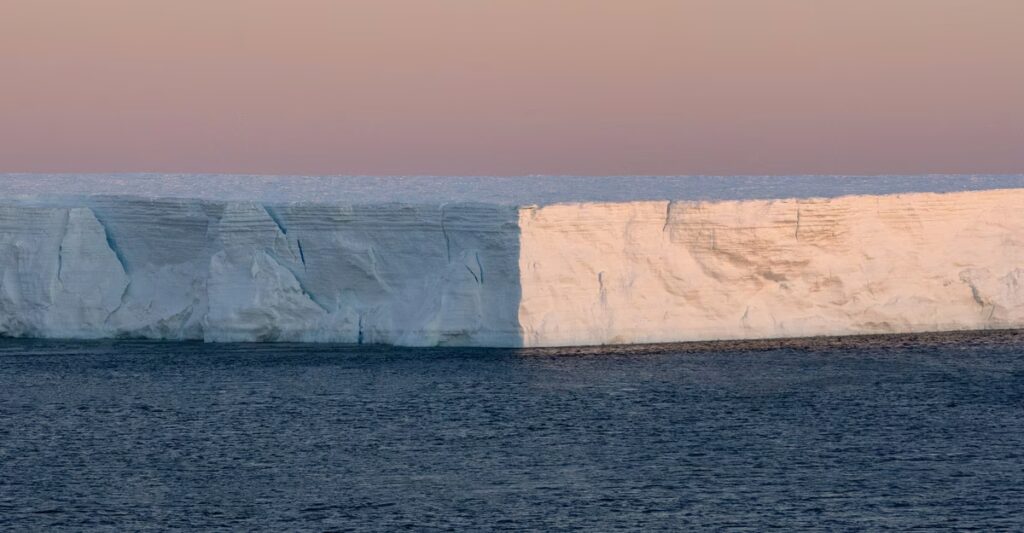
This month, an international team of scientists has been trying to set up sensors on and around Thwaites Glacier, one of the most unstable in the world. It’s often called Antarctica’s “doomsday glacier” because, if it collapses, it would add two feet of sea-level rise to the world’s oceans. On Thwaites itself, part of the team will try today to drop a fiber-optic cable through a 3,200-foot borehole in the ice, near the glacier’s grounding line, where the ocean is eating away at it from below. Sometime in the next week, another part of the team, working from the South Korean icebreaker RV Araon, aims to drop another cable, which a robot will traverse once a day, down to a rocky moraine in the Amundsen Sea. The data the sensors gather over the next two years will fill gaps in basic scientific knowledge about Thawaites. They will also determine the future of an audacious idea to slow its demise.
Right now, warm water is barely cresting the moraine, then flowing down a seabed canyon toward the glacier. If this natural dam were a little taller, it could block those warm ocean currents. Using the data on current speeds and water temperatures, scientists and engineers will model whether a giant curtain atop the moraine could divert warm water away from the glacier’s base—and if it would even be possible to construct one.
To avert catastrophe in this way would be a massive undertaking: The curtain itself would need to be up to 500 feet tall and 50 miles long. But these local conditions are in such tentative balance—“on a knife’s edge,” David Holland, a climate scientist at NYU and a member of the Seabed Curtain Project, told me from the deck of the RV Araon—that Holland and some other scientists believe that an intervention could change the glacier’s fate. Of his colleagues on the boat, he may be the only one thinking along those lines right now, he said. “But everyone’s data is going to be used by people for years and years for that purpose.”
A few years ago, the curtain project was a fringe idea that John Moore, a glaciologist at the University of Lapland, and a couple of like-minded colleagues had proposed in a series of academic articles. This kind of geoengineering, meant to address the symptoms of climate change without slowing it down, was a bête noire in the glaciology community. Now more scientists are coming to see targeted interventions in our climate as inevitable. The curtain project and at least one competing idea for slowing Thwaites’s melt have raised millions of dollars—not just from the usual geoengineering proponents but from traditional philanthropic foundations.
“The idea that there’s a clean exit on climate change, people need to get over that,” Holland said, before he set out on the icebreaker. “What is the least brutal outcome for the world is what will be decided.”
Geoengineering—which could also include removing carbon dioxide from the ocean and using stratospheric aerosol injection to dim the sun—is gaining adherents in part because decarbonization simply isn’t proceeding quickly enough. This past fall, the United Nations announced that within the next decade, global temperatures will likely rise by more than 1.5 degrees Celsius above preindustrial levels, a threshold that the Paris Agreement aimed to avoid. At the same time, climate impacts are getting real—droughts are supercharging fire seasons; hotter seas are intensifying hurricanes.
Marianne Hagen, a former Norwegian deputy minister of foreign affairs, told me that she’d long considered geoengineering “science fiction and just something not worth spending a lot of time on.” Then she watched as the Ukraine war changed the conversations around her: Energy security came to the forefront of European politics, and “nobody talked about energy transition anymore.” She thought of the vulnerable coastal nations she’d visited as a government official and, in 2024, signed on to co-lead the curtain project with Moore. “I ended up in John’s camp, mostly out of despair, because I could not see a safe pathway forward for future generations without doing the necessary research on these Band-Aid, buy-time solutions,” she said.
After that, the project quickly raised initial research funding from the nonprofits Outlier Projects, run by a former Meta executive, and the Tom Wilhelmsen Foundation, founded by a prominent Norwegian shipping company. Although government agencies in the United States and United Kingdom have funded lab research on geoengineering, rich patrons have been comparably powerful funders of geoengineering in general—and the primary funders of polar-geoengineering research. “There are lots of people with lots of money, and it’s in the scale of the private sector to do this,” Holland told me.
Another group, the Arête Glacier Initiative, is investigating the idea of refreezing Thwaites to bedrock by pumping lubricating meltwater out from its base or drawing heat away with passive heat pumps. An initiative called Real Ice is trying to pump seawater atop Arctic sea ice to thicken it. “We’ve found a lot of enthusiasm among the philanthropic community” for targeted geoengineering interventions that could limit damage to coastal communities, Brent Minchew, a geophysicist at Caltech and a co-founder of Arête, told me. “These are very localized interventions for global benefits.”
Scientists agree that, absent intervention, Thwaites’s retreat will accelerate within the next century and the glacier will eventually collapse. And Thwaites acts as a cork in the West Antarctic Ice Sheet, which contains enough water to raise sea levels by nearly 17 feet. The price of localized interventions at Thwaites, proponents say, pales in comparison with the price of building seawalls around major cities. In one paper, Moore and two colleagues estimated that the curtain could cost $40 billion to $80 billion to install (and $1 billion to $2 billion a year to maintain), whereas adapting to rising sea levels could cost an estimated $40 billion a year. One way or another, we are going to have to build in order to fight the sea.
But many in the science community still disagree, vehemently, both with geoengineering proposals and with the rationale for considering them at all. In a prominent paper published in the fall, the University of Exeter polar glaciologist Martin Siegert and 41 co-authors explained in detail how the curtain project, the type of refreezing that Arête wants to try, sea-ice thickening, and two other polar-geoengineering proposals would be too expensive, technically impossible, and potentially damaging to fragile ecosystems. The paper also raised a common argument against geoengineering—that pursuing these ideas is a dangerous distraction from decarbonization, the best solution to climate change.
Siegert decided to write the paper, he told me, after he was the sole dissenter at a talk on sea-ice thickening at the UN’s climate conference in 2023. He was shocked how mainstream the once-fringe field had become. To him, these ideas are so far from feasible, they offer a false hope that distracts from the necessary work of cutting back on fossil-fuel use to avoid catastrophe. Ted Scambos, a glaciologist who co-led the major U.S.-U.K. collaboration that studied the mechanisms driving Thwaites’s retreat, told me that he was once tentatively supportive of geoengineering research but, given that the Trump administration has slashed funding for climate science and renewable-energy development, is now strongly against it. “We absolutely should not fund or support efforts, or even tests, of climate or ice loss mitigation methods,” he wrote in an email. “It should be a matter of international law, and it should be set up as such immediately.” Instead, research and policies should “remain laser-focused on reducing fossil fuel use” and on minimizing the related economic impacts.
Those working on geoengineering research see opponents as equally shortsighted. Merely documenting changes to the cryosphere is like “choosing the best seat on the Titanic to listen to the last tune of the orchestra as the ship goes down,” Moore said. Studying geoengineering interventions is like “launching a few lifeboats.” At his point, decarbonization, even if it happened tomorrow, would not necessarily save Thwaites from collapse, he argued. “To decarbonize to the point at which we will be keeping the glaciers safe, you require actual magic to do that. It is delusional.”
Some proponents of projects like the sea curtain argue that they’re not a novel class of environmental action. They are an act of preservation not dissimilar from redirecting rivers and rebuilding beaches. Letting Thwaites collapse arguably violates the Antarctic Treaty System’s environmental-preservation clause, Minchew said.
How far we’re willing to go to keep the cryosphere in a recognizable shape while the world works on decarbonization is an open question. To geoengineering proponents, persuading the 29 member nations of the Antarctic Treaty with decision-making power to try to build a sea curtain looks easier than persuading the 193 members of the United Nations to, say, try seeding the atmosphere with sun-blocking chemicals. Opponents worry about breaking existing environmental protections for the region, and endangering the treaty altogether. But Holland, at least, is willing to predict the outcome of these debates.
“Fast-forward 1,000 years, the Earth will be geoengineered,” he said. “The entire climate will be regulated like a modern house—no question.” The climate may get screwed up in new ways as scientists attempt to turn the planet’s temperature dial down. But “if it survives, humanity is simply going to do this.”
The post A $40 Billion Idea to Keep One Glacier From Flooding the Earth appeared first on The Atlantic.