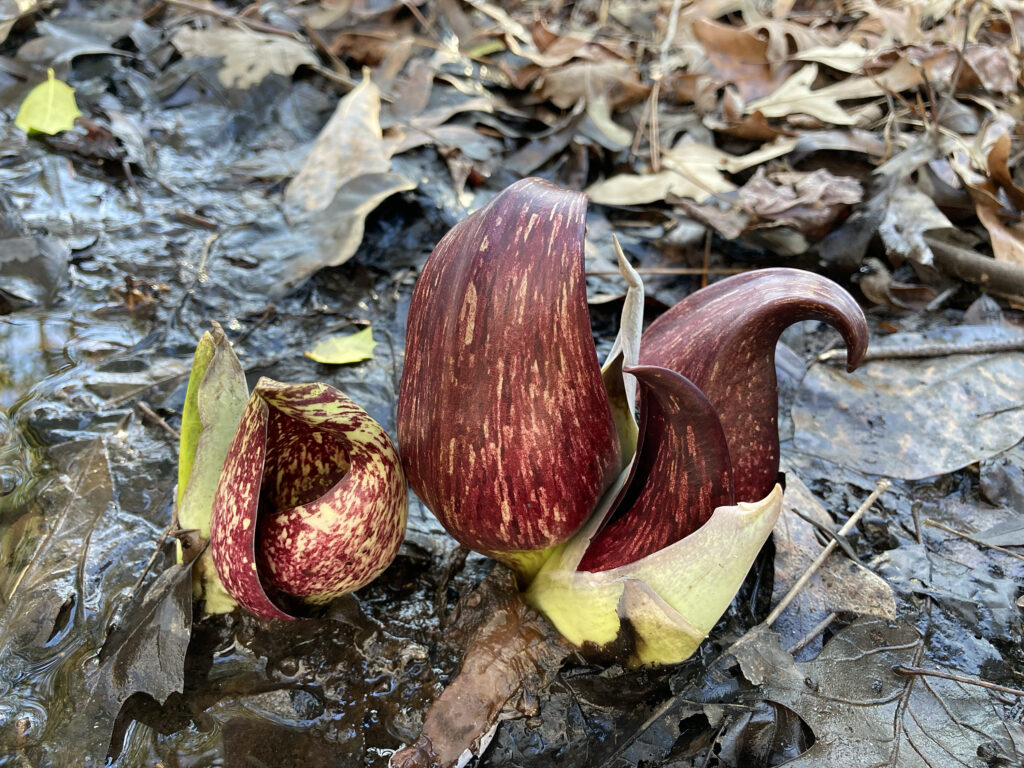
For those slogging through one of the harshest winters in recent memory, there’s a light at the end of the tunnel. The first wildflower of the year is already blooming — even if it is still covered in snow.
The spiky shoots of the eastern skunk cabbage poke through the mud in mid-January, months before other plants begin to wake up. Capable of generating its own heat, skunk cabbage produces one of the oddest flowers in the woods. Tiny and petal-less, they sprout from a fleshy, golf ball-sized knob called the spadix, which is enveloped by a mottled maroon leaf called a spathe. It looks like a peace lily going through a goth phase.
Skunk cabbage doesn’t just look weird; it smells weird too. Symplocarpus foetidus means “clustered fruit that is fetid,” an apt name for this plant that, scientists have learned, emits chemicals that mimic the smell of carrion.
But despite its unconventional appearance and less than pleasant odor, beholding one of these dogged plants blooming in the dead of winter has long been an encouraging sight for those counting the days until spring.
“If you are afflicted with melancholy at this season,” Henry David Thoreau wrote in his journal in 1857, “go to the swamp and see the brave spears of skunk-cabbage buds already advanced toward a new year.”
Turning up the heat
Skunk cabbage evolved during the Cretaceous period, meaning it lived alongside dinosaurs.
“That also means it survived the fifth mass extinction, which eliminated most of life on earth,” said Siobhán Percey, a veterinarian and Maryland Master Naturalist who has led the popular Skunk Cabbage Swamp Stomp at Jug Bay Wetland Sanctuary for the past 14 years. (This year’s event was canceled because of weather.)
“I’ve become known as the skunk cabbage expert,” she said, “not that there was any competition.”
According to Percey, most of the participants who take part in her walk are looking for any reason to get out of the house. “And that’s a pretty good draw — a flower in January. They want to come see if it’s true.”
Skunk cabbage is common across the Washington region in swamps and soggy woods, but it can be easy to miss. The flowers, which tend to grow in clumps of two or three, stand only inches from the ground.
Kate Goodrich, a biologist at Widener University who has studied skunk cabbage, says this low-lying structure — as well as a deep, dappled color that resembles flesh — may help the plant attract the few pollinators out in January, such as flies or beetles, who are mostly scouting for dead rodents and birds decomposing on the forest floor. “Skunk cabbage are mimicking that pool of resources on the ground,” she said.
The charade is made convincing by the high levels of dimethyl disulfide the plant emits, a chemical usually created by microbes as they break down an animal carcass. “It can smell like a cadaver,” Goodrich said. “It’s pretty foul.”
How does a diminutive plant produce such a funk?
Skunk cabbage is one of a few plants that can generate its own heat through a process called thermogenesis. Fueled by energy stored in its extensive root system, the plant can maintain temperatures up to 70 degrees inside of its spathe, even as the air temperature remains below freezing.
While many sources claim the flowers use this heat to push up through frozen soil, scientists haven’t found any evidence that skunk cabbage heats up during initial growth. Instead, the heat is likely used to volatilize that pungent odor and act as yet another lure for pollinators.
“They can come in from the cold and save energy,” Percey said. “It’s like an insect nightclub.”
While humans have used skunk cabbage in the past to treat headaches, coughs, and cramps, the plant is not palatable, owing to the calcium oxalate crystals in its leaves that produce a burning sensation in the mouth. It’s this spiciness that draws black bears, one of just a few animals that do snack on skunk cabbage leaves. Scientists believe the mammals turn to the plant as a laxative of sorts, to get things moving after a long hibernation.
Deep roots, long lives
Remarkably, skunk cabbage isn’t just the earliest blooming perennial in the United States, it’s also one of the longest-lived. The plant’s underground rhizomes can thrive for decades, possibly even centuries.
Skunk cabbage is also stabilized by a massive network of contractile roots, long, wrinkled tendrils that “look like socks pushed down around the ankles,” Percey says. These roots grow downward and then contract, pulling the plant deeper into the ground year after year.
The root system makes skunk cabbage difficult to remove or transplant, so if there’s a damp part of your yard calling for the plant, it’s best to start from seed.
While skunk cabbage is an ultra-early bloomer, winter isn’t the only time to admire the unusual plant. “It’s a cool January flower,” Goodrich said, “but also cool September flower.”
As temperatures warm and the spathe begins to wilt, the plant’s foliage emerges from a single stalk, unfurling in a bright green spiral. The oblong leaves of the tiny flower eventually grow to be one of the largest plants on the forest floor, stretching up to three feet long and a foot wide. They are handy for soaking up sunlight beneath a dense forest canopy come summer.
The flowers, meanwhile, swell after pollination and develop numerous berrylike fruits, which start out green and purple, but end up dark brown and black. This helps camouflage the seeds against the soil so that they can successfully germinate, beginning the plant’s extraordinary life cycle all over again.
“There is no can’t nor cant to them,” Thoreau wrote. “They see over the brow of winter’s hill. They see another summer ahead.”
Ashley Stimpson is a freelance writer in Columbia, Maryland.
The post The first bloom of the year is here, even if it’s buried in snow appeared first on Washington Post.