Statistics say that Americans are forgetting how to be neighborly. The recent actions of the people of Minnesota suggest otherwise.
A Pew Research Center survey of Americans released last year found that the share of people who said they knew all of their neighbors decreased from 2018 to 2025. In a different report on social connection in America, also from last year, 63 percent of respondents said they never got together with their neighbors to improve their community, and only 27 percent said that their neighborhood was close-knit. And in a 2024 survey, about half of people said that they seldom or never spoke with neighbors they didn’t know well. The decline in socializing with neighbors has been happening for decades—since about the 1970s, as the sociologist Robert D. Putnam documented in his 2000 book, Bowling Alone.
The past couple of months, however, have shown that huge numbers of Americans do love their neighbors—enough to show up in frozen streets, confront armed federal agents, and even risk death. The response to Border Patrol and ICE’s presence in Minnesota has prompted one of the greatest mass displays of neighborly love that I’ve seen in my lifetime.
[Read: Minnesota proved MAGA wrong]
Donald Trump’s administration has described immigrants not as neighbors but as threats, and even as subhuman. The Department of Homeland Security posted an image to social media last summer that featured the ICE-hotline number and the message report all foreign invaders. President Trump has referred to immigrants as “animals” and called Somalis, one of the immigrant groups his agents were reportedly sent to Minnesota to target, “garbage.” At a press conference this month, he held up mug shots of immigrants arrested in Minnesota and asked, “Do you want to live with these people?” The administration insists that it is going after criminals and immigrants here illegally, despite the fact that it has arrested some people with no criminal record, and has detainedand deported citizens. Agents across the country are reportedly racially profiling Latinos, and anyone who is not white. (DHS claims that agents are using “reasonable suspicion.”) Videos from Minnesota show agents questioning and detaining people based on their accents. The message this sends is that anyone who doesn’t fit the mold of what agents think an American citizen looks and sounds like is subject to suspicion, and doesn’t belong. Many people, however, are rejecting the message that skin color, language, or national origin disqualifies someone from being their neighbor.
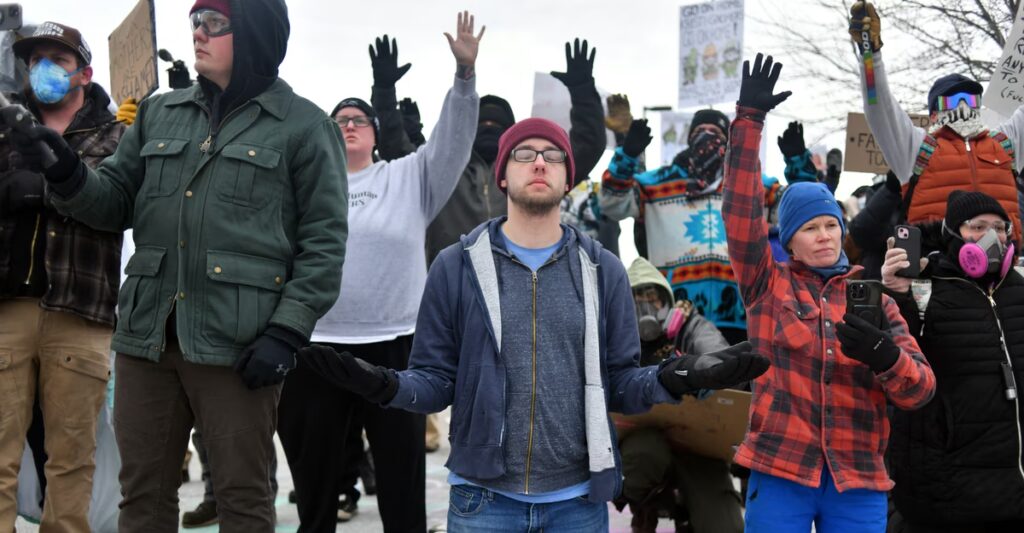
I’ve lost track of how many times I’ve heard the word neighbor in videos documenting interactions between Minnesotans and federal agents, and in interviews with local residents. In a video taken after an ICE agent shot the poet and mother of three Renee Good, a witness screams, “You just killed my fucking neighbor! … You’re killing my neighbors. You’re stealing my neighbors.” Signs at protests in Minneapolis this month—when thousands of people showed up despite temperatures of 20 degrees below zero—read Love thy neighbor, Stop disappearing our neighbors, We love our immigrant neighbors.
These are people unwilling to accept their neighbors being dragged from their homes and cars, pepper-sprayed in the face, and separated from their children. They have responded to federal agents’ cruelty and brutality with heroic care. As my colleague Adam Serwer has written, many Minnesotans are engaging in protests and efforts to deliver food and supplies to families in hiding. Local Signal groups monitor ICE activity and mobilize at a moment’s notice, a large-scale, seemingly leaderless operation that rests on relationships among neighbors. In doing so, they are accepting serious danger themselves. Two and a half weeks after Good’s death, federal agents shot and killed Alex Pretti, an ICU nurse who had been trying to help a woman he seemed not to have known.
Some of the Minnesotans defending their neighbors include those who would not have previously considered themselves activists. In one viral video, a man who says he has never protested before spews curses during an interview: “I got work in the goddamn morning just like everybody else,” he says. “I’m just here trying to stand up for community, dude.” Over and over, regular people have said, sometimes at the barrel of a gun, These are our neighbors. We claim them.
The outpouring of neighborly care is not limited to Minnesota. Local groups in Chicago, Baltimore, and other cities have also been monitoring ICE. Some schools and hospitals across the country are training staff on what to do if federal agents come knocking. People are delivering groceries to those who don’t feel safe leaving home in California, Oregon, Maine, Ohio, and many other states.
The forces of disconnection in American life today are strong. But the bravery of ordinary people has shown that Americans have not forgotten the power of loving their neighbors.
When you buy a book using a link on this page, we receive a commission. Thank you for supporting The Atlantic.
The post Americans Love Their Neighbors appeared first on The Atlantic.