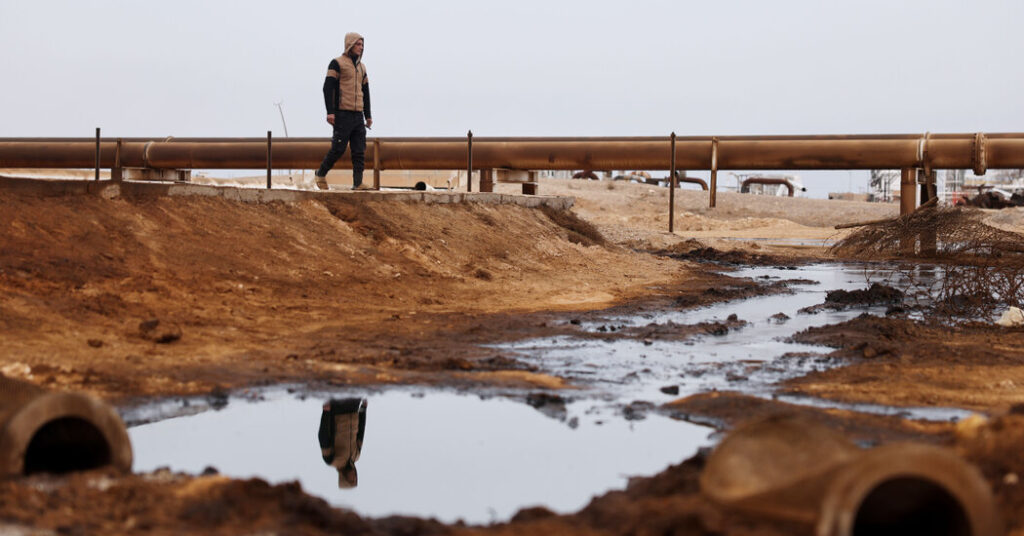
Fighting this month between the Syrian government and the Kurdish-led Syrian Democratic Forces, the United States’ former partner against ISIS, ended in a decisive defeat for the Kurds. Much of the territory they had governed since 2014 with American military and financial support is now out of their hands.
This was more than a tactical setback. It marked the end of the Kurds’ daring, if improvised, experiment in self-rule — a utopian model that combined leftist ideas and women’s empowerment in one of the region’s most conservative corners. It was much admired in the West but never fully embraced by the Arab communities it governed. It also underscored a harsher truth: The United States was willing to throw a partner that had fought and died for it under the bus when its interests changed. In Trumpian parlance, Kurds had “no cards” in post-Assad Syria.
The new map cemented President Ahmed al-Sharaa’s consolidation of power across much of the country and expands Turkey’s zone of influence along Syria’s northern border. The question now is what kind of Syria emerges from this moment — a pluralistic republic or a conservative, highly centralized regime with little room for diversity — and whether the United States, having spent years shaping the battlefield, will bother shaping the peace by pushing for a constitutional order that Syrians beyond Damascus can buy into.
It should. Syria cannot be stabilized through centralization of power alone. Success now largely depends on how Kurdish rights are guaranteed, and whether the Kurds have a credible political future not only in Syria but also across the border in Turkey, where the Kurdish question — the long-running struggle over political recognition, cultural rights and local governance of Kurdish populations — remains unresolved as well.
The Syrian government and the Kurds took an important first step on Friday, reaching an agreement to absorb Kurdish fighters into the Syrian military and integrate Kurdish civil institutions into the central government, among other measures.
Mr. al-Sharaa’s declaration earlier this month recognizing Kurdish identity was welcome, too. But the real test will be whether previous commitments on Kurdish local governance, language recognition, education and cultural rights become law and are implemented consistently, and whether two ideological extremes — the Kurds’ leftist vision and the conservative Islamist cast of Syria’s new rulers — can be reconciled.
For the United States, the stakes are not abstract. The risks of continued tensions between Turkey and the Kurds, an ISIS resurgence and new openings for Iran-backed militias across eastern Syria and neighboring Iraq remain. Those developments would once again pull Washington into managing crises it claims to want to leave behind.
There is little doubt that Washington has switched partners in Syria, moving from its alliance with the Kurds to working directly with the country’s new rulers. President Trump’s special envoy to Syria, Tom Barrack, repeatedly argued that the United States saw no viable alternative to a unified Syria — meaning Washington is not prepared to underwrite Kurdish separatism or a federation.
U.S. officials are mistaken to believe that military integration alone can bring stability. Syria’s path to reunification ultimately requires constitutional measures that guarantee Kurdish political inclusion as a recognized community, alongside other minorities. That means embedding into Syria’s constitution — and its laws — the right of minorities to use their languages, administer local affairs and shape educational and cultural policies. This constitutional recognition, paired with genuine administrative autonomy for the Kurds, Druze, Christians and other minorities, is the only viable way to unify Syria and prevent renewed tensions. You cannot ask a militia to put down its arms without giving its people a political horizon.
Washington cannot impose democracy in Syria, nor should it try to. But it can endorse Syria’s territorial unity while insisting that unity without minority rights is a recipe for more instability.
Regional politics make this moment in Syria especially delicate. Turkey has a longstanding ambition to wield influence in the region through friendly Sunni governments and economic leverage. With Iran weakened and Washington largely aligned with Turkey’s policies, President Recep Tayyip Erdogan now has an opportunity to shape the political architecture of the Middle East. He should build his legacy not solely by extending Turkey’s hard power but also by bringing a peaceful end to the conflict with Kurds in his country.
A Syria that integrates Kurds politically could serve as an example for Turkey to resume the stalled peace process with its longtime domestic enemy, the Kurdistan Workers’ Party, or PKK, which has links to Syrian Kurds. A workable political settlement in Syria could help stabilize both sides of the border with Turkey. Ankara should not waste time and move forward with its own legislation, already under consideration, allowing for the return of Kurdish fighters who lay down arms.
Both Mr. Erdogan and Mr. Barrack are students of Ottoman history and often appear to believe that a benevolent strongman can do more for his people than a weak democrat. But that reflects only one interpretation of the Ottoman legacy. Another is the recognition that stability in diverse societies comes not from homogenization, but from negotiated coexistence. Mr. Erdogan should draw on that legacy to understand that suppressing Kurdish political expression in Syria, once a part of the Ottoman Empire, would not serve Turkey’s long-term interests. Like the Ottomans at their best, Turkey should position itself not as an enforcer of uniformity under a rigid centralized system but as a guarantor of the rights and well-being of Kurds and other minorities in its neighborhood.
Ultimately, this is Mr. Erdogan’s choice. As he often speaks of shaping a new “century of Turkey,” the legacy he leaves will depend in part on whether he opts for coercion or coexistence across Turkey’s borders. In its turn, Washington needs to urge Turkey to jump-start the peace process with the Kurds. Turkey’s security concerns are legitimate, but a pluralistic Syria should be seen as a stabilizing force, not a threat.
Asli Aydintasbas is a fellow at the Brookings Institution and director of the institution’s Turkey Project.
The Times is committed to publishing a diversity of letters to the editor. We’d like to hear what you think about this or any of our articles. Here are some tips. And here’s our email: [email protected].
Follow the New York Times Opinion section on Facebook, Instagram, TikTok, Bluesky, WhatsApp and Threads.
The post Syria Must Protect Its Minorities appeared first on New York Times.