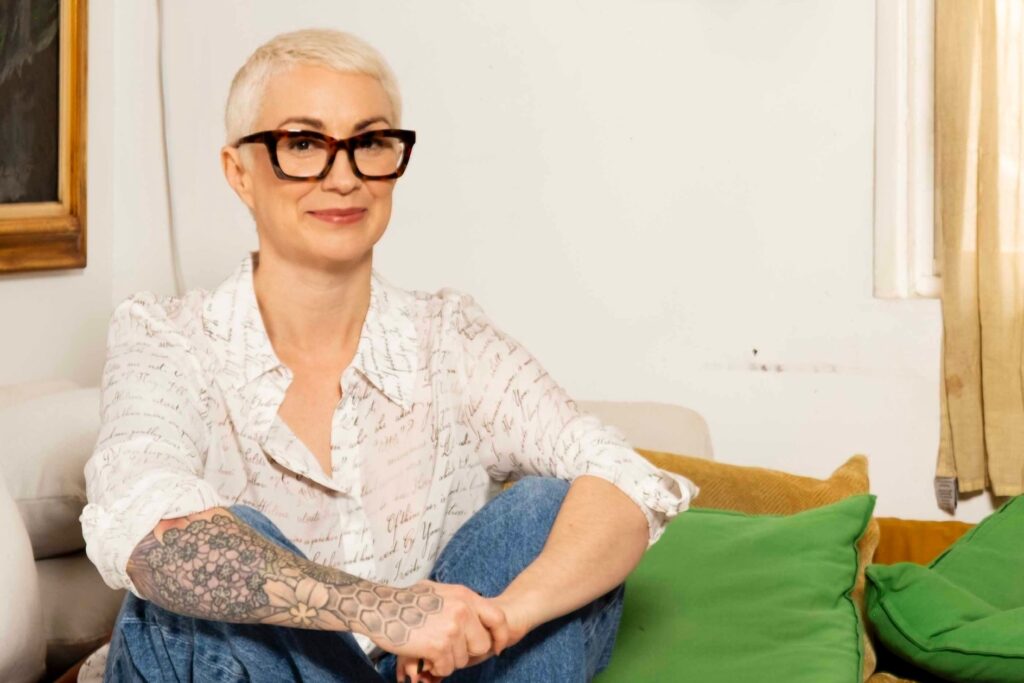
When songwriter Laura Veltz meets with young singers, she likes to tell them something that might sound counterintuitive: “You don’t have to work with me.”
Veltz, who has lived in Nashville for nearly two decades, knows that up-and-coming artists can feel pressure to collaborate with big-name writers. So she warmly reminds them that they owe her nothing: If they don’t want to write with her, she will root for them from the sidelines.
This perspective also helps Veltz, who likewise does not feel bound to write only with big-name artists, even those with whom she has already written hit songs. That’s unusual: It’s increasingly difficult to make a living as a songwriter, and many feel the need to hang on for dear life — “like a leech,” as she says — to the successful musician who chooses to favor them.
“In my life,” Veltz, 45, said in a phone interview from Nashville, “I have proven that the less I think about that, the more successful I am.”
After she emerged as the co-writer of some of the biggest country songs of the 2010s — Dan + Shay’s seven-time platinum “Speechless” in 2018, Maren Morris’s crossover sensation “The Bones” in 2019, among other chart toppers — Veltz wanted to stay fresh and sought out work with singers from other genres.
Her versatility will be on display Sunday at the 68th annual Grammy Awards, where Veltz is nominated for songwriter of the year, nonclassical, for the second time since the category was introduced in 2023. (It’s the fifth nomination of her career.) Her submission package includes songs with Morris, the country-rooted star who is still her frequent collaborator; as well as pop star and actress Demi Lovato, pop/hip-hop/trap singer Jessie Murph, rapper BigXthaPlug, Christian musician Blessing Offor and Canadian singer-songwriter Lauren Spencer Smith.
But her song that caused the biggest stir last year was not submitted for consideration. That was “1965,” Murph’s viral and much-criticized track about the frustration of modern dating, which got caught in a firestorm over lyrics yearning for old-school courtship routines (“I think I’d give up a few rights/ If you would just love me like it’s 1965”) along with an intentionally provocative and sexually explicit music video. Even as Murph explained that the song was “kind of a joke,” many listeners didn’t find the humor as abortion rights were toppling across the country and some conservatives were championing a cultural movement of “tradwives” who submit to their husbands.
Veltz didn’t want to include “1965” in her songs for consideration because she thought it might cause a distracting “political debate.” She is a staunch supporter of women’s rights. But she likes that the lyrics are “taking a really uncomfortable subject, and injecting humor and satire, and giving people a minute to just have a think, you know, about why we do the things we do — and particularly from the view of a young woman in the dating pool.” She hoped the song would cause a conversation.
“Making people think and ask hard questions and even have discourse around hard questions is a whole lot more interesting to me than just writing something I’ve already written over and over again,” Veltz said. “I care about the quality of the work, but I care about new frontier. That’s my interest as a songwriter, and I will constantly be pushing towards what hasn’t been said. And you know, I hopefully make people dance or laugh in the meantime.”
On Veltz’s podcast, “Songwriter Soup” — where she and her co-hosts discuss best practices for songwriters, both creative and financial — she once explained that her extreme desire for artistic freedom probably stems from her years spent in a family band with her parents, brother and sister. The group, called Cecilia, gained a following in the Washington area. (They briefly lived in the Northern Virginia suburb of Vienna in the late 1990s, where Veltz spent her junior and senior years at James Madison High School.) Those were difficult times, Veltz says now: The band was no hobby but literally the family’s livelihood.
In 2008, Veltz decamped to Nashville, where she now lives with her husband and kids, and remains grateful for the songwriting community that enveloped her. Her sister, Allison, is also a successful Nashville songwriter; they co-wrote “Leave Me Too” for Canadian country singer Josh Ross, which Veltz included in her Grammy submission.
Mike Molinar, president of Big Machine Music, recalls meeting Veltz at an industry event shortly after she moved to Music City. She gave him samples of her music, and he was struck by the details in the lyrics. The best songs, he said, keep the story specific but the emotions universal.
“She nailed it so perfectly. And there wasn’t a word out of place, which has become one of the hallmarks of her songwriting,” Molinar said. “She does not waste a word.”
Molinar became Veltz’s manager and eventually signed her to a publishing deal. Her first country radio No. 1 was Eli Young Band’s 2013 “Drunk Last Night,” which originated during a writing session when Veltz apologized to her co-writer for not being particularly sharp because she had gotten, well, a little drunk last night. They grabbed onto that line and turned it into a clever yet mournful tale about a doomed drunk dial.
Many of Veltz’s hit country songs are suffused by sadness, such as Chris Young’s 2014 “Lonely Eyes,” Morris’s 2016 “I Could Use a Love Song” and Lady A’s 2019 “What If I Never Get Over You.” However, there’s plenty of optimism in “Speechless” and “The Bones,” which were nominated for best country song at the Grammys in consecutive years. Both songs, in their own ways, are about the lasting power of true love. The hits blew up outside the confines of country radio and helped Veltz make more connections in the pop world. Artists and other songwriters from all genres gravitate to Veltz, Molinar said, because she is truly open to whatever anyone has on their mind.
“There’s nothing you can bring to her that she’ll say, ‘I don’t know how to write that,’” Molinar said. “She would rather write the personal story that somebody’s been holding on to for a long time, even if it’s just therapeutic for that artist, than feel like she’s got to make a hit that day.”
It’s nice, though, when the songs become hits: One of Veltz’s other Grammy entries with Murph, “Blue Strips” — in which a woman goes to a strip club, partly to throw dollar bills at the dancer who hooked up with her ex — became Murph’s breakout single in 2025.
“I had about as much fun as a person could possibly have with Jessie Murph this last year. We have had so much fun just being idiots,” Veltz said.
On the opposite end of the spectrum on her submission list, she penned “You’ll Be OK, Kid” with Lovato, which was featured in the singer’s documentary “Child Star” about growing up in show business. Veltz co-wrote almost the entirety of Lovato’s 2022 album, and she said that the two bonded over their respective childhood trauma. She admires the resilience of Lovato, the former Disney star who has been very open about the struggles in her youth: “You won’t meet a more healthy person on earth than Demi Lovato right now. And I don’t know how she managed to go from where she was to where she is, but I got to watch that journey from beginning to end.”
If the range of songs submitted for the Grammys have a theme, Veltz said, it’s topics that she feels aren’t often discussed, such as Morris’s “Grand Bouquet,” a quiet ballad about being so focused on wanting “more” that you miss the little things in front of you that already fill you with joy. She’s especially proud of the lyric, “The ones who bother with rose-colored fodder instead of putting water in the vase.”
She still wants to stretch her songwriting skills, as far as she can, which she believes relies on taking note of the small details of life. She has seen other songwriters grow miserable trying to cling to “success.” Her goal is to focus on the art, keep growing and not lose sight of the thrill of getting to write songs for a living.
“This is the most miracle job of all time,” Veltz said. “You get to go in at the crack of 11 a.m., write a song with friends and people who are interested in talking about their feelings, and you get to have a little piece of art that represents that union? And you get to go home and not be famous and just make dinner? And if you have kids, you get to hang out with them?”
She paused. “It’s a very, very lucky life.”
The post She writes the sweetest country songs. Also, the dirtiest viral hit of 2025. appeared first on Washington Post.