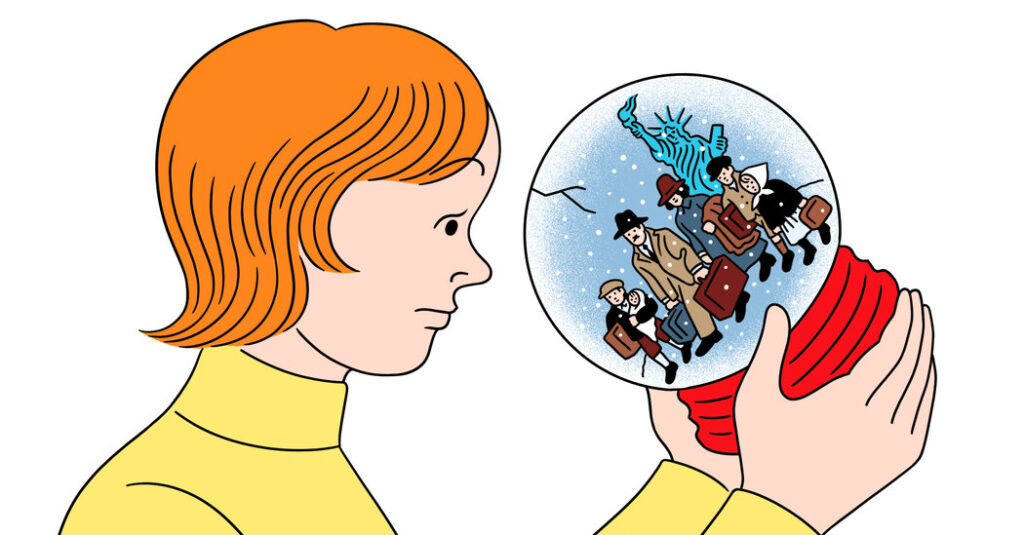
I grew up proud of my Polish American heritage, listening to stories about the perilous journeys of family members — not distant ancestors, but my own maternal grandparents, aunts and uncles — as they made their way from war-ravaged Europe to America in 1950. As is often the case, these stories were light on detail and heavy on drama, and I repeated them with pride and awe. They shaped how I understood myself and my place in the world.
As I grew older, I read many authoritative historical accounts of World War II, and things about my family’s history began to seem … off. Now in middle age, I’ve come to the hard realization that the stories I was told cannot be true. This late-stage enlightenment sent me into a tailspin of confusion and embarrassment. My question is whether I should ask my mother about it and gently reveal what I have discovered. Or do I just keep my truth to myself? I suspect there is nothing to gain, but I am feeling very lost and unsettled. — Name Withheld
From the Ethicist:
Ernest Renan, the 19th-century historian, observed that “forgetting, and I would even say historical error, is a crucial factor in the creation of a nation.” He wasn’t being cynical. He believed that nations require a selective, simplified, often mythologized past to sustain a coherent identity. Family stories can be a bit like that. The social and psychological work they do can come at the expense of accuracy. What gets handed down is frequently a mélange of exaggeration, confusion, things that happened, things that might have happened and things that happened to other people.
Even more unsettling is the fact that our tales about ourselves can be wildly off base. A writer I know was startled recently to learn that a vivid memory from his childhood in Venezuela was about something that happened not to him but to his father, a generation earlier. Your verdict that these stories “cannot be true” may be historically justified, but it’s worth thinking about what they signified. You might also ask yourself why you want to have this conversation now. Is it to relieve your own distress, to correct the record, to prevent future generations from inheriting a spurious coming-to-America tale? And is your mother emotionally and cognitively able to engage with this reassessment? For some people, these narratives are identity scaffolding; for others, they’re closer to folklore.
So proceed with deliberation and care. But the importance of the stories to your family isn’t a reason to stay silent; it’s a reason not to. In matters of significance, it’s generally better to live in the light of truth. You suspect there’s nothing to gain in voicing your doubts, yet the confusion and chagrin you describe may arise not only from your discoveries but also from your worries about sharing them. At the same time, reticence, even if it grows out of consideration, can shade over time into a lack of candor. What you have to gain is the possibility of living more honestly.
Readers Respond
The previous question was from a reader who was debating whether to tell another member of his church that he recognized him from a dating app. He wrote:
I am part of a faith community that does not affirm same-sex relationships, and I plan to continue following that teaching even though I am bisexual. I do not know many others in the same situation. A few years ago, while exploring my sexuality online, I came across a man from the same faith community on a dating app. I am not sure if he noticed me, and I quickly blocked him. He is now engaged to a woman. I have thought about reaching out, but I am unsure how to do so without making it feel intrusive. At the same time, it would mean a lot to have someone I could relate to in this area (and possibly he might feel the same). Would it be appropriate to make contact, or would that cross a line? — Name Withheld
In his response, the Ethicist noted:
My sense is that the implicit norms associated with such apps do not amount to “contact me whenever and wherever you wish.” Probably they tilt toward “don’t act like you know me if you see me at Costco.” … There’s a difference between facilitating intimacy and conferring acquaintance. If you tell this person you recognize him from the app, however benign your intentions, he may feel exposed, vulnerable and dependent on your discretion. … You should also ask yourself why you want to be in touch. Given that the other person is engaged, he is most likely committed, as you are, to abstaining from same-sex relationships. So think about what, exactly, you’re hoping to discuss and hoping to gain. … Even if your only aim is connection, you could be creating conditions under which doubt, temptation or defection reasonably arise. Whatever you decide to do, you should be mindful of this possibility.
(Reread the full question and answer here.)
⬥
I don’t think there is any appropriate response other than: Don’t! You shouldn’t try to satisfy your own needs at the expense of another person’s privacy. — Robert
⬥
It breaks my heart that you belong to a faith community that does not love and welcome your whole self. As a bisexual woman and a leader in a faith community, I want better for you. Having said that, we all come out in our own time. It sounds as if this man isn’t out in your community, and if so, that’s his business. If you aren’t even friends with this man, what he does on dating apps, or in his engagement, isn’t up to you. I support the idea of discussing, within safe relationships, whether this faith community is the right one for you. — Jessica
⬥
It wouldn’t hurt to encourage the letter writer to find another, more tolerant church where his bisexuality wouldn’t ever be something to hide or be ashamed of. If you find your own peace, you will be less likely to crash in on someone else’s. — Cathy
⬥
As a bisexual female member of a faith that has no ethical problems with same-sex relations, I would leave this man alone. He has found someone he is attracted to, and it wouldn’t truly matter if it were a woman or a man. The letter writer’s best bet is to find for himself an online support group until he can find a face-to-face one, if that kind of discussion is what he’s looking for. — Diann
⬥
Do not contact him. Who knows what his reasons were when he went on the app? Many people question their sexuality and explore only to find out that what they are experimenting with is not for them. This may be a part of his life that he regrets or simply wants to forget about. — Neal
The post Should I Let My Family Know That Our Cherished ‘Origin Story’ Is Bogus? appeared first on New York Times.