Faced with a lawsuit, a venture capital firm ended a contest that gave $20,000 grants to Black women entrepreneurs.
In a settlement, McDonald’s stopped limiting a college scholarship to students who had at least one parent of Hispanic origin.
A white theatergoer has sued an Off Broadway theater, demanding that it pay damages for offering discounted tickets to people of color.
Conservative groups have brought dozens of lawsuits since the Supreme Court’s decision in 2023 that ended affirmative action in college admissions.
Their ambitions are grand: To push that change beyond universities into other areas of American life, including corporations, law firms, health care, the arts and private nonprofits offering scholarships intended to help people of a certain race or ethnicity.
And in some cases, they are using a novel strategy, employing Reconstruction-era laws that were intended to ensure the rights of Black people against D.E.I. programs.
In many cases, they are claiming easy victories, lawyers on both sides say, with defendants buckling soon after the case is filed.
“My boss says ‘the air war has been won,’ and now we have to do the dirty work of going house to house and taking out these programs one at a time,” said Dan Lennington, deputy counsel of the Wisconsin Institute for Law and Liberty, a conservative nonprofit that has pursued several cases.
The number of lawsuits underscores both the way race-based preferences have embedded themselves into society as a means to overcome deeply-rooted racial discrimination, and the anti-affirmative action movement’s relentless determination to end any advantage perceived to be unfair.
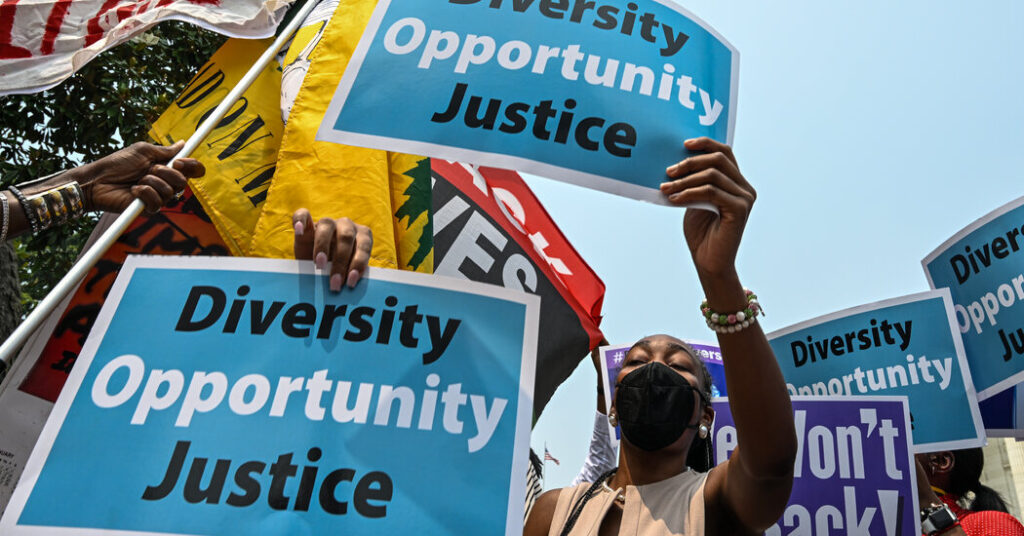
Taken together, the lawsuits could change the legal landscape, starting with diversity, equity and inclusion programs themselves. Some D.E.I. programs are used by universities, businesses and others to help create a talent pipeline, often through training and scholarships, for people of color, who are often hugely underrepresented in their organizations.
President Trump has issued an executive order banning D.E.I. efforts. But the lawsuits, should they reach the Supreme Court, could enshrine that order into law, making a broad array of programs illegal, according to some lawyers defending the programs.
“I would call it a multipronged assault on diversity, equity and inclusion,” said David Glasgow, head of the Meltzer Center for Diversity, Inclusion and Belonging at New York University. “It’s a legal, political and cultural war that they’re waging.”
But Mr. Lennington said the point was not to favor white people. “We’re looking for neutrality,” he said. “We’re not interested in creating a culture of white racial grievance.”
Mr. Lennington said he has used the Ku Klux Klan Act of 1871, which forbids engaging in a conspiracy to deprive someone of their civil rights.
More commonly, he and other lawyers are citing another Reconstruction Era law — Section 1981 of the Civil Rights Act of 1866. It was adopted to protect formerly enslaved Black people from discrimination by giving them the same rights as white people to write and enforce contracts.
The recent lawsuits argue that Section 1981 protects white people as well as Black people from discrimination. It is an interpretation of the law that the Supreme Court upheld 50 years ago, and that is now being revived to challenge racial preferences.
“Ironically, they’re using that statute as a way to dismantle programs designed to assist racial minorities,” said Jason Schwartz, a partner in the law firm of Gibson Dunn, which has represented several defendants in D.E.I. cases.
A Flood of Cases
One of the most tenacious groups is the American Alliance for Equal Rights, founded by Edward Blum, the architect of the Supreme Court cases against Harvard and the University of North Carolina. That decision upended the way colleges had shaped a racially diverse class of students for almost 50 years.
Mr. Blum, who is not a lawyer, said he started the alliance in 2021, anticipating that if affirmative action were overturned, he could test the ruling in other arenas.
In court papers, the alliance describes itself as a membership organization “dedicated to ending racial and ethnic classifications across America.” It has now orchestrated 22 cases challenging racial preferences outside the realm of college admissions, with the majority of them relying on the Reconstruction-era contracting law. After being sued, the defendants have changed or ended their programs in 14 of those lawsuits, according to Mr. Blum. The other eight, he said, are still being litigated.
To find potential cases, Mr. Blum said, he wakes up early to scour the news. Prospective clients also come to him. “There isn’t a day that goes by that I don’t get five, six, seven emails describing what someone believes is racial discrimination,” he said. Most do not have the evidence needed to build a case.
But some do. Kevin Lynch, a composer, was rankled by a “BIPOC Night” — offering discounted admission to patrons who identified as Black, Indigenous or people of color — held by Playwrights Horizons, the Off Broadway theater, at a November showing of its popular play, “Practice,” about an abusive theater director.
Because Mr. Lynch is white, he paid $90 for his ticket that night, which would have cost $39 if he had been a person of color, according to court papers.
He filed a class-action suit in December, accusing the theater of racial discrimination against patrons who did not receive the discount; in effect, white people. It cites Section 1981 of the 1866 Civil Rights Act. Mr. Lynch is represented by Consovoy McCarthy, a Washington, D.C.-area law firm that also represented Students for Fair Admissions in the Harvard case.
Mr. Lynch declined an interview, but sent an email saying he was “saddened” by the “isolation and segregation” he had experienced while attending the show. Playwrights Horizons declined to comment.
Other conservative groups are challenging government programs. The Trump administration has made their work easier, by typically not attempting a defense against the lawsuits.
Pacific Legal Foundation, a libertarian public interest law firm, has represented the plaintiffs in about 30 lawsuits since the Harvard decision, according to Joshua P. Thompson, director of equality and opportunity litigation. They include several challenges to professional boards, such as those for medical examiners and podiatrists, that reserve certain seats for members of racial minority groups. So far, it has won 13 cases and lost one, he said. Most of the rest are still being litigated.
Since the Harvard decision, “there’s a lot less fight from the defendants, a lot more rolling over,” Mr. Thompson said.
The Wisconsin Institute for Law and Liberty is fighting government programs that say they give preferences to the “socially disadvantaged,” which its lawyers say is a proxy for giving preferences for race, and in some cases, sex.
Mr. Lennington, the deputy counsel, said such programs multiplied during the Biden administration, and the institute has represented more than 80 clients in 25 states.
One of the institute’s clients is Adam Faust, who inherited a 170-acre dairy farm in Chilton, Wis., with about 70 Holstein cows on it. In June, he sued to stop more favorable government loan guarantees, among other programs, that are offered to “socially disadvantaged” farmers, according to the complaint.
Such programs were created to remedy years of discrimination against Black farmers, who were shut out by banks and the government.
Since he filed suit, the agriculture department has indicated that it will no longer defend these preferences, but Mr. Faust is seeking a final judgment.
“There’s enough challenges in this industry to survival, the last thing we need is the government picking winners and losers,” Mr. Faust said in an interview.
An Attack on D.E.I.
Mr. Blum’s opponents say many of his discrimination cases take on programs and scholarships that fit roughly within the umbrella of D.E.I. by encouraging diversity.
For instance, his alliance filed lawsuits against McDonald’s and the American Bar Association for sponsoring educational scholarships dedicated to certain minority groups. After being sued, both organizations opened their programs more broadly. McDonald’s settled the lawsuit, while the A.B.A. case is ongoing.
“I think they’ve been remarkably effective, actually, in expanding these principles into other areas of the law,” said Mr. Schwartz, of Gibson Dunn, discussing the alliance. His firm has a D.E.I. task force and puts out regular updates on policy and litigation “to help employers navigate the increasingly thorny environment.”
Mr. Blum calls D.E.I. “a fuzzy concept,” asking, “What do we mean by diversity? No one’s ever really answered that question.”
And he argues that awarding benefits like scholarships and contracts by race has always been illegal, but in the era of affirmative action, there may have been some ambiguity, and people looked the other way.
Mr. Blum conceded that some of the lawsuits seem like “small potatoes.” But, he said, the point of legal advocacy is to apply the law.
And, even in small cases, there could be larger goals. In August 2023, Mr. Blum’s alliance group sued the Fearless Fund, an Atlanta-based venture capital firm, over a Strivers Grant Contest for Black women.
The two sides settled the case, after an appeals court found that it was likely to succeed. But the lawsuit seemed to challenge the very existence of the Fearless Fund, which is dedicated to closing the gap in venture capital funding for businesses run by women of color. A lawyer for the fund, Alphonso David, said that this particular grant program had been winding down anyway, and the fund continues to carry out its mission in other ways.
He added, “the Fearless Fund exists.”
Kirsten Noyes, Kitty Bennett and Sheelagh McNeill contributed research.
Anemona Hartocollis is a national reporter for The Times, covering higher education.
The post After Affirmative Action Win, Conservatives Sue to Push Change Everywhere appeared first on New York Times.