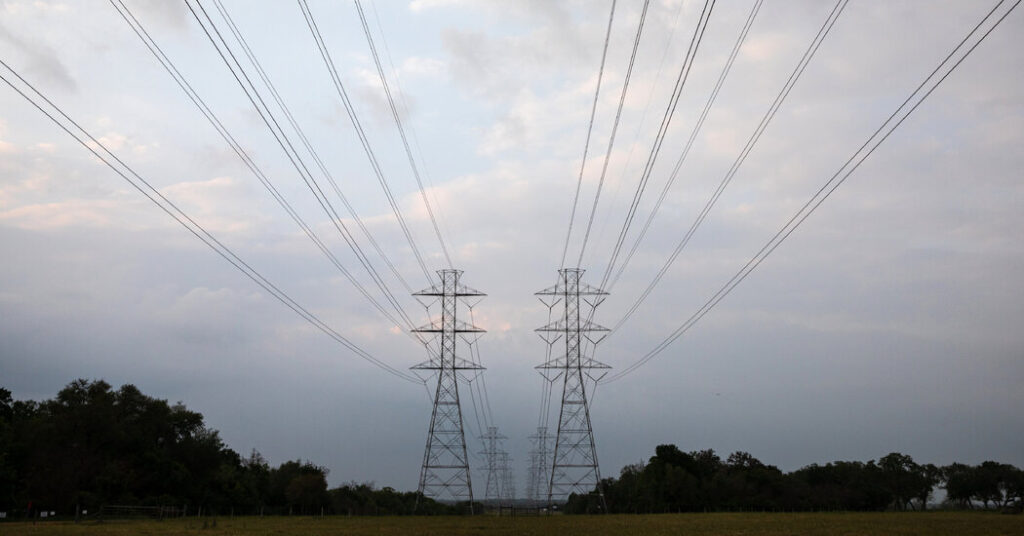
President Trump and Democratic and Republican governors this month announced a plan to build power plants to lower electricity bills in 13 Eastern states and the District of Columbia.
Energy experts said that even if the plan works, the plants will take years to build. But they added that governors, state lawmakers and utility regulators could do a lot of things that could have a big impact on energy costs a lot sooner.
Electricity prices have soared recently because of fast rising demand for energy from residents, businesses and data centers used for artificial intelligence. The national average retail rate was 5 percent higher in November from a year ago, nearly double the overall inflation rate. The average household spent $178 a month for 1,000 kilowatt-hours of electricity, according to the Energy Information Administration.
Costs are expected to climb further because recent very cold weather and winter storms drove up the wholesale prices of electricity and natural gas — costs that utilities will pass on to residents in the coming months.
About 17 percent of Americans are behind on their electric bills, according to the National Energy Assistance Directors Association, which represents state officials who administer the federal program that helps low-income families pay heating and cooling bills.
“The anger is growing,” said Mark Wolfe, executive director of the energy assistance directors organization. “You’re seeing much higher rates and they’re not coming down.”
But Mr. Wolfe and other energy experts said states can keep prices in check or even lower them.
Reduce or Reform Utility Profits
Most U.S. electric utility companies are monopolies, and state governments have a lot of control over how much profit they earn. States typically allow utilities to return to investors about 10 to 12 percent of the money they invest in their electric systems.
Some energy experts believe this “rate of return” approach is flawed because it encourages utilities to spend excessive amountson equipment and power lines. Consumer groups add that the rate of return should be lowered.
“Most shareholder-owned utilities in this country earn profits for their shareholders based on how much infrastructure that they build and how expensive that infrastructure is,” said Mark Dyson, a managing director at RMI, a nonprofit research organization formerly known as the Rocky Mountain Institute. “There’s a natural mismatch of incentives.”
Consumer Watchdog, a nonprofit that works on state policies, said utility returns have grown over the last 40 years to a level that is more than twice the interest paid by the 10-year U.S. Treasury note, which is around 4 percent now.
Lowering utility returns to between 6.5 percent and 7.5 percent, Consumer Watchdog said, would still grant utilities significant profits while helping consumers. “There are easy fixes to save billions of dollars from utilities,” said Jamie Court, president of Consumer Watchdog, which is based in Los Angeles.
But utility executives said that such proposals would undermine a business model the industry has relied on for decades to secure the investment to maintain the grid.
“The winter storm is a timely reminder that the electric grid is America’s most important machine — and we have to make sure it works reliably every day for families, businesses and local communities,” Drew Maloney, president and chief executive of the Edison Electric Institute. “The predictability and stability of financing are vitally important in all state regulatory environments to attract the capital needed to strengthen the grid and responsibly meet the growing demand for electricity.”
Some energy experts said states have another option — change how utilities make money.
Governors and legislatures could direct regulators to encourage utilities to save money, said Jennifer Granholm, who was the energy secretary in the Biden administration. States could, for example, allow utilities to earn a return on spending that helps them do more with what they have already built.
“Squeeze more efficiency out of the existing system and share the benefits with the ratepayers,” said Ms. Granholm, a former Michigan governor who has advised Gov. Mikie Sherrill of New Jersey.
Give Consumers Rebates
Last year, California issued refunds averaging $198 to nearly 12 million residential utility customers.
Such credits are one of the fastest ways to help consumers, if “you want to go as quickly as possible,” said Mr. Wolfe, of the energy assistance directors’ group. “Give them a bill credit. You don’t have to give them to everybody.”
Since 2014, California’s Cap-and-Invest Program — which seeks to address climate change by imposing a fee on greenhouse gas emissions — has delivered $14.6 billion in rebates to residents. This year, California will provide $1.4 billion for electricity customers, $1 billion for natural gas customers, and $122 million for small businesses.
The refunds range from $35 to $259 on electric bills. California issued two last year, in April and October.
Offer Free Electricity When There Is a Surplus
Much of Australia produces so much electricity, primarily from solar panels, during the day that the country plans to just give it away to residents. Beginning in July, electricity customers in the states of New South Wales and South Australia and the region of South East Queensland will receive free power for three hours during the day. The government hopes to offer the same break to the rest of the country by 2027.
The government and its supporters contend that this approach can help residents and the electricity system. People can shift energy-intensive tasks like laundry or charging home batteries and electric cars to the designated three hours. And by giving away the electricity, power producers can avoid shutting down solar and wind farms or selling energy at a loss.
“That can be a way for people who are cost-conscious to save a little money,” said Leah Stokes, an associate professor of political science at the University of California, Santa Barbara, who specializes in energy and environmental policy.
Solar and wind producers in some parts of the United States also struggle with too much renewable energy during parts of the day. Some estimates indicate that about 10 percent of the solar energy produced across the country is not used, Ms. Stokes said.
Some utility industry groups have objected to Australia’s plan, saying it could reduce industry profits and the incentive to invest in new electricity generation, power lines and other equipment. They have also said the plan would mainly help affluent residents who own home batteries and electric vehicles.
Encourage Home Solar and Batteries
Taking a cue from Germany, lawmakers in roughly half of U.S. states have introduced legislation to make it legal for Americans to use plug-in solar, also known as balcony solar.
These solar panels can be plugged into a normal wall socket and installed without an electrician or permission from local utilities. The systems are typically a lot cheaper than installing panels on rooftops, though they also generate less energy.
“It doesn’t matter if it’s portable and hanging off your balcony or bolted to your roof,” said Bernadette Del Chiaro, a senior vice president at the Environmental Working Group, “It’s generating electricity and cutting your utility bills.”
Solar panels, batteries and electric vehicles also can form what are known as virtual power plants, small systems linked together with software that can mimic large power plants.
Broader use of such systems can avoid the need for new power plants and lines while making the grid more resilient. Small systems also can be built a lot faster than natural gas and nuclear power plants.
States can encourage more solar and battery systems at homes and businesses by making it much easier for property owners and installers to obtain building permits and permission to connect to the grid, energy experts said.
However, the Trump administration has sought to stall renewable energy projects and increase the use of coal, natural gas and oil.
Some Republicans like Neil Chatterjee, who led the Federal Energy Regulatory Commission during part of Mr. Trump’s first term, say government officials ought to embrace an all-of-the-above approach to energy.
As electricity prices continue to rise, “solar is just going to be a cheaper alternative for residents than the bills they’re paying for their utilities,” Mr. Chatterjee said. “We can’t possibly do this with fossil fuels alone.”
Ivan Penn is a reporter based in Los Angeles and covers the energy industry. His work has included reporting on clean energy, failures in the electric grid and the economics of utility services.
The post Three Hours of Free Power and Other Ideas to Lower Utility Bills appeared first on New York Times.