To properly sing along to “Golden,” the inescapable hit song from the movie “KPop Demon Hunters,” it helps to know Korean, which is sprinkled into the lyrics.
The internet, apparently, agrees. The song, which is up for four Grammys on Sunday, is the subject of many YouTube and TikTok videos breaking down the pronunciation of its Korean words and lyrics. Combined, the clips have millions of views.
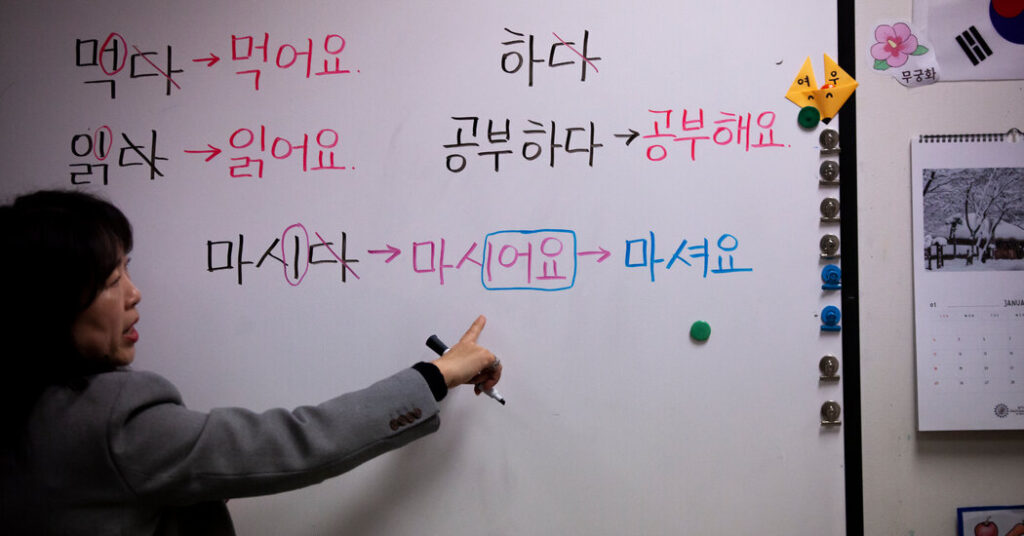
The U.S. obsession with Korean pop culture has now reached the point where more and more Americans, with little personal connection to the country, are learning the Korean language or alphabet, or hangul.
Demand is so high that universities from California to Arkansas are expanding their courses in Korean language and culture. Duolingo, a language learning app, saw a 22 percent growth in Korean learners in the United States over a one-year period last year. Language institutes are recruiting teachers to accommodate what they say is a surge in demand.
“We are limited only by our own capacity,” said Tammy Kim, the executive director of the Korean American Center, a nonprofit language institute in Irvine, Calif.
Brecken Hipp, 35, was watching a Korean game show on Netflix and eating Korean takeout with his wife one night when he got frustrated with the subtitles. He decided to start studying Korean.
“I just thought, ‘Boy, it’d be a lot easier if I knew what they were saying,’” recalled Mr. Hipp, who works at a gaming company in Irvine. He now spends about six to eight hours a week on it.
Known in Korean as “hallyu,” the Korean cultural wave crashed into America in 2012 when the rapper Psy’s galloping hit “Gangnam Style” became the first YouTube video to surpass one billion views.
In the years since, South Korea has become a hit factory. BTS, the boy band juggernaut, has sold out football stadiums and appeared on “Saturday Night Live.” Blackpink, the K-pop girl group, headlined at Coachella. “Parasite” became the first non-English movie to win Best Picture at the Oscars.
The first season of “Squid Game” became the most watched show in the history of Netflix. And “KPop Demon Hunters,” which was nominated this month for two Oscars, is now Netflix’s most popular film ever, with more than 325.1 million views.
That animated movie is mainly in English, but many of the other shows and films were offered in Korean with subtitles. And the K-pop songs are mostly in a mix of Korean and English.
“Korean language is cool now,” said Joowon Suh, director of the Korean language program at Columbia University. “That’s been very noticeable.”
The booming demand is striking given the eroding interest in foreign languages. Between 2016 and 2021, university enrollment in such courses dropped by 16 percent, according to the latest report from the Modern Language Association.
Only three languages saw increased interest. Korean had by far the sharpest uptake, spiking by 38 percent. (American Sign Language had a slight uptick and biblical Hebrew grew by 9 percent.)
Two decades ago, the University of California, Berkeley, offered two Korean classes for what are known as nonheritage learners and four for heritage learners, meaning they had some prior exposure to Korean, said Junghee Park, who oversees the Korean language program. Today, the school now has nine introductory Korean classes, with eight for nonheritage students.
“I couldn’t have imagined that 20 years ago,” Dr. Park said.
Bob Huh, who teaches Korean at Eleanor Roosevelt High School in Greenbelt, Md., said that many of his students, who are mostly Black and Latino, come into the introductory classes already knowing basic phrases and slang.
“Even though I grew up in Korea, they know more about K-pop than I do,” Mr. Huh said. “Now I listen to K-pop every day because I have to be up-to-date.”
Getting started with Korean can seem easy. It can take just a few hours to learn the alphabet, which is regarded as the most logical writing system in the world.
Attrition at the more advanced levels remains a problem, instructors said. It can take years of dedicated study to become fluent. Korean has a different sentence structure compared to English, and grammar and words change depending on the people in the conversation. Ages and familial relationships matter. The State Department has designated Korean as one of the most difficult languages to learn for English speakers, alongside Arabic, Chinese and Japanese.
Lisa Hunt, 20, a junior at Brown University, has studied Korean for five semesters. She marvels that she now understands K-pop performers when they speak at concerts.
“I do like to joke that is it is always my hardest class every semester,” said Ms. Hunt, who is majoring in applied math-economics. “You have to practice your grammar, your vocabulary, every single day in order to stay on track.”
Those who push through say that studying Korean — as with any language — has helped them discover an entire world.
Angel Huang, who grew up speaking Mandarin and English at home, studied Korean as a high schooler in her spare time in part to better connect with other K-pop fans. Now a senior at Duke University, Ms. Huang, 22, said that she has developed a deeper appreciation of Korean history and politics, too.
She even worked with North Korean refugees at a study abroad program in Seoul. In addition to her computer science major, she is minoring in Korean language.
“I honestly think that without getting into K-pop and Korean media, I probably would not have taken the same path at all,” Ms. Huang said.
For many aspiring Korean speakers, visiting South Korea is often the next step.
Max Abrams, 27, an influencer with the social media handle “MaxNotBeer,” gained 1.3 million TikTok followers by chronicling his life in Seoul, often shocking locals by speaking their language.
His interest in the language began in high school, he said, when he first heard Girls’ Generation, a K-pop group. After graduating from college with a double major in international affairs and Korean, Mr. Abrams moved to South Korea where he taught English and then became a full-time content creator.
Even for foreigners fully conversant in Korean, he said, building a sustainable life there can be challenging, partly because of visa issues and cultural barriers.
“The vibrancy that comes with learning Korean comes on a sociocultural level,” said Mr. Abrams, who recently moved back to the United States. “In terms of professional stuff, it’s less promising.”
In interviews, some Americans emphasized that their interest in the language did not make them a “Koreaboo,” a pejorative term for people seen as overly obsessed with Koreans and their culture.
Andy Ko, 21, said he found the term troubling. After moving from South Korea to the Chicago suburbs, he had been teased, he said, for talking about Korean dramas or K-pop. Now, as a junior in college, he will sometimes pepper Korean words into conversations with other students — no problem.
“I feel proud, honestly,” he said.
Amber Guidry, 37, seems to live a very Korea-centric life, even though she lives in Seattle.
Enthralled by Korean dramas, Ms. Guidry, a scientist with no Korean background, started studying the language two years ago. Now, Ms. Guidry shops at H Mart, the Korean grocery chain. She cooks dishes like tteokbokki (stir-fried rice cakes) or kimchi jjigae (a spicy stew). Her bathroom vanity is littered with Korean beauty products.
With girlfriends, she went to see “KPop Demon Hunters” on a big screen. The theater was packed with children and adults, some dressed up in costumes. As the movie played, virtually everyone sang along to “Golden.”
Oh-oh-oh, up, up, up with our voices
영원히 깨질 수 없는 (Unbreakable forever)
Gonna be, gonna be golden.
Ms. Guidry is planning her first trip to Seoul this spring.
Adeel Hassan contributed reporting.
Amy Qin writes about Asian American communities for The Times.
The post Fans Are So Obsessed With ‘KPop Demon Hunters,’ They Are Learning Korean appeared first on New York Times.