In the predawn darkness, the teacher slips out of her apartment, into the idling car of a colleague waiting in her driveway.
Normally, the teacher, who moved from the Philippines a year and a half ago and does not yet have her own car, would Uber to work, where she spends her days working with disabled children who are nonverbal. It is one of the hardest jobs in education and one of the hardest to fill, which is why her Minnesota school district sponsored her to come teach on a visa.
But ever since immigration raids began sweeping the Twin Cities, and especially since Renee Good and Alex Pretti were shot dead, she has been fearful.
She is here legally. But if American citizens are not safe, she wonders, what might happen to her?
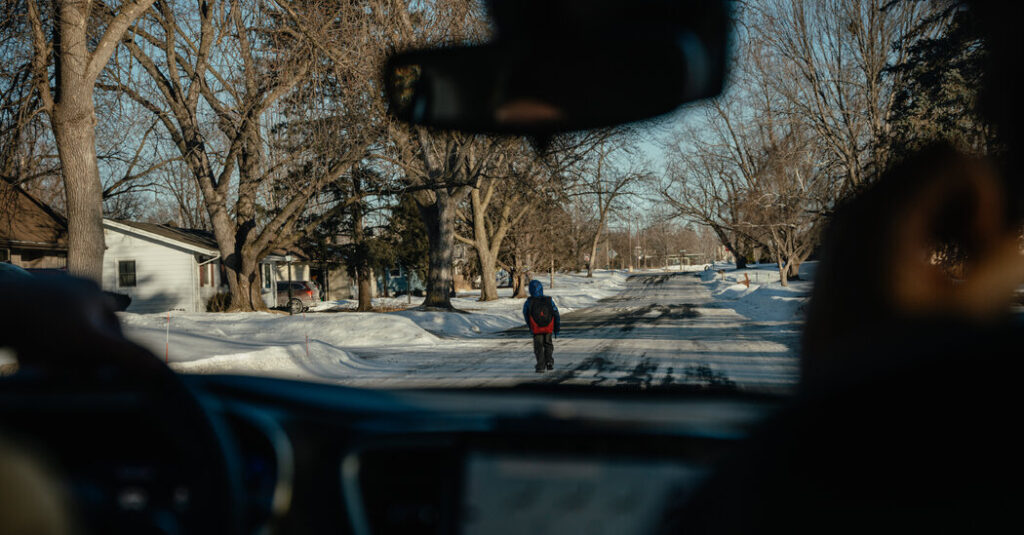
Now, a district official escorts her to work each morning. They pull out of the driveway shortly before 7 a.m., the start of another tense school day in Fridley, Minn., a Minneapolis suburb of big-box stores, apartment complexes and modest, snow-covered homes. Twenty-seven other anxious school employees are also being escorted in vans and car pools, the new morning ritual.
In the school district next door, more than two dozen parents and four students have been detained by federal agents, including a 5-year-old boy on his way home from school who was detained with his father.
From sunup to sundown, Fridley school officials are on high alert, worried federal agents might show up on their doorstep next.
Across the district, several hundred children are learning online because they are scared to go to school. Administrators are packing up groceries for families and trying to help with rent for parents who are afraid to work.
It all feels eerily similar to the pandemic, school leaders said. To their frustration they said, this time, the crisis is man-made.
“You have taken away the basic human right of children to be at school,” said Brenda Lewis, the Fridley superintendent. Her district is home to about 2,700 students, including significant Somali and Ecuadorean populations. Nearly 20 percent of students in the district are still learning English.
Though many families are legal immigrants, or U.S. citizens, fears about racial profiling and encounters with federal agents have grown.
As part of its crackdown on illegal immigration, the Trump administration rescinded Biden-era guidance that limited enforcement in or near “sensitive” locations, such as schools, churches and hospitals. Schools officials in the Twin Cities say federal agents have appeared at bus stops, and showed up at people’s homes at times when they are coming and going from school.
Trump administration officials say federal agents do not target or raid schools, and are focused on arresting violent criminals.
“Our ICE law enforcement officers are making arrests of child pedophiles and predators to protect the children of Minneapolis,” said Tricia McLaughlin, a spokeswoman for the Department of Homeland Security.
In Fridley, though, fears of ICE are everywhere. Children come to school reporting raids in their neighborhoods and agents at their windows.
The adults at school see it as their job to shelter families in their care, to keep the daily act of going to school, at least, safe. Amid it all, they are also trying to maintain a sense of normalcy, even joy.
8 a.m.
At Fridley Middle School, students stroll in, cups of Cocoa Puffs and cans of Pepsi in their hands.
The principal, Jordan Halverson, greets them at the door. “Morning, Antonio.” “A.J., how was practice?” He prods them along. Three minutes until first period.
A former running back and linebacker at Fridley High, Mr. Halverson, 34, is the middle school’s brand-new principal. He knew his first year would come with challenges. He never expected this.
Halfway through the school year, federal agents arrived, leading to tense protests across the region. His voice mail filled with more than 100 messages from parents. He remembers listening to several in Spanish. He could understand only snippets, but he understood enough. “You can hear the fear,” he said.
Some parents said they would be keeping their children home. Others asked him directly: What will you do to protect us?
“It’s a helpless feeling,” he said. “As a leader, you try to be there, to be the rock, to have all the answers. But you don’t.”
The helplessness continues at home, where his 7-year-old daughter is asking questions about her classmates who haven’t come to school lately. They looked at a class picture together, and she pointed to the faces of those missing.
Mr. Halverson, who is Black, Vietnamese and white, has few answers for her. In his car, he is carrying his U.S. passport, in case he himself gets pulled over.
10:30 a.m.
By late morning, school officials are out in the cold, loading 50 grocery bags into cars to give away to families. Boxes of macaroni and cheese. Crackers. Applesauce.
About 40 families are expected to pick up food, along with Chromebooks for their children who are learning online. The district officials stage their giveaway near the high school gym, where the sneaker squeaks and whoops of students playing lacrosse during gym class echo.
A few days earlier, the gym had been the site of a sit-in, organized by several students, including the superintendent’s two children, who said they needed to do something, anything, to speak out.
They described worries about friends who had stopped coming to school, and for themselves, in case they are profiled because of the color of their skin.
Yasin, a 10th grader whose parents are from Somalia, said his mother had warned him to be careful and carry extra documents, though he is a U.S. citizen. He says children shouldn’t have to do that just to go outside or go to school.
In the parking lot, parents are pulling up one by one. The first car is a mother picking up a computer for her kindergartner.
“Hello!” says Danielle Thompson, a district official who has been doing weekly grocery shopping. “Do you need food or supplies?”
A little girl in a pink hat waves from the back seat.
2 p.m.
Toward the end of the school day, Dr. Lewis, the superintendent, is in a Chrysler Pacifica minivan, circling the neighborhood.
She sees dismissal as a vulnerable time of day, when parents line up their cars outside school doors and buses drop off children to walk home.
In the driver’s seat is Mark Mickelson, a former police officer now in charge of district security. For the past several weeks, they have spent each afternoon patrolling, looking for federal agents near schools and bus stops.
Across Minneapolis, these kind of patrols, from citizen observers, have at times led to escalating confrontations with federal agents, who Trump officials say are there to do a job.
“Those blaming ICE for low attendance at schools are creating a climate of fear and smearing law enforcement,” said Ms. McLaughlin, the Department of Homeland Security spokeswoman, adding that inflammatory rhetoric had led to an increase in assaults against ICE officers.
Dr. Lewis says she needs to be out monitoring the streets, in part to tamp down rumors and reassure community members, who regularly call in potential ICE sightings.
At 2:11 p.m., one of those calls comes in. It turns out to be a false alarm.
At 2:38 p.m., there is another call. An S.U.V. with out-of-town license plates, spotted nearby.
Mr. Mickelson swears and turns the steering wheel. Quickly, both he and Dr. Lewis start receiving phone calls from school officials keeping watch in the neighborhood.
“We are looking for a Texas plate,” says Dr. Lewis. “A Chevy Suburban, silver.”
They find the vehicle parked at Commons Park, a public park next to several schools. They pull up and peer inside. The driver is wearing a hat and appears to have on a tactical vest. Another man sits in the back seat, his face partially obscured by a mask. The license plate matches one in a community database tracking ICE vehicles.
Dr. Lewis types a text to her principals: “Hi team, we have a confirmed ICE at Commons. Please make sure we have all eyes on dismissal.”
Mr. Mickelson drives around the block and circles back. The S.U.V. is pulling away. As they cross paths, the man in the back seat rolls down his window and waves.
Whatever his intent, it leaves the school officials shaken.
“It’s games,” Mr. Mickelson says. “They know exactly what this vehicle is and what we are doing, and they are just letting us know.”
Dr. Lewis worries the agents could be looking for a family in her district. She wonders whether a news conference she did the day before, denouncing ICE and its impact on schools, could have attracted them.
At one point, Mr. Mickelson thinks he has spotted them again. He speeds down a suburban road. But they are gone.
6 p.m.
It’s rivalry night at the boys’ varsity basketball game: Fridley vs. Columbia Heights, a neighboring district.
Normally it would be standing room only. But tonight, attendance is down. Several Columbia Heights students have been detained, including 5-year-old Liam Conejo Ramos, whose detention while he was wearing a Spider-Man backpack on his way home from school, along with his father, has drawn national attention.
Squinting into the stands, Tanya Moore, a Columbia Heights district employee and one of the few people in “Heights” sweatshirts, counts just six students from her district, aside from basketball players.
One Fridley 11th grader, who has been learning online, is there to work the concession stand with her friends. She feels safe, she says, because there are lots of people around. Police officers and school officials are at the entrance. It is scarier, she says, on a quiet school morning, when agents could be anywhere.
For now, though, it’s almost like any other high school night: back in their teenage bubble of TikTok dances and makeup checks in the girls’ bathroom, their biggest worries over who will win a basketball game.
It’s close, down to the end. But Fridley pulls away in the final seconds, 75-73.
The scoreboard switches off and the crowd scatters from the gym, out into the night.
Sarah Mervosh covers education for The Times, focusing on K-12 schools.
The post A Minnesota School District Guards Against ICE, From Dawn to Dusk appeared first on New York Times.