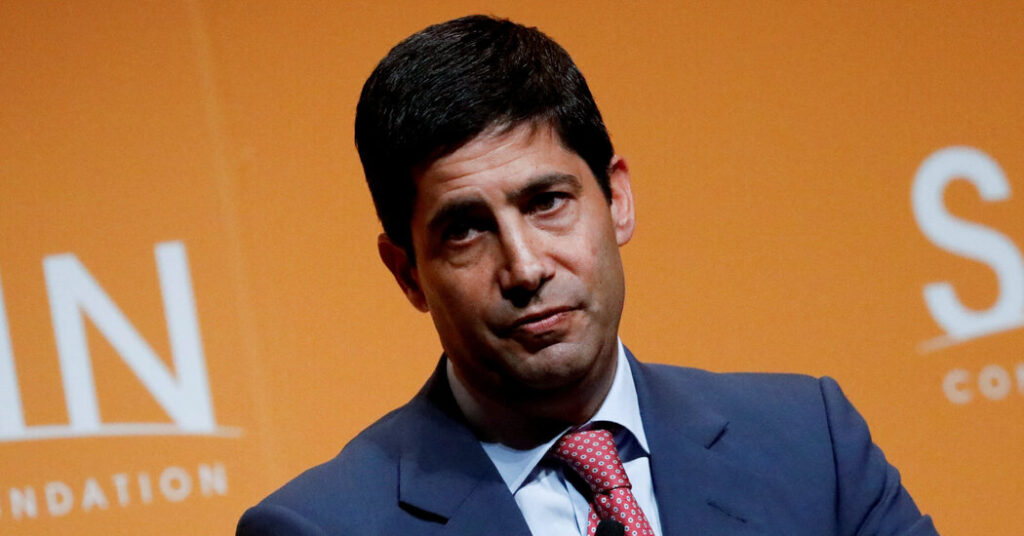
Kevin M. Warsh, then a junior at Stanford University, seemed aware of the brewing ill will.
He had just won a contentious election for chair of the student senate after a vote that some members felt was too hasty. Facing anxiety about the process and his ability to lead impartially, he quickly tried to provide some assurances.
“I will not be manipulated by political parties,” he told The Stanford Daily, the school’s student newspaper, in May 1991. “I do not have an agenda.”
Thirty-five years later, the onus is on Mr. Warsh once again to prove that he can run an institution under pressure — this time with implications far beyond the halls of student governance.
On Friday, President Trump announced that he planned to nominate Mr. Warsh, 55, to serve as the next chair of the Federal Reserve, capping a lengthy bake-off to replace Jerome H. Powell, whose term as Fed chair concludes in May.
Those who know Mr. Warsh, a former Fed governor, believe he is up to the task, bolstered by his talent for amassing support that has long been one of his signature strengths.
“He’s able to bring individuals together,” said John Cogan, a senior fellow at Stanford’s Hoover Institution who has known Mr. Warsh since his days as an undergraduate. “He knows where he stands on issues, but he also knows the importance of consensus and compromise to get a job done.”
Mr. Warsh still needs to be confirmed by the Senate, and Mr. Trump has not exactly greased the path. For months, the president has attacked Mr. Powell and the central bank for its reluctance to more aggressively lower interest rates. On Friday, Senator Thom Tillis, Republican of North Carolina, reiterated his refusal to confirm any nominee for the Fed until the Justice Department — which opened a rare criminal investigation into Mr. Powell this month — resolved the inquiry.
In naming Mr. Warsh, Mr. Trump praised him for being “central casting” and vowed that he would “go down as one of the GREAT Fed Chairmen, maybe the best” — descriptions that did not allay concerns that he would be able to guide the country’s monetary policy free of influence from the White House.
Mr. Warsh’s recent policy pivots have also raised questions from some lawmakers and economists about what he really believes is the best policy path forward and what he will do if the president presses him to pursue something out of step with the economic data. During his time as a Fed governor from 2006 to 2011, Mr. Warsh warned against cutting rates — including during the Great Recession — only to embrace race cuts once Mr. Trump returned to office.
Mr. Trump, in remarks at the White House, said he had not gotten a commitment from Mr. Warsh to cut rates, but expected that he would.
“He certainly wants to cut rates, I’ve been watching him for a long time,” Mr. Trump said.
Mr. Warsh, who was a front-runner to be Fed chair during Mr. Trump’s first term, has himself been a vociferous critic of the central bank, saying recently that “the credibility deficit lies with the incumbents that are at the Fed.”
But current and former colleagues of Mr. Warsh on Friday batted away anxieties that he would be anything but an unbending steward of the Fed’s primary goals of supporting stable prices and a healthy labor market.
“Kevin has the credentials, credibility and horsepower to be an excellent Fed chair, and I think that will be clear to everyone in the confirmation process and then as he actually executes the job,” said Randal K. Quarles, the Fed’s former vice chair for supervision, who first worked with Mr. Warsh during the George W. Bush administration.
“When you really understand what the Fed’s process is, he is a superb person to work that process because he knows how to work a process,” Mr. Quarles added.
Mr. Warsh grew up in Loudonville, N.Y., near Albany, where he attended public school, appeared in local television commercials and played competitive tennis.
When he expressed interest in going to Stanford, he recalled in a podcast interview in 2023, his guidance counselor’s initial response was to mistakenly ask if Mr. Warsh knew the university was in Connecticut.
“Through good fortune, I ended up out West,” Mr. Warsh said.
At Stanford, Mr. Warsh studied public policy and distinguished himself with his intelligence and inquisitiveness.
Condoleezza Rice, who was Mr. Bush’s secretary of state and is now the director of the Hoover Institution, said she met Mr. Warsh when he was a student in her class on international politics. He asked to come to her office hours, and she agreed.
“He was just somebody who was always probing,” she said. “You couldn’t just give him one answer. You always had to give him three or four.”
After being named senate chair, Mr. Warsh told The Stanford Daily that while he did not envision working in government he conceded that “politics may loom in the distant future.” Instead, he said, he hoped to become a trial lawyer.
After graduating from Harvard Law School in 1995, he joined Morgan Stanley and worked in the bank’s mergers and acquisitions department, where he helped structure deals and advised companies “across a range of industries, including manufacturing, basic material, professional services and technology,” according to a Fed website.
Under Mr. Bush, he served as an economic policy adviser and executive secretary at the National Economic Council.
When Mr. Bush nominated Mr. Warsh, then 35, to serve as a Fed governor in early 2006, he initially faced some skepticism from those who thought he was too young and did not have the relevant experience.
To help assuage the doubts, Senator Paul Sarbanes of Maryland, the ranking Democrat on the Senate Banking Committee, set up a meeting between Mr. Warsh and Paul D. Volcker, the famous former Fed chair, Mr. Warsh recalled in the podcast interview.
A star-struck Mr. Warsh asked Mr. Volcker about bank reserves and printing money before Mr. Volcker offered some advice. No. 1: “‘You have to get interest rates about right,’” Mr. Warsh said Mr. Volcker had told him. No. 2: “‘Make sure you look like you know what you’re doing.’”
Once confirmed, Mr. Warsh cemented his reputation as a collegial and deft policymaker, especially during the financial crisis of 2008-9.
With his deep ties to Wall Street, he helped to broker the sale of Bear Stearns to JPMorgan Chase and arrange the federal government’s bailout of American International Group, the insurance giant.
Carol Tomé, a former chair of the Federal Reserve Bank of Atlanta, said she had seen firsthand how Mr. Warsh promoted cooperation between the central bank and financial institutions.
“He did a masterful job of managing and serving as a liaison,” said Ms. Tomé, now the chief executive of UPS, where Mr. Warsh is a board member.
Randall S. Kroszner, a University of Chicago economist whose Fed nomination was considered at the same congressional confirmation hearing as Mr. Warsh’s, described him as an “extraordinarily skilled communicator and negotiator.”
Mr. Warsh left the Fed in 2011, in part because he opposed the central bank’s bond purchases that were intended to lower long-term interest rates and encourage bank lending. Since then, he has worked with the billionaire investor Stanley Druckenmiller and served as a senior fellow at the Hoover Institution.
He is married to Jane Lauder, daughter of Ronald Lauder, who is the heir to the Estée Lauder fortune. Mr. Lauder has known Mr. Trump since college and planted the idea in his mind of buying resource-rich Greenland.
Should he be confirmed as Fed chair, a process that is sure to be both lengthy and heated, Mr. Warsh would head the central bank at a particularly precarious time, amid concerns about its independence in the face of relentless attacks from the president.
One crucial constituency is Wall Street. Ushering in lower interest rates will be impossible without Wall Street’s buy-in.
Mr. Warsh will also have to show the rest of the world that he is a credible Fed chair, who steers monetary policy based on economic data and not political pressures.
Several of his former colleagues said they expected his skills as a smooth talker and consensus builder to come in handy, given how much of the job is centered on communicating with the public.
“He’s going to be very good at what is the key job of the Fed chair, which is to catalyze and then communicate a decision,” said Mr. Quarles, the former Fed vice chair. “He’s a good persuader.”
Sydney Ember is a Times business reporter, covering the U.S. economy and the labor market.
The post Kevin Warsh Has a Tough Job Ahead. It’s Not the First Time. appeared first on New York Times.