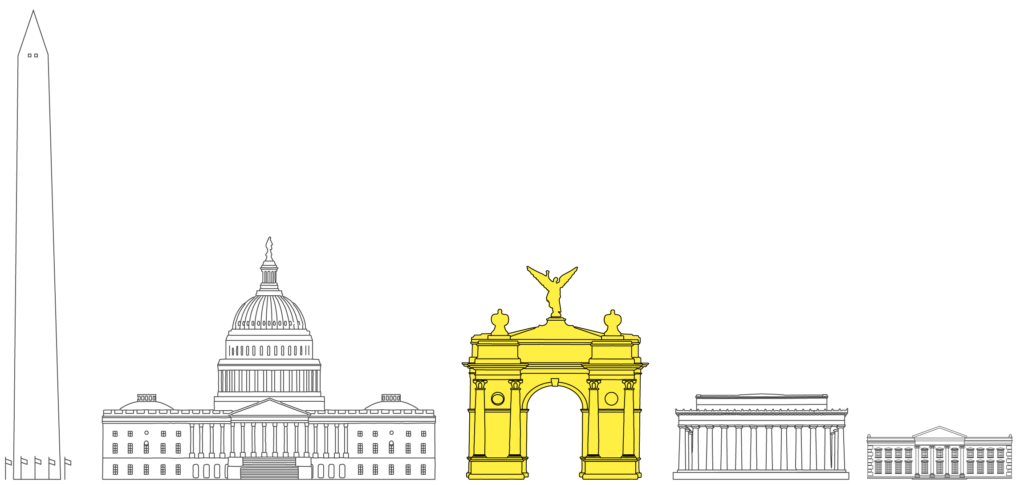
The White House stands about 70 feet tall. The Lincoln Memorial, roughly 100 feet. The triumphal arch President Donald Trump wants to build would eclipse both if he gets his wish.
Trump has grown attached to the idea of a 250-foot-tall structure overlooking the Potomac River, according to two people who spoke on the condition of anonymity to describe his comments, a scale that has alarmed some architectural experts who initially supported the idea of an arch but expected a far smaller one.
The planned Independence Arch is intended to commemorate America’s 250th anniversary. Built to Trump’s specifications, it would transform a small plot of land between the Lincoln Memorial and Arlington National Cemetery into a dominant new monument, reshaping the relationship between the two memorials and obstructing pedestrians’ views.
Trump has considered smaller versions of the arch, including 165-foot-high and 123-foot-high designs he shared at a dinner last year. But he has favored the largest option, arguing that its sheer size would impress visitors to Washington, and that ‘250 for 250’ makes the most sense, the people said.
Architectural experts counter that the size of the monument — installed in the center of a traffic circle — would distort the intent of the surrounding memorials.
“I don’t think an arch that large belongs there,” said Catesby Leigh, an art critic who conceived of a more modest, temporary arch in a 2024 essay — an idea that his allies championed and brought to the White House. Leigh also later recommended an architect, Nicolas Leo Charbonneau, who has been retained by the White House to work on the project.
Charbonneau did not respond to requests for comment.
The White House did not immediately respond to questions about the arch’s design, size and timeline for planned construction. Trump told Politico in December that he hoped to begin construction of the arch within two months. Memorial Circle, the plot of land that the president has eyed, is controlled by the National Park Service.
“The one that people know mostly is the Arc de Triomphe in Paris, France. And we’re gonna top it by, I think, a lot,” Trump said at a White House Christmas reception in December.
The Arc de Triomphe — already one of the world’s largest triumphal arches — measures 164 feet.
Washington does not have a triumphal arch, making it unusual among major cities that have built arches to commemorate wars and celebrate milestones, and some historians and civic leaders have long argued that such a monument is needed.
Rodney Mims Cook Jr., an Atlanta-based developer and president of the National Monuments Foundation, proposed a peace arch to Washington leaders in 2000 before the plans were withdrawn in the wake of the Sept. 11, 2001, terrorist attacks. Cook later built a monumental arch in Atlanta, the Millennium Gate Museum, intended to celebrate Georgia’s history.
Trump this month appointed Cook to the Commission of Fine Arts, a federal panel that would be set to review and approve the design of new monuments in Washington — including the president’s potential arch.
Trump on Jan. 23 also posted images on his Truth Social platform with no comment that depict three versions of a large triumphal arch, including one option with gold gilding — a hallmark of Trump’s construction projects. The White House did not immediately respond to questions about whether the images represent a new design for the arch, rather than previous concepts presented by Trump and Charbonneau that included a large Lady Liberty statue.
City planners have eyed the land around what is now Memorial Circle for more than a century. A 1901-1902 report overseen by the Senate Park Commission, which laid the groundwork to construct the National Mall and beautify much of the city’s core, appears to envision some sort of structure in the circle drawings show. Architect William Kendall in 1928 also presented plans to the Commission of Fine Arts to construct a memorial there.
Local historians and architectural experts have said that a large arch could change the relationship between several historic sites, including Memorial Bridge itself, which was intended as a bridge between North and South in the wake of the Civil War, and memorials for Lincoln and Confederate general Robert E. Lee.
“It’s a very somber corridor,” said John Haigh, the chair of Benedictine College’s architecture program, who visited Memorial Circle with his students last year to consider the arch project. “We discussed the gravity of putting an arch there,” particularly one intended to be triumphal.
The structure as planned could obstruct views of Arlington House, the former Lee estate that sits on a hillside in Arlington National Cemetery.
“I would be very concerned about the scale,” said Calder Loth, a retired Senior Architectural Historian for the Virginia Department of Historic Resources, warning that a 250-foot-high arch could alter pedestrians’ views as they approach Arlington National Cemetery from Washington. “It would make Arlington House just look like a dollhouse — or you couldn’t see it all, with the arch blocking the view.”
They also cautioned that, barring major changes to the circle, it could be difficult for pedestrians to visit a potential monument there, given the busy motor traffic.
Loth also invoked the vantage point from Arlington National Cemetery, where visitors often look across the river toward the Lincoln Memorial and the capital beyond — a view he said the proposed arch would reshape.
“How does it impact the panorama of Washington?” Loth said, invoking a question that he said should guide designers of monuments. “What is supposed to be doing the speaking?”
Leigh initially proposed a 60-foot arch that could pop up as a temporary structure to mark America’s 250th. Trump instead wants a permanent arch, more than four times larger, funded with leftover private donations to his White House ballroom project, which he has said could cost about $400 million. Publicly identified donors to the ballroom project, such as Amazon, Google and Lockheed Martin, collectively have billions of dollars in contracts before the administration. (Amazon founder Jeff Bezos owns The Washington Post.)
Any construction plan for the arch would likely need to go through several review panels and potentially require the sign-off of Congress, given laws around constructing new monuments in Washington.
Trump’s interest in enlarging the arch mirrors his desire to expand the White House ballroom, which last year sparked clashes with James McCrery II, the architect initially tapped for the project. Shalom Baranes, the architect now leading that work, told federal review panels this month that White House officials have halted plans to make the ballroom even larger.
Leigh suggested a compromise location that could allow Trump his large monument without imposing on other structures.
“If you’re going to build an arch that big, you should build it in another part of town and one possible site that comes to mind is Barney Circle,” Leigh said, referencing a site in Southeast Washington next to Congressional Cemetery, overlooking the Anacostia River. “There’s nothing around it competing with it.”
The post Trump wants to build a 250-foot-tall arch, dwarfing the Lincoln Memorial appeared first on Washington Post.