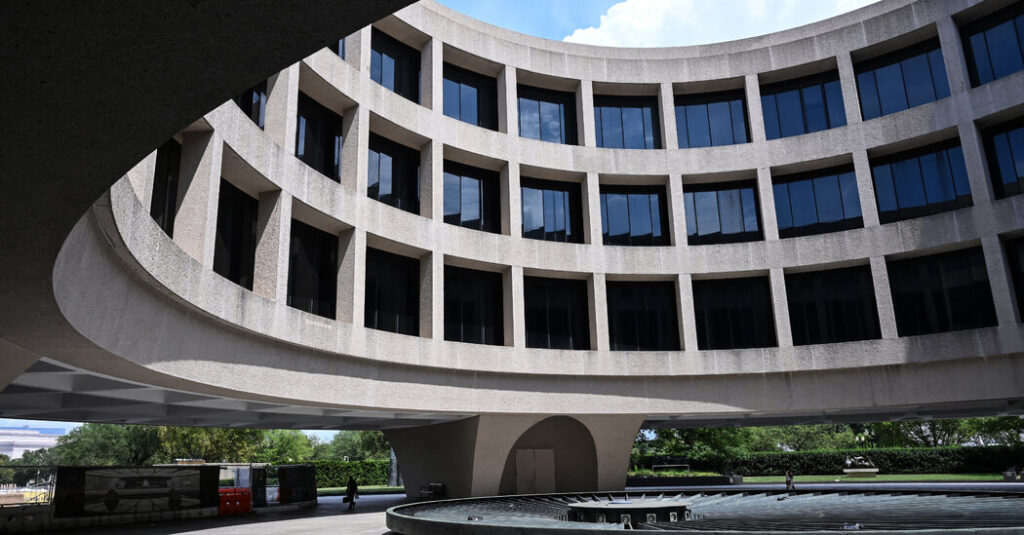
With its recognizable Brutalist-doughnut architecture, the Hirshhorn Museum and Sculpture Garden is the Smithsonian Institution’s redoubt for modern and contemporary art on the National Mall in Washington.
As part of the Smithsonian, it is meant to be a museum for all of America. And to underscore that national mission — and to emphasize that modern and contemporary art need not be exclusive to liberal metropolitan coastal elites — the Hirshhorn has decided to loan scores of artworks from its large collection to smaller museums in all 50 states, red and blue.
“We asked ourselves, how can we do more to make the Hirshhorn the national museum of modern and contemporary art,” said Melissa Chiu, the Hirshhorn’s director. “We want to help museums across the country have more access.”
“It’s Georgia O’Keeffe, Thomas Eakins, Joan Mitchell, Calder,” Chiu added. It’s also Wayne Thiebaud, Willem de Kooning, David Hockney, Stuart Davis and Yoko Ono, and all currently in storage, from the museum’s collection of 13,000 artworks.
The program is the Hirschhorn’s contribution to celebrating the nation’s 250th anniversary this year. It’s part of the broader Smithsonian plans for the Semiquincentennial, marking the birthday of the Declaration of Independence.
The Smithsonian Asian Pacific American Center is staging the exhibition “How Can You Forget Me: Filipino American Stories.” Lonnie G. Bunch III, the Smithsonian Secretary, is co-curating the show, “American Aspirations” at the Castle, the institution’s historic headquarters: Articles the show is considering featuring include Thomas Jefferson’s desk and the gold nugget that triggered the California gold rush. The Hirshhorn will also open its sculpture garden, which is being renovated, for a partial viewing for Semiquincentennial visitors before its official reopening in the fall.
The museum is working on the loan project with Art Bridges Foundation, a nonprofit founded by the Walmart heir Alice Walton in 2017 to help lend American art to public institutions, especially in underserved regions.
Art Bridges now has about 300 museum partners across the country, from the Met to much smaller institutions, like the Doris Ulmann Galleries at Berea College in Kentucky. The loan program with the Hirshhorn is by far its largest to date. Together, Art Bridges and the Hirshhorn are making available an initial 204 artworks, many by towering figures.
Most big museums have only a small proportion of their works on show at any given time — in the Hirshhorn’s case, just 2 percent.
Over the past year, the Trump administration has accused Smithsonian museums of political bias, and has announced a comprehensive audit of their contents and plans. The Hirshhorn is among those under scrutiny, but Chiu said that the loan program was not any kind of political response to the president’s criticisms.
Instead, she said, the idea was born about three years ago after the coronavirus pandemic, when the discussion centered on how to expand visitor numbers; the approaching 250th birthday celebrations gave it greater impetus. “Our idea was to say, ‘OK, we are in D.C. but actually we are going to have a presence across the nation,’” she said.
Aware of the lack of access to modern and contemporary art in some regions, the Hirshhorn and Art Bridges were most eager to find partners willing to take part in states in the center of the nation. But as they have publicized the offer, they have found museums able to take part all over the country. So far, museums in 46 states have signed up.
“We did have a focus in the center of the country because we know there are fewer contemporary art museums in certain states than others,” Chiu said.
Anne Kraybill, the Art Bridges chief executive, said it has been her job to find participants in every state and Puerto Rico, though in some states art museums are less plentiful than in others.
“These communities deserve access to really great works of art,” she said.
Kraybill said collaboration will help the Hirshhorn carry out its mission. “I hope people really do see an institution serving the whole country,” she said. “It’s not just for D.C. and folks visiting D.C., but a national institution, that’s really important.”
Participating museums get a checklist of the pieces the Hirshhorn is initially open to loaning — from early modernists to Jackson Pollock, Mark Rothko and Ed Ruscha, and the latest video installation.
Chiu said the Hirshhorn’s collection covers a 100-year period and, perhaps surprising to some, is strong in works by artists such as Thomas Eakins, Thomas Hart Benton and John Singer Sargent.
The participating museums themselves will identify their needs and apply. Loans will likely involve more than one work, and last for three to five years, longer than the typical 12-week loan period, Chiu said. Art Bridges and the Smithsonian pay for shipping, insurance and educational programming around the art.
The Des Moines Art Center in Iowa is one of the institutions taking part. Founded in 1948, it was the first art museum in the United States to open after World War II. It has some impressive works among its 6,800 — Giacometti, Brancusi, Cecily Brown, Matisse’s “Dame à la robe Blanche (Woman in a White Dress)” and Francis Bacon’s “Study After Velazquez’s Portrait of Pope Innocent X.”
But, said Kelly Baum, director and chief executive, “We don’t have a lot of depth and we have gaps.”
“We have the Francis Bacon but not a lot of other Francis Bacons,” she said. “We have a great Jasper Johns, but I wish we had more.”
On her own “heavily noted and annotated and flagged list” from the Hirshhorn, she said, she has identified Abstract Expressionists like Alma Thomas and Jackson Pollock; early 20th century modernists like Joseph Stella; and Arthur Jafa’s “Love is the Message, the Message is Death” from 2016, a seven-minute video installation of Black life in America.
“We are one of the very few art museums in the whole state,” Baum said. “There are only a handful of art museums serving millions of people.” The program “allows us to introduce to the public works of art that they wouldn’t know otherwise.”
The Boise Art Museum (BAM) is the only nationally accredited collecting art museum in the state of Idaho, said Melanie Fales, its executive director. A small museum with an operations budget of about $2 million a year, it was founded in 1932 during the Great Depression. It has about 4,000 artworks, with a focus on American art from the 19th century onward. It has strengths, for example in ceramics, and works by artists like Richard Diebenkorn and Robert Motherwell.
“This is an opportunity for us to share artworks with our community that we would not otherwise quite frankly be able to afford to bring to Boise,” Fales said. Visitors will be able to dwell in front of the artworks, “rather than if they had to travel to Washington, D.C., to see them briefly and then leave.”
BAM, which has about 50,000 visitors a year, is looking at borrowing between one and seven works. High on the list:
more canvases by Wayne Thiebaud, known for his colorful culinary paintings. Loans of works by major female artists like Helen Frankenthaler and Joan Mitchell could help Fales with a theme she has been trying to emphasize: “This is a great opportunity to broaden our story of who are the important artists in American art history and in particular who are important women artists,” she said.
“It’s fun to dream and see what we might want to do,” she said of the Hirshhorn’s offerings.
But she accepts that there’s going to be competition. She will submit her request soon and then she’ll just have to wait.
“It’s lottery time,” she said. “We learn, after everyone gets their request in, what we get.”
Graham Bowley is an investigative reporter covering the world of culture for The Times.
The post Art for All: A Smithsonian Museum Spreads Its Bounty for America’s 250th appeared first on New York Times.