When President Trump upended global trade with his “Liberation Day” tariffs last year, China could have seized the moment to win over bewildered U.S. allies and partners with a charm offensive. Instead, it did the opposite.
Beijing threatened countries that dared to cooperate with the Trump administration in restricting trade with China. And when China unveiled a plan to choke exports of its critical supplies of rare earths, it targeted the world, not just the United States.
It was a high-stakes gamble by President Xi Jinping of China. Rather than provide relief to spurned American allies, Beijing wanted to compound their dilemma, analysts say, so that countries unnerved by Washington would learn that crossing China also carried economic pain.
The calculation was that those countries would eventually seek closer ties to China to hedge against the United States, and that when they did so, they would be more accommodating of Beijing’s interests.
That bet is now paying off with the procession of European and Canadian leaders arriving in China seeking to deepen ties with the world’s second-largest economy — even as Beijing has conceded little on the issues that once divided them, like human rights, espionage, election interference and unbalanced trade. (This outreach has drawn a sharp rebuke from Mr. Trump, who warned on Friday that it was “dangerous” for Britain and Canada to look to China as the answer to their economic woes.)
“China chose to accentuate rather than alleviate the pressure on the allies to force them to tilt closer to Beijing’s position,” said Jonathan Czin, a researcher at the Brookings Institution who previously worked at the C.I.A. analyzing Chinese politics. “Beijing’s patient policy now seems to be paying dividends.”
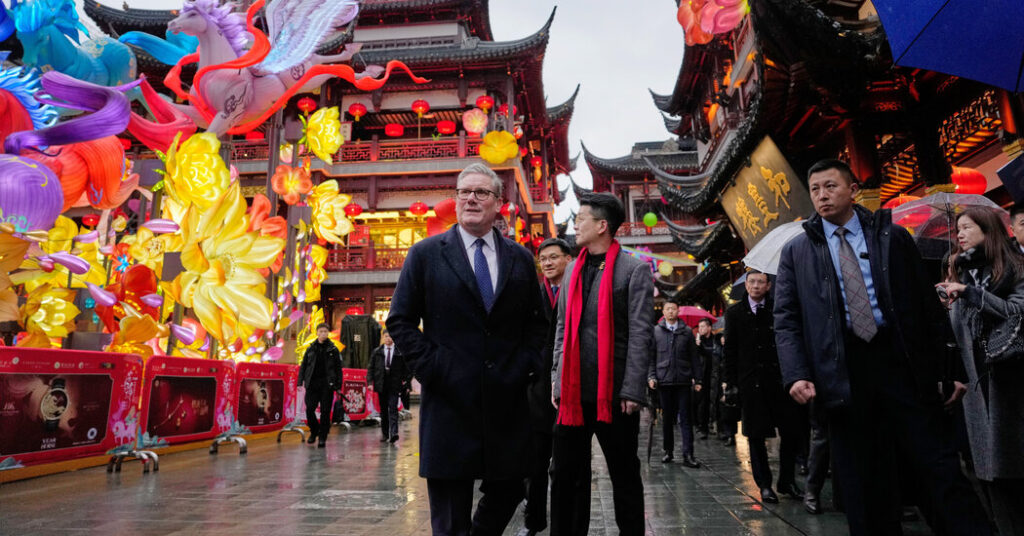
That was underscored by Prime Minister Keir Starmer of Britain, who reversed years of frosty relations on a visit to China this week, the first by a British leader since 2018.
Mr. Starmer made clear that his priority was cutting business deals while tiptoeing around contentious issues like the imprisonment of the Hong Kong democracy activist Jimmy Lai, a British citizen. Critics of Mr. Starmer say he also caved to Beijing when his government recently approved a new Chinese mega-embassy in London despite concerns that it would enable China to ramp up spying.
Similarly, Prime Minister Mark Carney of Canada arrived in Beijing this month as the first Canadian leader to travel to China in almost a decade. He sought a “pragmatic” reset with a country that has imprisoned Canadian nationals, meddled in Canada’s elections and dressed down its former prime minister.
Mr. Carney announced a “new strategic partnership” with China, agreed to cut tariffs on a small number of Chinese electric vehicles and made clear that Canada was willing to break ranks with the United States for its economic survival.
“Beijing has played this all extremely well, much better than they could have reasonably expected at this time last year,” Mr. Czin added.
Some Chinese analysts argued that China’s refusal to budge in the face of U.S. pressure commanded a certain geopolitical deference.
America’s allies need to “diversify the risk of their dependence on the United States,” said Wang Yiwei, a professor of international relations at Renmin University in Beijing. “Naturally, they chose China.”
“China’s might has won respect,” he said. “China’s stance has won respect.”
Beijing has been quick to capitalize on this opening. Mr. Trump’s aggressive maneuvers — like tariffs and military strikes in Venezuela, the Middle East and Africa — have allowed Beijing to cast itself, however improbably, as a defender of the rules-based order, the global trading system and a leader of the Global South.
China has long sought to drive a wedge between the United States and Europe. This campaign has been helped by Mr. Trump’s threats to seize Greenland, which have rattled the foundations of the North Atlantic Treaty Organization, the security alliance that Beijing has long considered one of America’s greatest strengths.
Since December, when President Emmanuel Macron of France toured China (and was mobbed by adoring students at a university in Sichuan Province), Western leaders have been lining up to seek an audience with Mr. Xi, while he holds court as the indispensable partner in an unstable world. In addition to the prime ministers of Canada and Britain, visitors have included leaders from Ireland, South Korea and Finland, and Chancellor Friedrich Merz of Germany is expected to arrive in the coming weeks.
“As Trump widens divisions between America and its traditional partners, China is sitting back and collecting the diplomatic windfall,” said Ryan Hass, the director of the John L. Thornton China Center at the Brookings Institution.
“The growing rift between America and its traditional partners gives Beijing more margin for error in its diplomacy with these countries,” Mr. Hass continued. “Beijing does not feel it needs to make concessions to pull these countries closer, it just needs to remain predictable and firm on its top goals.”
That could make it more difficult for Europe and other Western allies to push back on matters that are important to them, like China’s support for Russia in the war in Ukraine and China’s global trade surplus, which reached a record $1.2 trillion last year.
It could also leave Taiwan, the self-governing island claimed by Beijing, more isolated and exposed to Chinese coercion. Already, two Canadian members of Parliament cut their visits to Taiwan short at their government’s request days before Mr. Carney was set to embark on his trip to China.
“Beijing will increasingly use whatever it has to make sure that countries do not speak or act out of line on these trigger issues, especially when it comes to Taiwan,” said Yanmei Xie, a senior associate fellow at the Mercator Institute for China Studies and a senior adjunct researcher at RAND’s China Research Center.
Ms. Xie argued that Canada and China have effectively swapped roles. Canadian prime ministers used to arrive in Beijing dangling offers of nuclear energy technology and other advanced industrial products. This time, Mr. Carney traded a foothold for Chinese electric vehicles in Canada for the easing of Chinese tariffs on Canadian canola.
“It’s a poignant display of the techno-industrial rise of China and the technical industrial decline of the West,” Ms. Xie said.
The parade of Western leaders has provided a propaganda win for China, masking a domestic reality of an economy in the doldrums and a military leadership hollowed out by political purges. “Xi leads China’s diplomacy to usher in new chapter in turbulent world,” one headline in a state media report said.
“The applause for China at Davos is sincere,” said another headline, referring to the World Economic Forum, a gathering this past month in Switzerland of world leaders and corporate executives.
Still, some Chinese analysts view the rebalancing by Western countries as a short-term pivot rather than an enduring change of heart. The United States, they said, has long underwritten the global trading system that allowed its allies and partners to thrive. China, on the other hand, has frustrated many countries by dumping exports onto their markets and using state subsidies to tilt the playing field in favor of Chinese firms.
“This is purely a short-term tactical remedy, not a reorientation toward China,” on the part of the West, said Shen Dingli, an international relations expert based in Shanghai.
David Pierson covers Chinese foreign policy and China’s economic and cultural engagement with the world. He has been a journalist for more than two decades.
The post U.S. Allies Are Drawing Closer to China, but on Beijing’s Terms appeared first on New York Times.