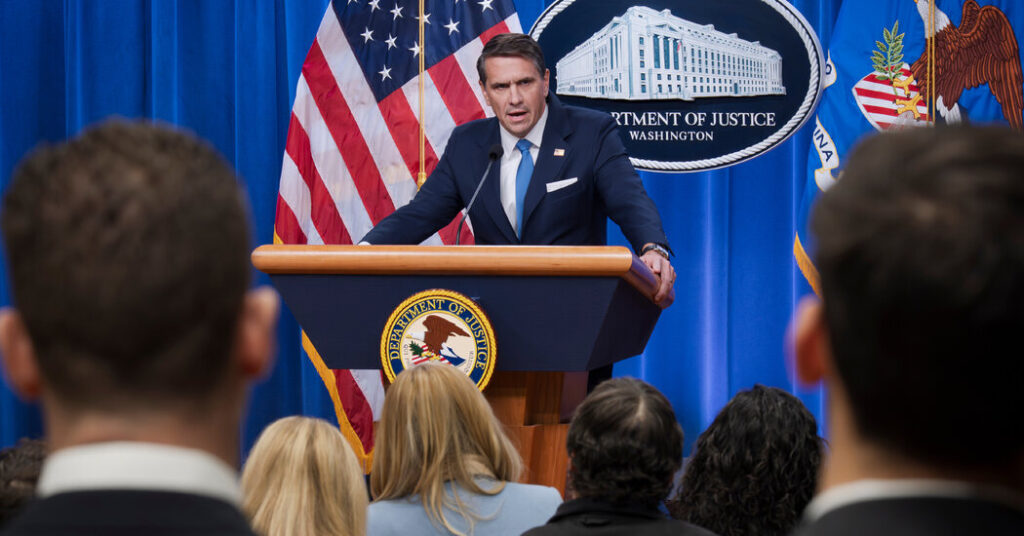
The Justice Department on Friday finished its belated release of investigative files related to Jeffrey Epstein, the convicted sex trafficker, though officials conceded that the disclosure of more than three million pages was unlikely to put to rest the suspicions that surround the case.
That was quickly reinforced by Democratic lawmakers and some of Mr. Epstein’s victims, who had forced the Trump administration to disclose the documents related to the case. They asserted that the massive tranche still fell short of a full accounting, and that the documents revealed personal information about people Mr. Epstein abused.
Hundreds of prosecutors have spent the last two months reviewing more than six million pages potentially related to the case. As of Friday, around 3.5 million pages had been published in response to a law passed by Congress last November. The latest files also included 2,000 videos and 180,000 images.
The files appeared to contain at least 4,500 documents that mention Mr. Trump, according to an initial review by The New York Times. One was a summary F.B.I. officials assembled last summer of more than a dozen tips from members of the public involving Mr. Trump and Mr. Epstein. Mr. Trump has denied any wrongdoing in connection with the disgraced financier.
“We did not protect President Trump,” Todd Blanche, the deputy attorney general, told reporters on Friday. “We didn’t protect or not protect anybody.”
Mr. Blanche said that many of the pages that were reviewed were duplicates, and that roughly 200,000 pages were redacted or withheld after Justice Department lawyers determined that they were protected by various legal privileges, including attorney-client material. One small tranche of papers, from a law firm involved with an Epstein-related case, still has to be dealt with, Mr. Blanche said.
“I think there’s a hunger or a thirst for information that I do not think will be satisfied by the review of these documents,” he added. “There’s nothing I can do about that.”
Hours after the release of the documents, a group of 18 survivors of Mr. Epstein’s abuse said in a joint statement that the disclosure did not do enough to hold his enablers accountable.
“Once again, survivors are having their names and identifying information exposed, while the men who abused us remain hidden and protected. That is outrageous,” they said, without specifying what material had been revealed. “This is not over. We will not stop until the truth is fully revealed and every perpetrator is finally held accountable.”
Justice Department officials said that the department redacted images of every woman in the files except for Ghislaine Maxwell, Mr. Epstein’s longtime companion and associate who has been convicted of sex trafficking. Any information about other victims that was inadvertently exposed would be swiftly removed, they said.
The demand for the full release of documents grew to a crescendo last year, after the Trump administration teased the release of the investigative files and a “client list” related to Mr. Epstein’s sexual abuse of teenage girls. When the Justice Department backtracked last July, declaring that there was no such client list and that no new documents would be released, Democrats and others accused the administration of a coverup.
Congress ultimately passed a law requiring the release of the files after Mr. Trump, under intense political pressure, agreed to sign it.
Mr. Epstein, who was a friend to many rich and powerful people, including Mr. Trump, was accused of sexually abusing and trafficking dozens of women and girls. He reached a plea deal with state prosecutors in 2008 for soliciting prostitution from a minor — a lenient agreement that drew criticism years later.
He was arrested again by federal authorities in 2019. Less than a month later, he was found dead in his jail cell. Mr. Epstein’s death, which was ruled a suicide, fueled a host of suspicions about the investigations into his crimes and about his powerful friends.
Among the documents released on Friday were unsubstantiated tips about Mr. Epstein received by the F.B.I.’s national hotline, including some that made accusations against Mr. Trump. But the files did not make clear when the tips had been offered, or if the F.B.I. had found anything of merit.
Many of the emails provide a window into Mr. Epstein’s chummy interactions with a wide array of influential figures long after he had been accused of sexual misconduct, including Elon Musk and Howard Lutnick, now the president’s commerce secretary.
Mr. Epstein and Mr. Musk exchanged multiple messages between 2012 and 2014, comparing their schedules to find time to meet in Florida or in the Caribbean.
“If you find some time, come visit me on my island” in the Caribbean, Mr. Epstein wrote to Mr. Musk on Sept. 25, 2012, urging the billionaire to “bring your friend or friends.”
“Sounds good, will try to make it,” Mr. Musk replied. In a social media post last September Mr. Musk wrote that Mr. Epstein “tried to get me to go to his island and I REFUSED.”
Mr. Musk did not respond to a request for comment.
In 2012, Mr. Lutnick planned a trip to the island, according to the documents released on Friday. The planned visit came years after Mr. Lutnick has said he severed ties with Mr. Epstein.
The records show that Mr. Lutnick sent an email to Mr. Epstein saying that he had a group of people — including his wife, children and another family — who were visiting the Caribbean. He asked where Mr. Epstein was located and whether they could visit for a meal. They eventually settled on plans for a lunch gathering.
Reached by phone on Friday, Mr. Lutnick said he could not comment about the island visit because he had not seen the latest Epstein documents. “I spent zero time with him,” Mr. Lutnick said. He then hung up.
The documents show that Mr. Lutnick and Mr. Epstein’s lives continued to overlap in more recent years. In 2017, Mr. Epstein contributed to a charity dinner honoring Mr. Lutnick. In 2018, they exchanged emails that appeared to discuss joining forces to battle construction plans by The Frick Collection, a museum across the street from their homes.
On Friday, Representatives Thomas Massie, Republican of Kentucky, and Ro Khanna, Democrat of California, who co-sponsored the law requiring the release of the files, formally requested a meeting with the Justice Department to review all of the unredacted documents.
In a letter to Mr. Blanche, a copy of which was viewed by The Times, the lawmakers cited concerns “regarding the scope and consistency of redactions” in the documents that had been released so far, including in so-called 302 reports documenting victim statements.
Democrats also seized on Mr. Blanche’s acknowledgments that the department had withheld files. They suggested that he was continuing to mislead the public, pointing to the disparity between the six million pages originally collected and the 3.5 million pages that had been released.
Mr. Khanna said that the gap “raises questions as to why the rest are being withheld.”
Senator Chuck Schumer, Democrat of New York and the minority leader, accused Attorney General Pam Bondi of failing to adhere to the law, in part because the final release of the files came 42 days after the Justice Department had been required to release them.
“Every member of this body voted that all the Epstein files should be released,” Mr. Schumer said on the Senate floor on Friday. “We are not satisfied that the law is being complied with. We believe it is not.”
Democrats on the House Oversight Committee, which issued a subpoena for federal prosecutors’ material in August, said that the Justice Department was still required to provide the panel with more material, including files it had already redacted or withheld because of privilege.
“The subpoena requires the full, unredacted Epstein files to be turned over to the committee, including any classified materials and information tied to ongoing investigations, while still protecting the identities of survivors and potential victims,” Representative Robert Garcia of California, the committee’s top Democrat, said in a statement.
Mr. Blanche said that no classified material was withheld, because no classified material related to Mr. Epstein was in the government files. He also said that members of Congress would be allowed to review unredacted copies of files that were released partially redacted.
Reporting was contributed by Michael C. Bender, Sharon LaFraniere, Ryan Mac, Ana Swanson, Nicholas Confessore and Michael Rothfeld.
Devlin Barrett covers the Justice Department and the F.B.I. for The Times.
The post Release of Three Million Epstein Pages Falls Short, Survivors Say appeared first on New York Times.