Federal agents arrested the former CNN anchor Don Lemon on Thursday, claiming he and others who entered a church in St. Paul, Minn., last week during an anti-ICE protest had violated a federal law prohibiting the obstruction of abortion clinics and places of worship.
Joining a small group of activists who had streamed into the church to denounce an Immigration and Customs Enforcement official who serves as a pastor of the church, Mr. Lemon has maintained that he was present in his capacity as a journalist to document the confrontation.
Mr. Lemon was indicted by a federal grand jury. His arrest came after a federal magistrate judge concluded last week that there was insufficient evidence that Mr. Lemon had violated the law. His arrest raised profound concerns about press freedom and First Amendment activity. But it also demonstrated the ways the Trump administration has repurposed a 1994 law, which was previously used more often to shield women’s health clinics from disruptive blockades.
What is the FACE Act?
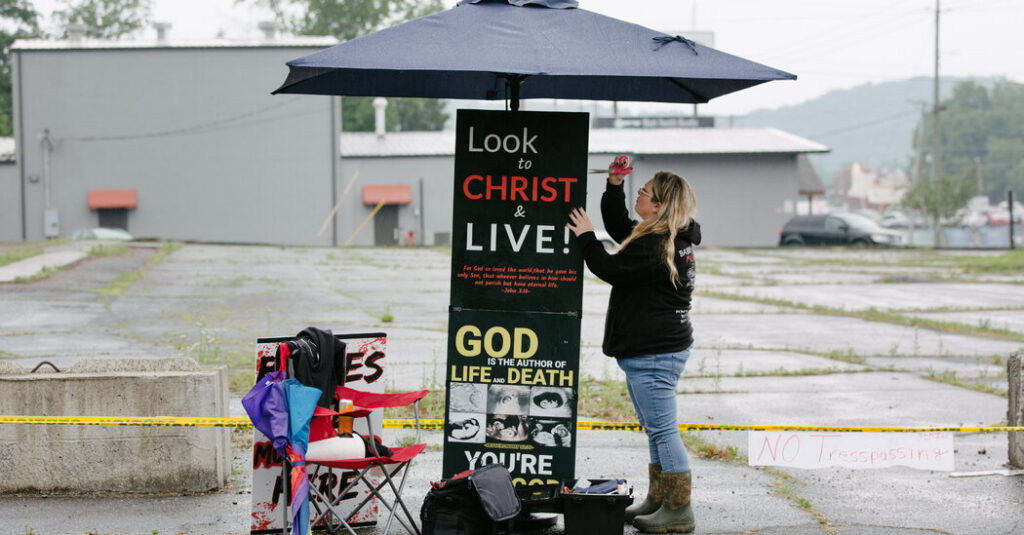
The Freedom of Access to Clinic Entrances Act of 1994 is a law signed by former President Bill Clinton that makes it a federal crime to physically obstruct entry to clinics offering reproductive health services.
The law was drafted as a response by Congress to a Supreme Court decision in 1993, which held that women seeking abortions were not a protected class that could be shielded from confrontational protest activity under existing federal statutes. The court had ruled 6 to 3 that an 1871 law banning threatening vigilantism by the Ku Klux Klan against Black residents could not be extended to prohibit disruptive demonstrations at abortion clinics.
The FACE Act addressed the legislative gap by specifically protecting access to reproductive health services. At the same time, it included a provision extending similar protections to people seeking to enter a house of worship “to exercise the First Amendment right of religious freedom.”
By design, the law has typically been used to charge individuals whose conduct veered into intimidation or interfering generally with medical practitioners or people seeking treatment. Nonviolent and first-time offenses are usually charged as misdemeanors, according to the law, but more serious cases involving bodily injury can be charged as a felony with a penalty of up to 10 years in prison.
How has the FACE Act been used previously?
Under President Joseph R. Biden Jr., a number of demonstrators were found guilty of violating the law while picketing or obstructing the entrance to reproductive health centers.
In 2024, Lauren Handy, a prominent anti-abortion activist, was sentenced to 57 months in prison for her role in a blockade of a center in Washington, D.C., which involved making a false patient appointment to enter the clinic. In another case that year, Bevelyn Beatty Williams was sentenced to 41 months after a series of incidents in Florida, Tennessee, Georgia and New York, in which she tried to prevent patients and medical staff members from entering various clinics.
Ms. Handy was pardoned by President Trump in 2025, on his fourth day in office, just days before the annual anti-abortion March for Life rally.
Trump Administration: Live Updates
Updated
- Senate passes deal to fund government and negotiate ICE limits.
- A judge weighs Trump’s removal of slavery markers from George Washington’s house.
- Some Republicans lament the spending deal Trump has blessed.
Last year, the Justice Department used the FACE Act after heated demonstrations at an event in a synagogue in West Orange, N.J.
Pro-Palestinian protesters outside the synagogue had clashed with pro-Israel counterprotesters, resulting in violent exchanges and the arrest of two pro-Israel demonstrators who were charged with aggravated assault.
The Justice Department charged members of the pro-Palestinian groups with violations of the FACE Act, moving to bar them from protesting outside houses of worship and seeking to fine them tens of thousands of dollars.
“Those who target houses of worship and violate our federal laws protecting people of faith are on notice that they will face the consequences,” Harmeet K. Dhillon, the head of the Justice Department’s civil rights division, said at the time.
The Trump administration has simultaneously substantially scaled back its use of the law in cases involving health clinics. A Justice Department memo sent out last year advised that “future abortion-related FACE Act prosecutions and civil actions will be permitted only in extraordinary circumstances.” And federal prosecutors under Mr. Trump moved last year to drop pending cases involving blockades of clinics from before the president’s second term.
First Amendment overlap
Since its inception, the FACE Act has run into challenges from anti-abortion activists who argued it infringed on their freedom of speech and right to lawfully assemble.
Throughout the 1990s, the law withstood a number of legal challenges. At least four federal appeals courts have upheld FACE’s constitutionality.
The Supreme Court has not heard a direct challenge to the FACE Act but it has declined to take up certain cases involving parallel issues. Last year, the Supreme Court declined to hear an appeal opposing protest buffer zones around abortion clinics, leaving in place some restrictions on how close to an entrance demonstrators could stand.
A vastly different use
Republican lawmakers and conservative and religious groups have pushed for several years to defang or even repeal the FACE Act because of its use against people protesting abortion on religious grounds. At the same time, others have called for a beefed-up use of the law in cases involving places of worship, with Republicans in Congress petitioning the Justice Department under Mr. Biden to place a heavier emphasis on protests outside churches.
What was Don Lemon charged with?
Mr. Lemon and eight others were charged with one count of violating the FACE Act on Friday. They were also charged with conspiring to “injure, oppress, threaten or intimidate any person” exercising their freedom of religion.
In the indictment, the Justice Department claimed that the demonstrators in the group had poured into the church shouting at both the pastor and the congregants, including children, calling them “nazis” and referring to the church as “the house of the devil.” The indictment claimed that Mr. Lemon refused to leave after being asked to exit the church by the pastor and that the demonstrators blocked the pastor in while Mr. Lemon “peppered” him with questions.
Zach Montague is a Times reporter covering the federal courts, including the legal disputes over the Trump administration’s agenda.
The post What to Know About the ‘Abortion Clinic’ Law Being Used to Charge Don Lemon appeared first on New York Times.