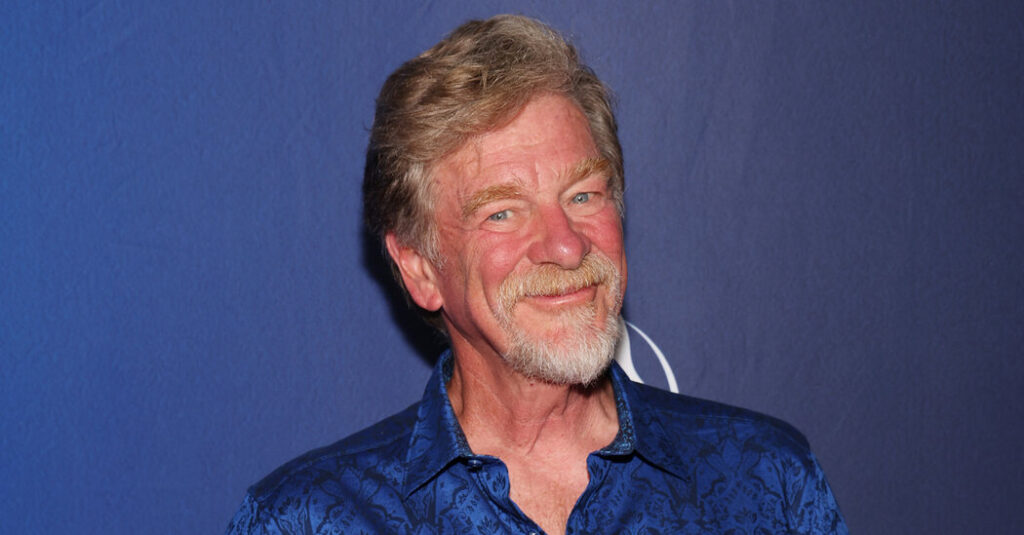
Roger Allers, who was co-director of the 1994 megahit movie “The Lion King” — a high point in Disney’s renaissance in animation that began in the late 1980s — and who then pivoted to help turn the film into a Tony-winning musical, died on Jan. 17 at his home in Santa Monica, Calif. He was 76.
His daughter, Leah Allers, said the cause was a heart aneurysm.
“In many ways, Roger, whose favorite Disney film was ‘Peter Pan,’ was very much like Peter himself,” said Rob Minkoff, Mr. Allers’s co-director on “The Lion King,” “eternally youthful, filled with a sense of adventure, playful, and always brimming with love and laughter.”
Mr. Allers established himself as a skillful filmmaker in the animated musical “Oliver & Company” (1988), his first film for the Walt Disney Studios, as head of the story team. He then burnished that reputation over the next few years working on classics like “The Little Mermaid,” “Beauty and the Beast” and “Aladdin.”
“I first worked with Roger on ‘The Rescuers Down Under,’” Thomas Schumacher, who produced that 1990 animated film, said in an interview. “He had that thing — he was extraordinarily visual, had a great story sense and a beautiful design sense.”
Mr. Allers’s success as a storyboard artist and story developer for Disney led to his assignment to direct his first film, “The Lion King,” with Mr. Minkoff.
A musical drama — leavened with comic relief — “The Lion King” is set in the kingdom of Pride Lands, which is ruled by Mufasa (voiced by James Earl Jones). His nefarious brother, Scar (Jeremy Irons), who wants to rule the kingdom, provokes a wildebeest stampede that kills Mufasa as he tries to save his young cub, Simba (Matthew Broderick). Scar persuades Simba that he is at fault for his father’s death. As an adult, Simba confronts Scar.
During the film’s production, Mr. Allers and Mr. Minkoff acted out the storyboards and performed songs like “Hakuna Matata” for top Disney executives.
“They were like two little Mr. Broadways,” Irene Mecchi, one of the film’s writers, said in an interview. “We called them the Don Hahn Players,” a reference to the film’s producer.
Mr. Allers and Mr. Minkoff divvied up the directing, each man taking scenes that “really spoke” to him, Mr. Allers said in an interview on the film’s Blu-ray digital disc release in 2011. Mr. Allers’s scenes included ones that featured the songs “Can You Feel the Love Tonight” and “I Just Can’t Wait to Be King.”
Mr. Minkoff recalled Mr. Allers restructuring the music sung on one of the demo tapes by Elton John, who wrote five songs for the film with Tim Rice.
“‘Hakuna’ had a very long intro that didn’t work,” Mr. Minkoff said, “and Roger said, ‘Let’s start with some dialogue and go into the song that way.’”
The film grossed nearly $1 billion worldwide. Mr. Allers then shifted to adapting it for the Broadway stage.
Roger Charles Allers was born on June 29, 1949, in Rye, N.Y., and grew up in Scottsdale, Ariz. His father, George, was an equestrian, and his mother, Shirley (Williams) Allers, ran the home.
After seeing “Peter Pan” at around age 4, he got a package of glitter sold by Disney, emptied its contents into his slippers, dived off the back of a couch and cried, “I can fly!” he told The Los Angeles Times in 1994. He broke his arm in the fall.
Roger dreamed of working for Walt Disney himself but when Mr. Disney died in 1966, “I was crushed and thought I had missed my chance,” he said in the Blue-Ray interview.
After earning a Bachelor of Fine Arts degree at Arizona State University in 1971, Mr. Allers spent two years in Greece; during that sojourn, he met his future wife, Leslee Hackenson, in Crete. For a time, they lived in a cave and sold paintings and crafts that they made to earn money for bread, yogurt, honey and other supplies.
After returning to the United States, Mr. Allers audited animation courses at Harvard and was hired by Steven Lisberger, an independent animation director.
Mr. Allers’s projects for Mr. Lisberger included the lion sequences for the 1980 animated film “Animalympics,” which was made for NBC Sports’ broadcast of the Summer Olympics that year in Moscow (Games that the United States ended up boycotting) and some of the storyboards that helped persuade Disney to produce “Tron,” a 1982 science fiction thriller, directed by Mr. Lisberger, which mixed live action and computerized imagery.
“Roger was a visionary for where Disney could go with their animation to get back to their classical roots,” Mr. Lisberger said in an interview.
Mr. Aller arrived at Disney in 1985 and soon brought his storytelling sensibility to “Oliver & Company,” a loose version of Dickens’s “Oliver Twist” — with the singer Billy Joel as one of the voices — about a lonely kitten who joins a gang of urban dogs.
Disney executives began to consider turning “The Lion King” into a stage musical soon after the film’s release, to replicate what they had done with “Beauty and the Beast,” which had opened in 1994. Mr. Schumacher, who by then was overseeing Disney’s theatrical division, asked Mr. Allers and Ms. Mecchi to meet with Julie Taymor, the experimental director known for her inventive use of puppetry.“We were helping her and would segue into character voices,” Ms. Mecchi said, “And one day Julie said: ‘They’re moving toward a script. You seem to know this, why don’t you do it?’”
The musical opened in 1997 at the New Amsterdam Theater and won six Tony Awards, including for best musical and best direction; Mr. Allers and Ms. Mecchi were nominated for best book for a musical. (Terrence McNally won that award for “Ragtime.”) The show has been performed more than 11,000 times on Broadway. Over nearly 30 years, Mr. Allers and Ms. Mecchi helped adapt the script for productions around the world.
“Irene and I haven’t left the story,” Mr. Allers said of Ms. Mecchi in an interview with WABE Radio in Atlanta in 2024. “It keeps going on, and we keep going back and revisiting it. Right now, we’re doing a bit of a dialogue polish for a revival of it in Mexico City.”
After leaving Disney, Mr. Allers directed “The Little Matchgirl” (2006), based on the Hans Christian Andersen story about a girl who lights the matches she sells to keep her warm. The film was nominated for an Oscar for best animated short.
Robert Abele of The Los Angeles Times described it as a “master class in transformational imagery.”
He also wrote and directed “Kahlil Gibran’s The Prophet,” an animated anthology, with voices by Liam Neeson and Salma Hayek, based on the book of poetic spiritual essays published in 1923.
Mr. Allers was moved by the book when he first read it in his 20s, his daughter said, and “carried it around with him through the years.”
In addition to his daughter, Mr. Allers is survived by his son, Aidan, both from his marriage to Ms. Hackenson, which ended in divorce, and his husband, Genaro Pereira.
Mr. Allers recalled being in the recording studio when he first heard James Earl Jones lend his deep voice to the role of Mufasa.
“Before doing his first lines, he proceeded to clear his throat,” Mr. Allers told the website Fat Guys at the Movies in 2011. “The strength and resonance of his ‘harrumphs’ practically blew us off our chairs in the recording booth. That man is a lion.”
Richard Sandomir, an obituaries reporter, has been writing for The Times for more than three decades.
The post Roger Allers Dies at 76; Helped Put ‘Lion King’ on Screens and Onstage appeared first on New York Times.