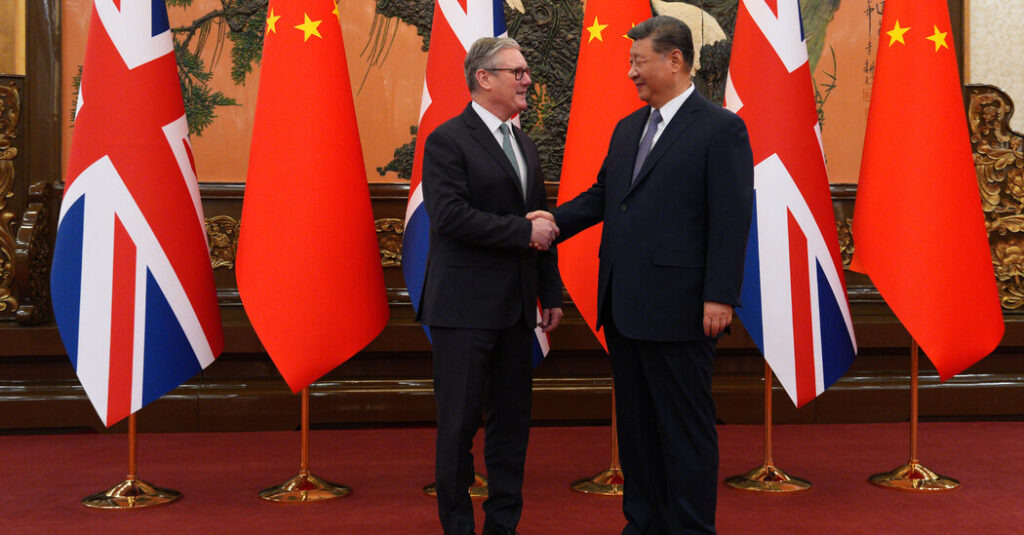
Prime Minister Keir Starmer of Britain arrived in China this week with more than two dozen of his country’s business and financial leaders in tow for the first visit by a British leader to the country in eight years. Mr. Starmer’s embattled government is trying to reverse sluggish economic growth, in part by helping British businesses strengthen ties with China, the world’s second-largest economy.
Over the years, Britain’s $140 billion trading relationship with China has veered from a “golden era” to an “ice age,” Mr. Starmer said.
The thaw in relations comes as Mr. Starmer says that Britain must “deal with the world as it is.” After years of upheaval, from Brexit up until President Trump’s tariffs, diversifying Britain’s international ties would make its economy more resilient. Britain’s economy is suffering from a “bout of mild stagflation,” an unwelcome combination of low growth and high prices, according to Oxford Economics, a research group.
As the global trading order breaks down, the prime minister has insisted that Britain doesn’t need to choose between aligning itself closely with Europe, the United States or China. The government also recently signed trade deals with India and South Korea.
But there is pressure to pick sides. On Thursday, Mr. Trump said it was “very dangerous” for Britain to boost trade with China. He added that Canada, another Group of 7 country courting Beijing, “can’t look at China as the answer.” Deepening ties with China risks retaliation from Mr. Trump, who has readily used the threat of U.S. tariffs and other restrictions to deter countries from making trade deals with that country.
Mr. Starmer’s trip to China, where he met with President Xi Jinping, produced some tangible results: British citizens will be able to travel to China without a visa for short trips; China will lower tariffs on Scotch whisky; and Chery Commercial Vehicles, a large Chinese automaker, will open European headquarters in the north of England. More deals could result from 10 cooperation agreements the countries announced in areas including trade, finance, health, education and law enforcement.
Questions remain about how quickly the agreements announced by Mr. Starmer and Mr. Xi can be leveraged into economic gains in Britain. Mr. Starmer has pushed for closer ties even as he acknowledges concerns about Chinese spying and the country’s record on human rights.
The cost of not doing business with China is big “and getting bigger,” said Kerry Brown, a professor of Chinese studies at King’s College London. “At some point it’s going to be a security issue that we don’t have stuff with China,” Mr. Brown said, because they will be producing things Britain needs, including advanced technologies and medicines.
Reviving Britain’s relationship with China has been months in the making. Rachel Reeves, Britain’s top finance official, traveled to Beijing a year ago, and several other ministers have been there since. Still, relations have been strained at times in the past year, especially when the British government took control of a steel plant in northeast England after its Chinese owners planned to close its blast furnaces.
“We’ve got a growth challenge in this country, and I think the quickest route out of that is exports,” said Steven Lynch, the director of international trade at the British Chambers of Commerce.
The biggest potential is in services, which makes up most of the British economy. British businesses exported about 13 billion pounds ($18 billion) of services to China in the year to June 2025.
Beijing announced on Friday a series of steps that could eventually help Britain expand the sale of services in China, especially financial services like banking and insurance. A new China-United Kingdom financial working group was formed and held its first meeting. The London branch of the Bank of China has begun trading of China’s currency, the renminbi. London is the largest hub for trading Chinese currency outside of Asia.
But most of Britain’s trade with China is in goods. None of China’s moves appeared likely to produce a significant or immediate narrowing of Britain’s large and widening trade deficit with China, in which Britain imports far more goods than it exports to China.
China’s pledge to reduce tariffs on Scotch whisky to 5 percent, from 10 percent, could help expand exports to China by the equivalent of around $340 million over the next five years. But the Chinese market is relatively small, amounting to less than $500 million last year, according to China’s customs data.
The trade imbalance has become a growing concern, as China’s trade surplus with the rest of the world has ballooned. Across Europe, officials are nervous about the redirection of Chinese goods away from the United States because of higher tariffs.
Britain has been more amenable to Chinese imports than some of its neighbors.
Unlike the European Union, Britain does not impose high tariffs on Chinese electric vehicles, which has led to many more Chinese cars on British roads. On Friday, Chery said that Liverpool would be a base for its European business, but there were few details about it.
Beyond this, there were no other specific commitments by Chinese companies to invest in Britain. AstraZeneca, a Britain-based pharmaceuticals giant, said it would invest $15 billion in China by 2030 to expand medicines manufacturing and research and development in the country.
To increase trade between two countries, Mr. Lynch said, the British government needed to be clearer about what businesses could do without worrying about breaching national security concerns.
“It’s really opaque,” he said. And it generates a reluctance to export to China, he added, until officials “better articulate what are the risks and what are the opportunities.”
Keith Bradsher contributed reporting and Ruoxin Zhang contributed research.
Eshe Nelson is a Times reporter based in London, covering economics and business news.
The post In a Bid to Kick-Start Growth, Britain Turns to China appeared first on New York Times.