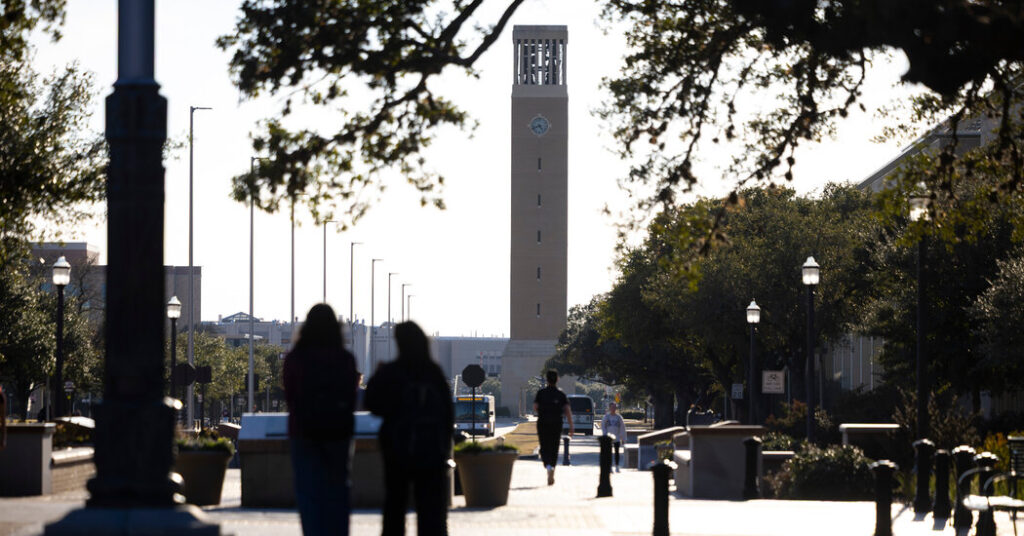
Texas A&M University said on Friday that it would end its women’s and gender studies program, and that the syllabuses for hundreds of courses had been altered under new policies limiting how race and gender ideology may be discussed in classrooms.
The university said that six courses had been canceled entirely because of the new rules, out of the roughly 5,400 that were planned for this semester at one of the nation’s largest public universities.
The A&M system’s regents — all of them appointed by Gov. Greg Abbott, a Republican — approved the restrictive policies late last year, and officials have been scrambling since then to interpret and enforce them. Supporters contend that the rules are appropriate measures to prevent political ideologies, especially those often associated with the left, from entering classrooms. Opponents say the approach encourages self-censorship and is itself ideological.
A top-down demand to scrutinize a university’s entire course catalog in so short a time is extraordinarily rare in the United States, where professors have long had sweeping control over their syllabuses.
“I have never seen anything like this,” said Leonard Bright, a professor in A&M’s Bush School of Government and Public Service and the president of the American Association of University Professors chapter in College Station, where the A&M system has its flagship campus of more than 74,000 students.
The regents do not seem interested in the academic freedom of students and the faculty, he added, only the “freedom of their speech.”
Friday’s announcement about shutting down the university’s women’s and gender studies program went beyond the immediate repercussions that many people had anticipated.
Tommy Williams, the university’s interim president, said in a statement that he had directed the closure because of low enrollment and “the difficulty of bringing the program in compliance with the new system policies.” He said that students who were already pursuing degrees or certificates in the program would be able to complete them.
In 2024, the regents ordered A&M to drop its minor in L.G.B.T.Q. studies. But ending a full bachelor’s degree program represents a sharp escalation in the debate over what should be taught at public universities in Texas, the nation’s most populous conservative state.
A&M is not the first school to drop gender studies. New College of Florida, for example, moved in 2023 to shut down its program, which had operated for decades.
Until Friday, discussions at A&M had often focused on how individual courses this semester would be affected by the new limits, which Mr. Williams argued in an interview this week had “restored rigor into some areas where maybe we had had some drift.”
“This has given us a transparent way to go through and make sure that what we’re advertising the course is about is actually what’s being taught,” he said on Tuesday, adding that the approach “strengthens academic integrity, it protects our academic standards and, I think, most importantly, it builds trust in higher education.”
A&M officials have nevertheless been bracing for recriminations, including possible court challenges, and for prospective students or professors to be thinking twice about heading to College Station.
“It’s been harmful to our reputation, there’s no question about that,” said Mr. Williams, a Republican former state legislator. “But I think it’s transitory.”
Mr. Williams, who previously worked for Mr. Abbott, said he had not discussed the policies with the governor. And during the interview, Mr. Williams did not mention any plans concerning the women’s and gender studies program, which currently has 28 students enrolled in its major.
Under the new systemwide policies, no A&M course may “advocate race or gender ideology, or topics related to sexual orientation or gender identity.” Certain classes that are not part of the core curriculum may include teaching about those subjects, but only if a campus president agrees that there is “a necessary educational purpose.”
Asked whether any part of him believed that the policies went too far, Mr. Williams replied, “No.” Pressed on whether deans and department heads would share that view, Mr. Williams responded, “Some would and some would not.”
Trump Administration: Live Updates
Updated
- The stock and bond markets appear unfazed by Warsh’s nomination as Fed chair.
- Here’s what to know about Kevin Warsh.
- Trump picks Kevin M. Warsh, a former Fed official, as the central bank’s next chair.
For the most part, those deans and department heads have been the ones trying to navigate how far A&M should go in excising content.
“Day by day, we began to have a clearer understanding of where the line may be,” said Simon North, the interim dean of the College of Arts and Sciences in College Station.
Dr. North acknowledged, though, that it was impossible to know exactly how many courses had been affected because some faculty members may have modified their syllabuses themselves.
“There are actions that people took in consultation with us,” Dr. North said, “and there are actions that people may have done on their own.”
Syllabus reviews largely took place at the departmental and college levels, but some reached the interim president’s desk. As he prepared this week to weigh requests for exemptions, Mr. Williams said that “common sense is what we’re trying to use as our gauge.”
He said that A&M officials were not looking to cut material in ways that might prevent students from being competitive in the marketplace, and that opponents of the new rules had “confused what academic freedom is.”
“It doesn’t mean you get to do whatever you want to in the classroom,” he said. “You have academic freedom, but it comes along with the responsibility, and part of that responsibility is to make sure that the learning outcomes are achieved and they’re done in a way that’s compliant with state and federal law and what our regents mandate us to do.”
Even before the wholesale course review, Texas A&M was debating what content was appropriate in college classrooms. In September, the university fired a lecturer for displaying a gender unicorn — which is used to explain the differences between gender expression and gender identity — during a course on children’s literature. The president of the university at the time — Mr. Williams’s predecessor — quickly stepped down.
A faculty appeals panel ruled that the university was “not justified” when it ousted the lecturer, Melissa McCoul, but A&M has refused to reinstate her.
Then the regents’ policies deepened the turmoil. One of the largest ruptures unspooled in the philosophy department, after a professor, Martin Peterson, proposed including portions of Plato’s Symposium in a contemporary moral issues course that can be used to fulfill a core curriculum requirement.
He also scheduled teaching modules covering race and gender ideology. He had discussed similar topics in the course in the past, though previous syllabuses showed that the modules had different names, like “race and gender issues.”
Kristi Sweet, the head of the philosophy department, asked him to “mitigate” the course to remove that content, or face reassignment to a different class. After the dispute became public, university officials repeatedly suggested that Dr. Peterson had constructed his syllabus as a provocation.
Dr. Peterson acknowledged that he had wanted to “test the waters,” but he said in an interview this week that he thought the Platonic passages would be less contentious than material he had assigned in the past: an excerpt from the Supreme Court ruling that recognized a right to same-sex marriage. He has since replaced the disputed modules and Plato readings with lessons about academic freedom.
Administrators note that Plato appears in the syllabuses for other classes.
“Hundreds of Aggies are reading Plato in their courses right now,” Dr. Sweet said. She added that the entirety of Plato’s Symposium was being taught in the Philosophy of Art course, and that despite a wide outcry over its handling of the Peterson class, the department’s “strategic priorities for continued excellence are untouched by current events.”
Dr. Bright, the A.A.U.P. chapter president, has faced questions about his own courses. Administrators initially flagged an article that included discussion of sexual orientation and gender identity. But the dean of the Bush School, John Sherman, told Dr. Bright that administrators would support letting him use that text, “given the scholarly nature of the work and the applicability of the reading.”
Another of Dr. Bright’s courses worried administrators more.
Dr. Bright wrote that the course would examine the impact of race, gender, religion, sexual orientation and other social identities “on public policy and the professional ethical responsibilities of public servants.”
Dr. Sherman asked him how sexual orientation would be covered. After Dr. Bright responded that it was impossible to say exactly when the subject might come up in a discussion-driven course, the dean canceled the class.
“To say this gives me no pleasure is an understatement,” Dr. Sherman wrote. “To be clear, transparency does not equate to censorship.”
Dr. Bright said that university leaders had made an impossible demand about a course that is often shaped by current events.
It is rare for university governing boards to make decisions that reach so far into classrooms so quickly. Still, R. Bowen Loftin, a former A&M president, said there were few practical options available to campus officials who might disagree with the regents.
“When you become an administrator, especially at a public institution, there’s going to be limits on what you can say and what you can do, and you have to come to grips with that,” he said.
Dr. North, the arts and sciences dean, said “questions of academic freedom and academic responsibilities are really difficult,” but that he was “trying to implement these changes in a way that puts students first and supports faculty.”
Dr. Bright showed little patience with such defenses.
“When it comes to certain things, you’ve got to say no,” he said. “I don’t excuse administrators from that responsibility.”
Alan Blinder is a national correspondent for The Times, covering education.
The post Texas A&M Ends Women’s Studies and Overhauls Classes Over Race and Gender appeared first on New York Times.