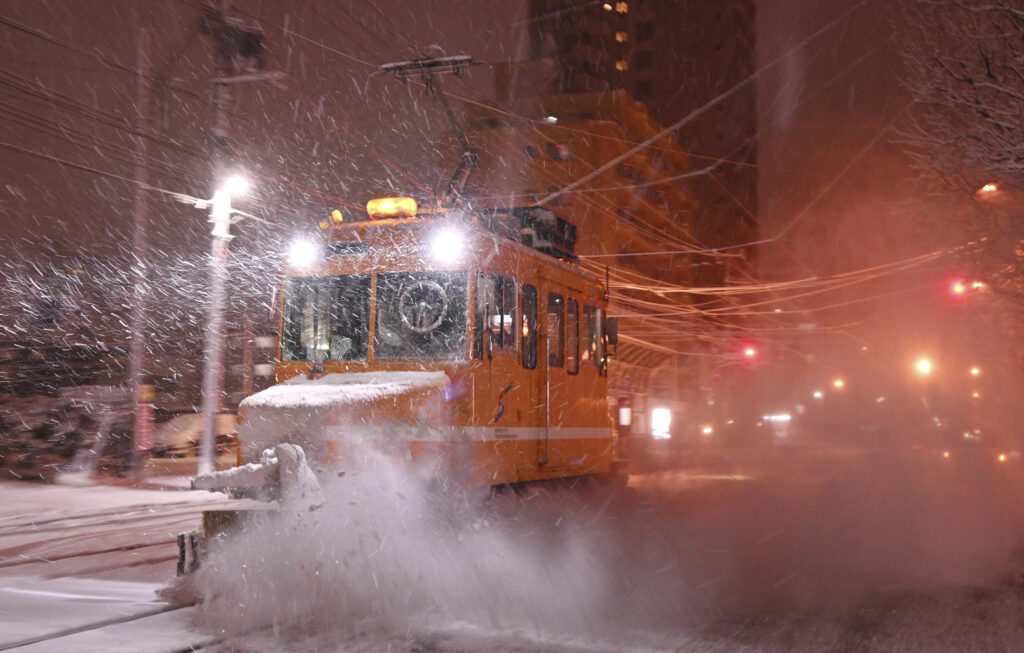
For days now, Washington has struggled to remove roughly 4 to 7 inches of snow, frozen below a layer of ice, from its sidewalks, streets and highways. But the snow piles and slush puddles clogging up the capital’s streets would seem quaint in some other cities around the world — including ones prone to greater quantities of snow — on account of their innovative approaches to snow removal.
One of the snowiest countries in the world, Japan uses various methods to remove snow, alongside innovative techniques that prevent snow from collecting on thoroughfares in the first place.
Japan is famous for its heated sidewalks, warmed by electrical cables or hot water running through pipes underground, said David Gordon, a professor in the School of Urban and Regional Planning at Queen’s University in Canada.
In the northwestern part of Japan, known as snow country, decades-old snow drains known as ryusetsuko are active in some areas. People clearing the sidewalk or the road can shovel snow straight into the drain, where it is flushed away.
In Kanazawa, Japan, sprinklers that eject warm groundwater are positioned between the streets and sidewalks, said Justin Hollander, a professor of urban and environmental policy and planning at Tufts University.
After a big storm in 2025, a snow removal plant in the city of Otaru, Japan, got rid of snow by dumping it into the ocean, according to a U.S.-based skiing news website.
Why Japan Dumps Tons of Snow Into the Ocean?#fyp #foryou #oddlysatifying #snow #cleaning
When Moscow was hit with more than 24 inches of snow in January, it marked the highest accumulation in Russia’s capital in decades, according to the Russian state-backed outlet RT. Thousands of workers and hundreds of snowplows were deployed — but like in other cities, including Washington, there was often not enough space to put the snow that had been cleared away. Workers began piling it up at Miusskaya Square in north-central Moscow, forming a mound so large that it became its own attraction, with locals gathering there for sledding, snowboarding and other winter activities.
In Helsinki, this problem is resolved using a Snowcuber, equipment that compresses snow into dense, manageable blocks, making it easier to transport, said Hollander, the Tufts professor. Snowcubers reduce the number of trips needed to remove snow from the road, speeding up removal and lowering fuel consumption.
But experts say these methods cannot be copy/pasted directly to Washington, which sees only a handful of snowstorms a year, and rarely one as severe and icy as Sunday’s.
It’s also not just a matter of purchasing snow-removal equipment, added Hollander. Heavy snow removal machinery is expensive and would require long-term care and maintenance, he said. Ideally, D.C. would invest in machinery with multiple functions that could be fitted with snow blades during the winter to deal with severe storms.
In D.C., massive snow events are uncommon, and light and heavy snowplows typically get the job done. But this time, city officials said, heavy snowfall was not the problem — it was the hours and hours of sleet and ice that came afterward, turning the snow into concrete-like mounds. Days of freezing temperatures followed, also unusual for D.C., further hardening the snow mounds.
“We had snow covered in a very thick layer of ice,” said Clint Osborn, director of the city’s Homeland Security and Emergency Management Agency. “Those layers of ice and snow have quickly turned into what we call snow-crete, a dense, complicated, compacted layer.”
Lighter snowplows struggled to make a dent in the snow-crete and even broke in some cases, officials in the region said. D.C. brought in construction contractors Tuesday night with more specialized equipment, including Bobcats and dump trucks, which hauled snow to vacant parking lots at the site of the city’s old football stadium.
By using a “fire snake,” crews were able to safely warm the rail, melt surrounding ice, and complete repairs efficiently — restoring service in a timely manner to keep our customers moving safely. pic.twitter.com/ZETi5VFOz4
— Metro Forward (@wmata) January 27, 2026
Washington’s public transportation system used a variety of methods to get its trains running despite the heavy snow and ice — including a “fire snake,” a flammable gel held together in a tubelike casing, placed along the tracks. Ice can cause rails to fracture, and fire snakes can be used to melt the ice on and around the tracks.
Canada, where 65 percent of the territory is covered by snow for more than six months of the year, also has multiple ways to remove snow.
Canadian cities in the snow belt, a region that receives heavy and frequent snow, have large budgets and equipment at the ready for removing snow during snowfall. Ottawa is particularly good at snow clearance, said Gordon, the Queen’s University professor.
During a storm, major streets and highways are plowed continuously. The arteries are plowed next, while lesser-used roads may have to wait another day to get cleaned up, Gordon said, adding that transit roads take priority during clearing.
Tiny Bobcats are used to plow sidewalks and bike lanes, ensuring that bikers can continue to commute safely. “Ottawa and Montreal are known to be the best cities to bike in in North America, and you are able to bike in Ottawa through most of the winter,” said Gordon.
Some Canadian cities in the north even try to make the roads drivable without removing all the snow. When temperatures drop too far below freezing and salt is not effective at melting what’s accumulated, authorities dump sand onto the roads, providing traction for cars, Hollander said.
The post As D.C. faces snow woes, here’s how cities around the world plow ahead appeared first on Washington Post.