On October 1, fireworks soared from El Helicoide, a sprawling prison complex that spirals around a hill in the center of Caracas. To many of those who knew what went on inside the structure, the spectacle was sickening.
At El Helicoide, guards reportedly hang political prisoners by their limbs and force them to plunge their face into bags of feces. Venezuela has quite a few places like it: Locking up critics was a key feature of President Nicolás Maduro’s governing style. His regime jailed thousands of them—opposition leaders, journalists, activists, foreign nationals, as well as everyday Venezuelans—typically on charges such as “betrayal of the homeland” and “rebellion,” and usually without granting them a trial.
El Helicoide stands out from the other prisons in part because of its history: In the 1950s, architects conceived it as a futuristic mall, but the building went unused until Maduro repurposed it as a series of torture chambers. Some Venezuelans have come to see El Helicoide as the defining monument of Maduro’s rule. With his pyrotechnic display, which came as the Trump administration was intensifying its rhetoric against Maduro and striking boats off of Venezuela’s coast, Maduro seemed to be sending a brazen message: His regime was holding together, and its repression would not relent.
Now Maduro sits in an American prison, and Venezuela is governed by his erstwhile second-in-command, Delcy Rodríguez, under a heavy American hand. What she will do with the repressive apparatus that El Helicoide represents is the question that preoccupies many Venezuelans who hope to leave the Maduro era behind.
[Read: The Venezuelan opposition’s desperate gamble]
According to human-rights organizations, Venezuela held at least 1,000 political prisoners at the time of Maduro’s capture. His reign had become so associated with these detentions that many family members of prisoners told me that as soon as they found out Maduro had fallen, they rushed to the prisons to inquire what would happen to their loved ones. Opposition activists made the detainees’ plight a core issue.
“I think all sectors of Venezuelan civil society have taken up the liberations as our central banner,” Adriana Pichardo, a former lawmaker now in exile, told me shortly after Maduro’s capture. “It’s the most important thing we need in order for Venezuela to have a real transformation.” Local journalists began covering the issue assiduously, scrutinizing public statements for clues as to what would happen to those who were detained.
For much of the Venezuelan opposition, the fate of the political prisoners promises to show both what the Trump administration intends for Venezuela and whether the country has left Maduro behind. Earlier this month, American officials began calling for them to be freed, and Rodríguez seemed to respond, if slowly. According to the human-rights group Foro Penal, the regime released 104 people on Sunday. (President Trump thanked Rodríguez for the “powerful humanitarian gesture.”) The total number of people who have been released this month is now 302. This leaves about 70 percent of known political prisoners locked up, suggesting that either American officials don’t have as much control over the regime as they claim—or that they do and haven’t cared enough to use it.
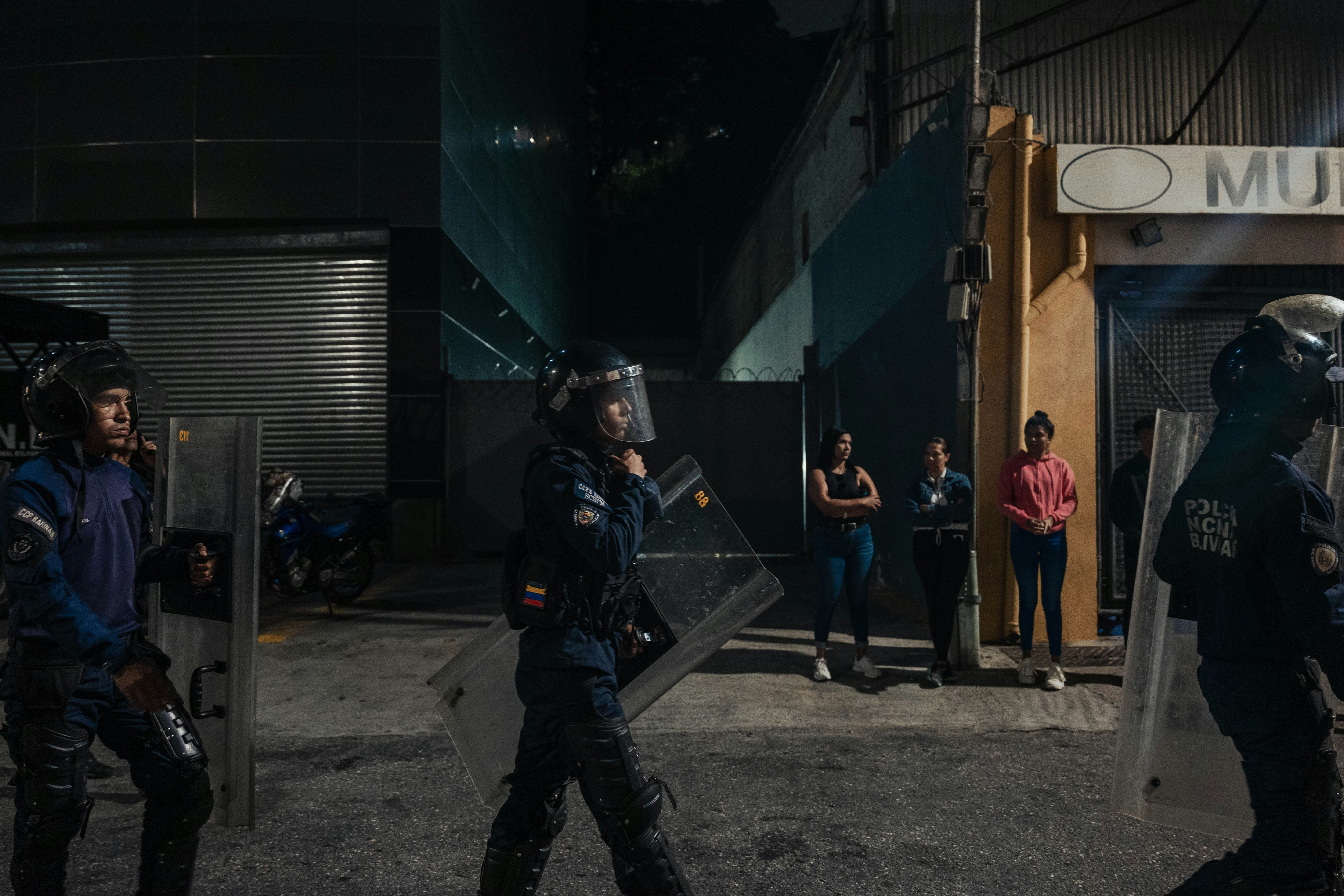
The Maduro regime used arbitrary detention as one of its primary tools of intimidation. Foro Penal has documented more than 18,000 cases in the past decade of people arrested without legal justification or due process. These include children, people with disabilities, and the elderly, as well as political targets such as opposition leaders and activists. In 2024, police intercepted a private voice message in which a doctor named Marggie Orozco, in referring to the country’s economic crisis, said that the government was “starving us to death.” For her complaint, Orozco received a 30-year prison sentence.
During its first days in power, Rodríguez’s government imprisoned dozens of Venezuelans, including two farmers who had celebrated Maduro’s fall and 14 journalists who had covered the new president’s swearing-in ceremony. Then, three days after Maduro’s capture on January 3, Trump made a passing comment that seemed to cause the regime to change tack.
“They have a torture chamber in the middle of Caracas that they’re closing up,” Trump said during a speech to congressional Republicans, without elaborating. Within hours, Spanish-language news outlets were reporting that Trump had announced the closure of El Helicoide, citing no further evidence than Trump’s verbal aside.
El Helicoide did not close. But Jorge Rodríguez, the president of Venezuela’s parliament and Delcy’s brother, announced on January 8 that the government would release a “significant number” of prisoners. Trump seemed pleased: “Because of this cooperation,” he wrote on Truth Social, “I have cancelled the previously expected second Wave of Attacks, which looks like it will not be needed.”
Over the next two weeks, the government released prisoners at a pace that activists described to me as “drop by drop”—about 10 a day, on average. Rumors spread that many of the remaining detainees were dead. (One of them, Edilson Torres, died at age 52 just days after the releases began.) Some in Venezuela speculated that the government had tortured the prisoners so gruesomely that it was afraid to let the public see or hear from them. Back in 2023, Amnesty International reported that officials had beaten a prisoner until she had to use a wheelchair and forced her to have an abortion.
Zair Mundaray, who worked as a public prosecutor for about 20 years before fleeing the Maduro regime, offered two theories about why the release of Venezuela’s political prisoners has been so sporadic. The first relates to Maduro’s wife, Cilia Flores, who controlled much of Venezuela’s judiciary before U.S. troops captured her along with her husband. According to Mundaray, his former colleagues who still work for the Venezuelan government say that Flores left behind a power vacuum that no one has been able to fill. As a result, he told me, judicial decision making has slowed. The second theory is that Rodríguez is not herself in any hurry to release these prisoners, which the Trump administration doesn’t seem to mind.
Last week, Rodríguez claimed that the government had released 626 prisoners, but she provided no evidence. She also did not specify whether these were common prisoners or political ones—a distinction that the government doesn’t acknowledge and that has become hard for NGOs to draw. In 2024, the government officially banned groups that track political prisoners, such as Foro Penal. Many of them continue to operate, but their jobs have grown more difficult. Many political prisoners go unclassified because families fear that registering them with an illicit organization would lower their chance of getting out. Since the releases began, though, many people have registered their loved ones. Foro Penal has verified some 200 previously unreported instances of political imprisonment since January 8.
Even when a political prisoner is released, their liberty remains conditional. Edward Ocariz, an activist and former prisoner, told me that many former detainees have to go to court for monthly check-ins. In many cases, authorities use these occasions to rearrest them, Ocariz said. The government also forbids former prisoners from leaving the country or giving interviews to the press, a condition of release that he decided to break at his own risk. He asked me to use the word unjailed to refer to released inmates, not freed.
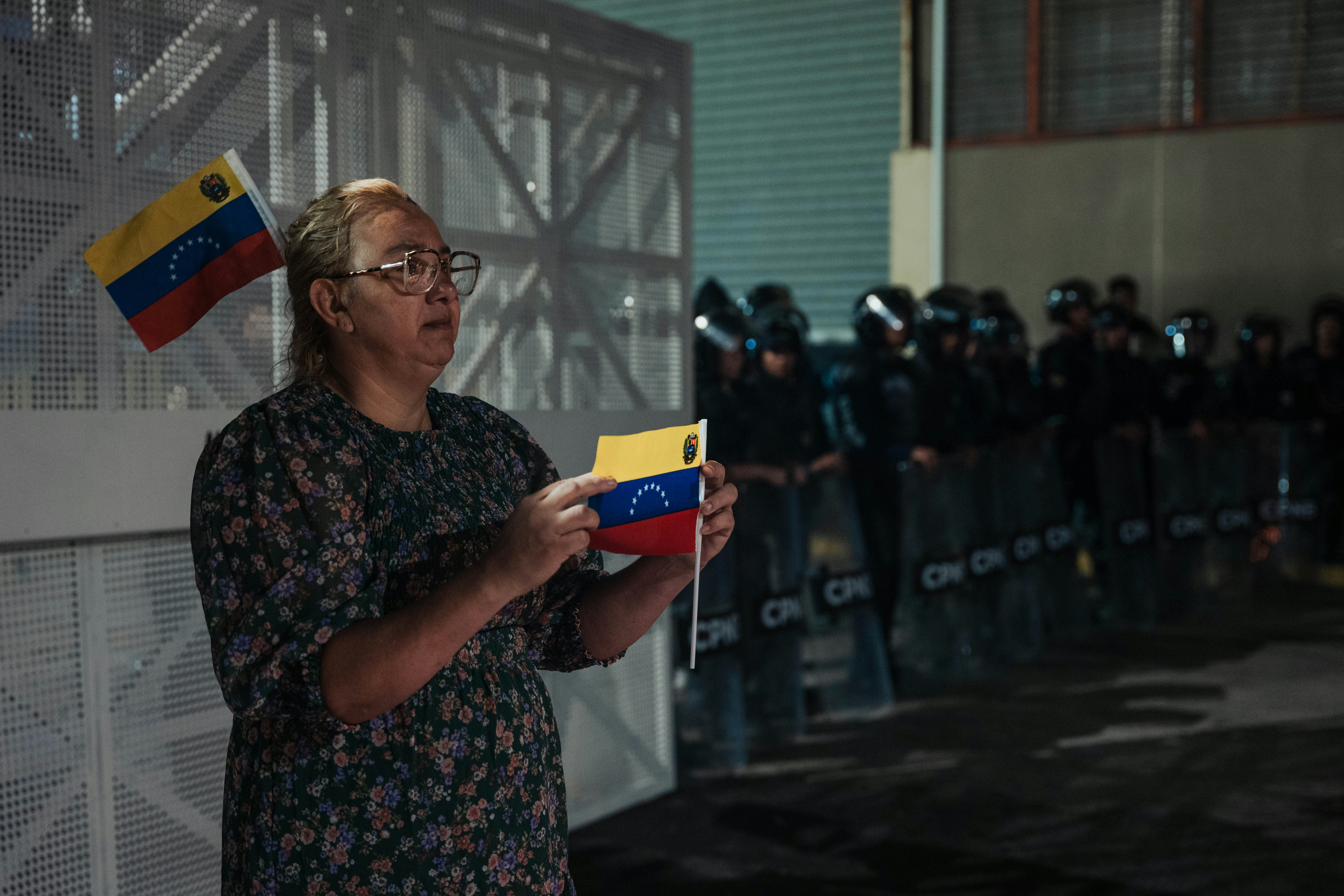
Last Friday, Venezuela observed a national holiday commemorating the fall of a military dictatorship that ruled the country until 1958. Rodríguez called for a demonstration in Caracas to protest the capture of Maduro—the man who, she suggested, best embodies the spirit of that day.
[Read: The Venezuelan opposition has a choice]
Not far from the demonstration, in a town near Caracas, people were lining up outside El Rodeo 1 prison hoping to see their loved ones. Each Friday, a queue starts forming at dawn, Lorealbert Gutierrez, a 19-year-old with five relatives in prison, told me. Many visitors bring gifts; Gutierrez usually comes bearing soap. Some visitors aren’t able to get in, and those who do typically wait for hours. Guards blindfold them and escort them to a room where they have 25 minutes to speak with their loved one from behind a screen, under constant supervision.
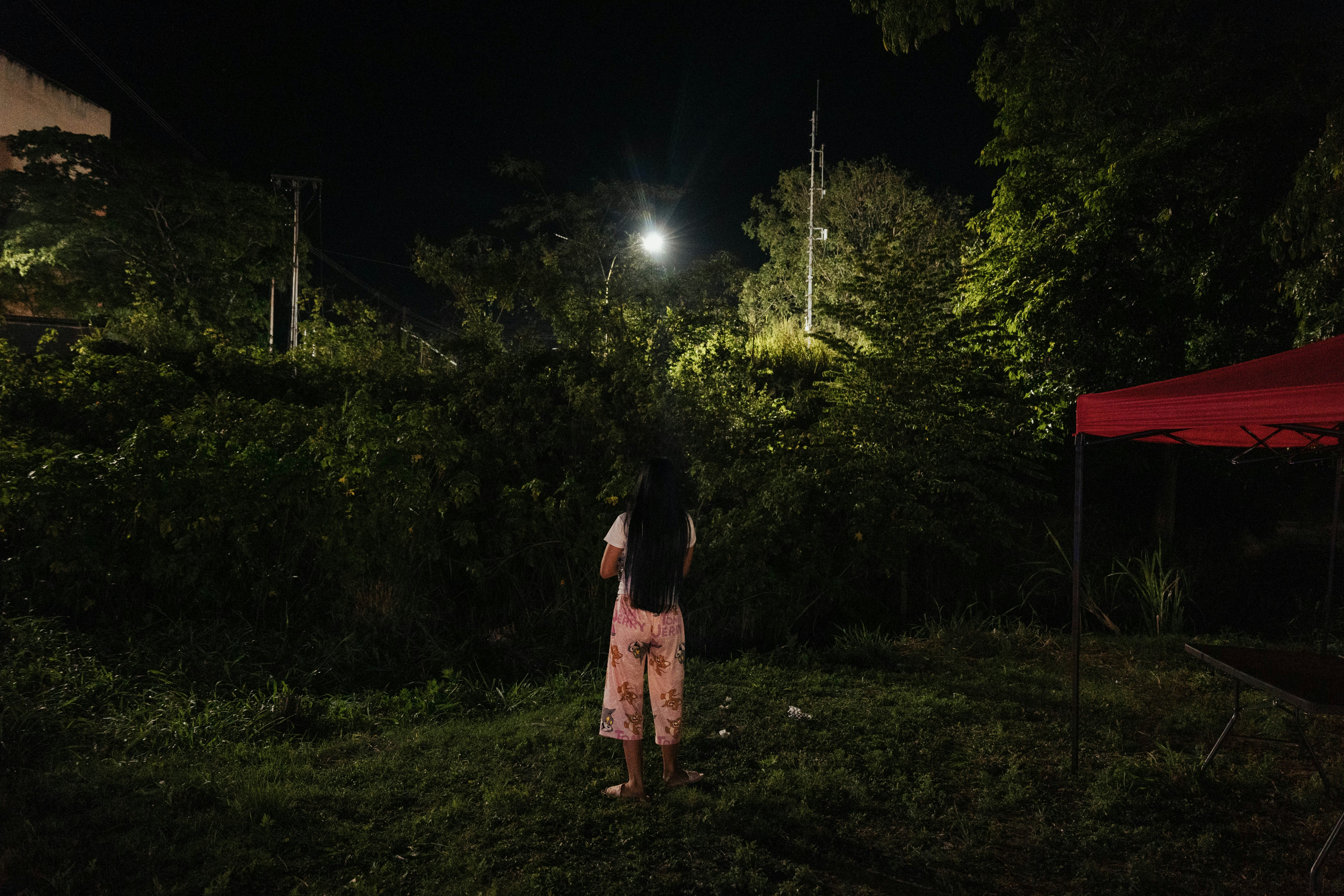
Massiel Cordones, the mother of a prisoner, wasn’t scheduled to visit her son until Sunday, but she had been camping outside El Rodeo for weeks. As soon as she heard that the government would release some prisoners, Cordones drove seven hours to Caracas. She couldn’t afford a hotel in the capital, so she slept under the roof of a pavilion next to the prison, where vendors sell food to family members of prisoners on visiting days. The first night, she slept on the floor. Then volunteers gave her a mattress.
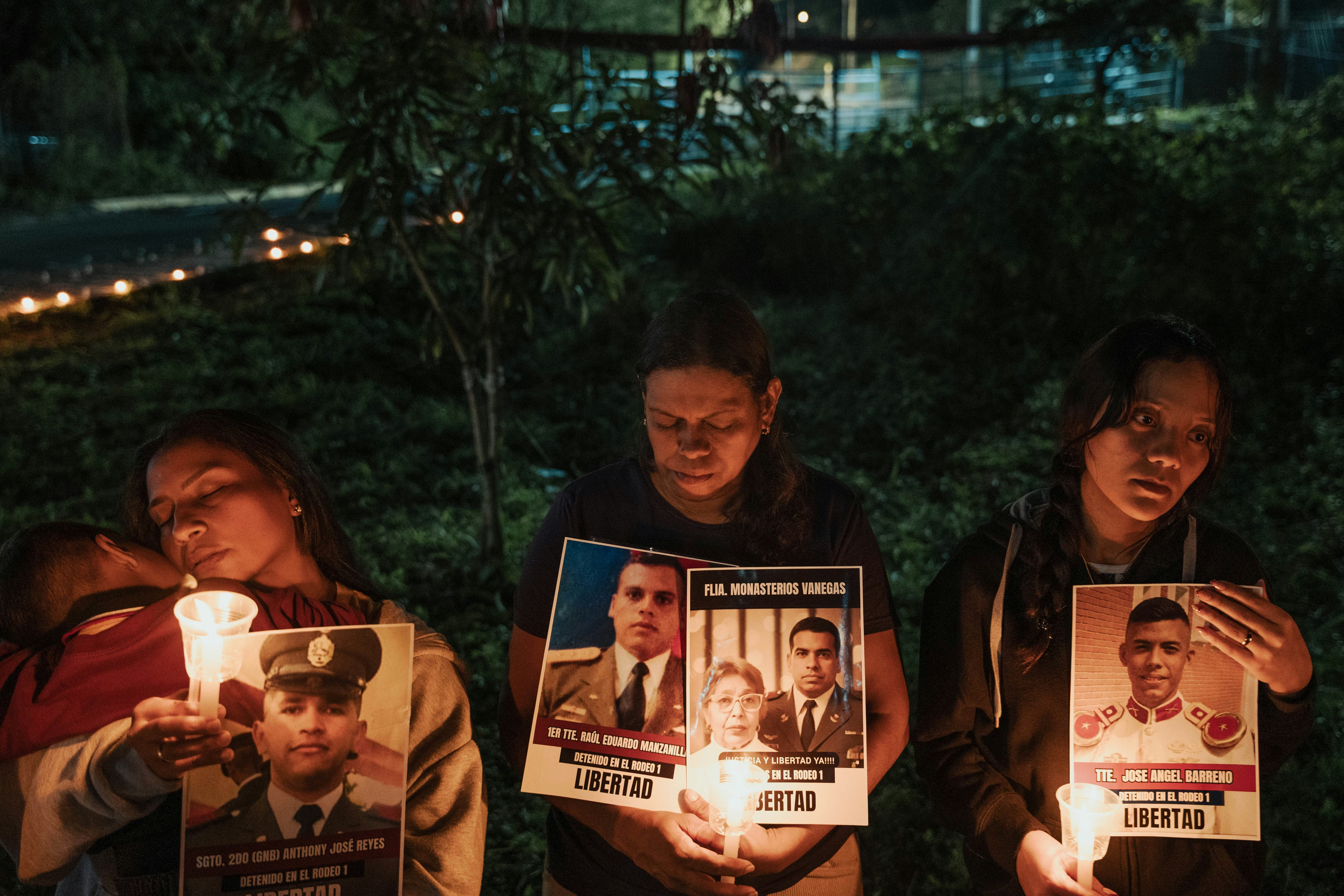
Cordones’s son is José Ángel Barreno, a 28-year-old army lieutenant. She told me that Barreno never disobeyed his superiors or criticized the government, but he is the nephew of a soldier who defected, so his colleagues distrusted him. In 2020, the regime arrested Barreno while the military searched for his uncle. Authorities first sent him to El Helicoide, where guards administered electric shocks as a form of torture. Yet he told his mother that El Rodeo, where he’s been since 2022, was worse. “He said this was the true hell,” Cordones told me. Cordones sold her house to pay for lawyers and reported her son’s case to Foro Penal.
“You know, when your son is a political prisoner, you are a political prisoner,” she said. “It’s the end of happiness. How can you eat knowing he’s not eating? How can you sleep knowing that he’s cold?”
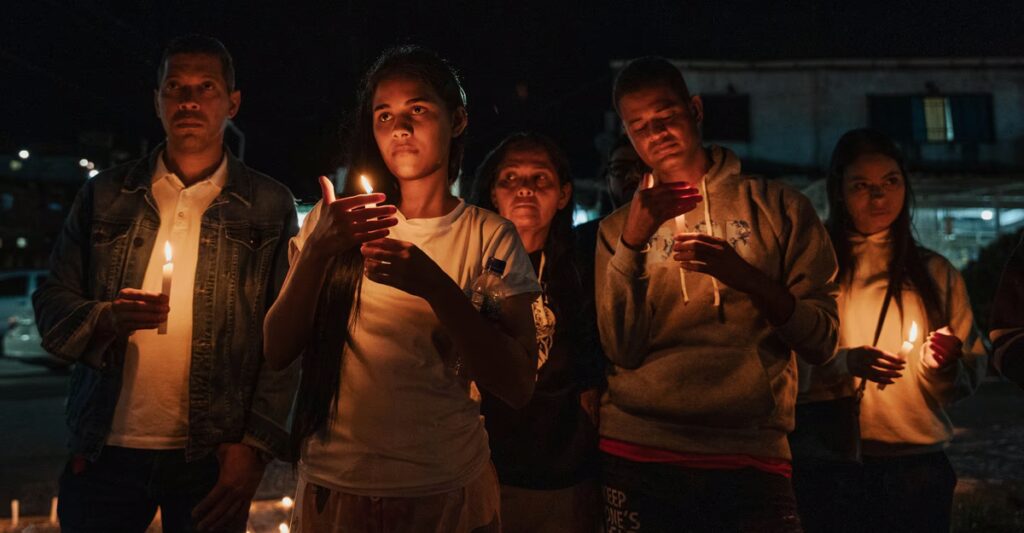
I first spoke with Cordones on Saturday. She told me she was almost sure that officials wouldn’t let her visit. Earlier last week, she had made a public statement calling out the torture inflicted on prisoners. Cordones feared that authorities would punish her or her son for her outspokenness. But her son had told her many times to carry on talking to the press about conditions inside the prison. She had heard that guards were telling the prisoners that their families had stopped camping outside and were no longer holding candlelit vigils every night. Cordones wanted her son to know that this was not true.
I spoke with her again the following afternoon and found her overjoyed. She had woken up to the news that more than 100 political prisoners had been released in just a single day. And she had gotten to see her son and relay the news. Cordones told me she now felt certain that he’d be released one day. And at the very least, she had gotten to tell him that families were still camping outside and holding vigils—that the political prisoners had not been forgotten.
The post An Early Clue About Venezuela’s Future appeared first on The Atlantic.