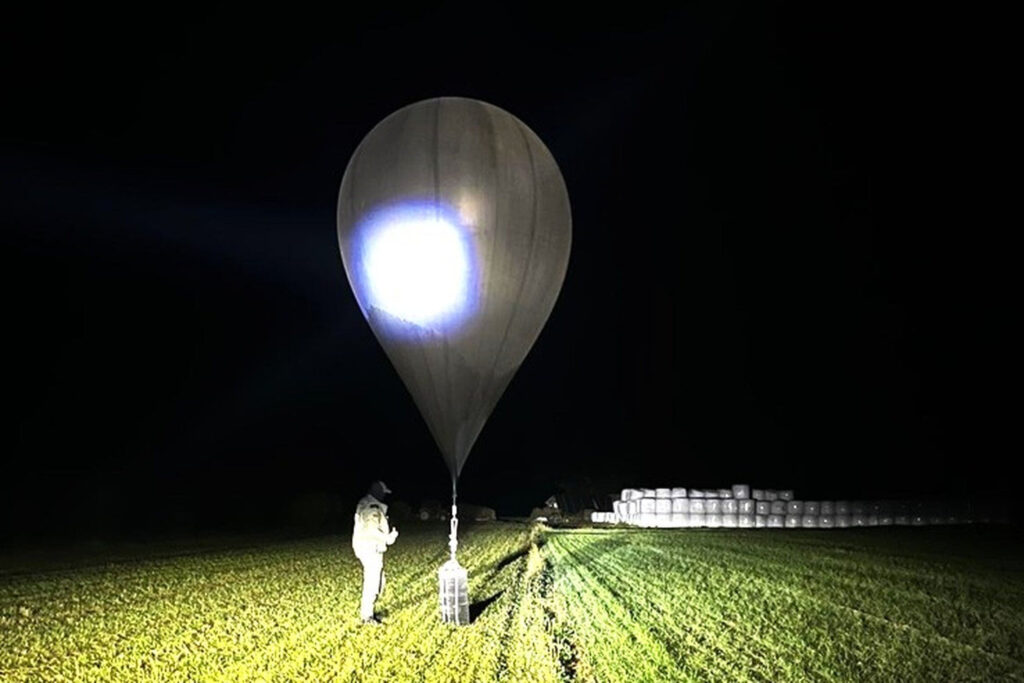
At first, they might not seem like much of a threat: weather balloons, filled with helium or hydrogen, carrying bundles of cigarettes from Belarus.
But as the number of these balloons crossing into NATO airspace has multiplied – including two major incursions this week into Lithuania and Poland that forced officials to shut air traffic – officials and experts are concerned that it represents an escalation of a Russian hybrid warfare campaign against the alliance and the European Union.
On Tuesday night, Lithuanian authorities detected 42 balloon flights from neighboring Belarus, forcing the airport in the capital, Vilnius, to halt flight traffic multiple times. The next night, balloons from Belarus encroached on Polish airspace in the country’s east, the Polish military reported.
Polish Foreign Minister Radoslow Sikorski, speaking in Brussels on Thursday, accused Belarus of “waging a hybrid war against our country.” Sikorski said the episode highlighted the “nature of the regime” led by dictator Alexander Lukashenko in Minsk, combining foreign policy with illegal acts.
Poland and Lithuania have complained in recent months of a rising number of balloons from Belarus smuggling cigarettes, which are far cheaper in Belarus than in the European Union nations. But the threat goes beyond contraband, experts say — posing a test of NATO’s defenses and resilience.
“Who can guarantee that one day instead of cigarettes, there is no bomb, explosive or anything else?” said Laurynas Jonavičius, an adviser to the Lithuanian foreign ministry and lecturer at Vilnius University. “So it’s really a security threat. It may be a criminal activity, but knowing the history of what the Belarusian regime does to Lithuania, it’s quite obvious that it’s also a test.”
Lukashenko, the Belarusian leader, is a close ally of Russian President Vladimir Putin, has allowed his country to be used by the Russian military, and has often referred to Russia as a “big brother.” Jonavičius described Belarus and Russia as “one state, de facto,” on security and defense.
“Belarus is a cobelligerent in this war,” said Christina Harward, a Russia expert at the Institute for the Study of War, a Washington-based nonprofit. “They should not really be viewed as separate actors at this point.”
Hybrid war is an ill-defined term, and Harward said she prefers to describe the balloon flights and other Russian-linked incursions as “phase zero” of a conflict with NATO, setting the stage for a potential direct engagement. The goal, she said, is to sow confusion and discord within the alliance.
“The NATO states are having to sit down and figure out: Was this an attack?” she said. “Was it Russia? Was it truly cigarettes from smugglers?”
Russia has increasingly tested NATO with a series of incursions, most strikingly in September, when about 20 Russian drones flew into Poland, leading NATO to scramble jets and shoot down several of them. European officials accused Russia of an intentional act to see how NATO would respond.
“This was a deliberate and coordinated strike constituting an unprecedented provocation and escalation of tension,” the foreign ministers of Lithuania, Poland and Ukraine said in a joint statement following the drone incident.
The Polish armed forces operational command reported Thursday that “balloon-like objects” had entered Polish airspace Wednesday night, prompting the closure of some airspace to civilian flights. “No threat to the security of the airspace of the Republic of Poland was identified,” the operational command wrote on X, but it described the incident as “part of the catalogue of hybrid activities Poland is experiencing” along its eastern border.
“The situation is being monitored on an ongoing basis, and the forces and resources of the Polish Armed Forces remain ready to carry out tasks related to the protection of Polish airspace,” the operational command wrote.
In October, in response to a flurry of balloons, Lithuania temporarily closed its border with Belarus. Prime Minister Inga Ruginiene said the country was “sending a signal to Belarus that we will not tolerate any hybrid attacks and will take the most stringent measures to stop them.” Lithuania frequently has had to halt flight activity in response to these balloons and the risk of a collision.
“The situation at the border with Belarus is worsening, with the growing incursions of smuggling balloons into Lithuania’s airspace,” European Commission President Ursula von der Leyen wrote in December on X. “Such hybrid attack by the Lukashenka regime is completely unacceptable.” She said the E.U. was preparing additional sanctions against Belarus.
Europe is scrambling to build up its defense capabilities in the face of Russian aggression and a growing U.S. insistence that the continent defend itself.
Poland has taken the lead, assembling the E.U.’s largest land army, but it’s unclear that the increased spending and personnel are equipped to handle new forms of warfare, including drone attacks and the kind of sabotage that occurred on a Polish rail line in November.
The Belarusian tobacco industry is known to be controlled by people in Lukashenko’s inner circle, said Vytis Jurkonis, a political scientist who leads the Vilnius office of the nonprofit Freedom House. The Lukashenko regime could stop the smuggling if it wanted to, he said.
“They can pretend that it’s some non-state actors, but they are able to control it,” Jurkonis said. “They choose not to.”
Throughout his rule since 1994, Lukashenko has oscillated between periods of rapprochement with Western capitals and deep political and economic integration with Moscow, depending on what best served his political needs.
Russia tightened its embrace in 2020, when Lukashenko faced the gravest challenge to his quarter-century rule after mass protests erupted over his claimed victory in a presidential election widely viewed as fraudulent. Moscow stepped in with loans, cheap energy and security guarantees to shore up his position. When Russia launched its full-scale invasion of Ukraine in 2022, Lukashenko returned the favor.
Belarus became a staging ground and logistical hub for Russian forces, which launched assaults on northern Ukraine from Belarusian territory. Since the invasion, Minsk and Moscow have signed a sweeping security pact.
More recently, Lukashenko has sought to curry favor with the Trump administration by releasing several high-profile political prisoners in exchange for partial sanctions relief. Trump officials described the effort to unfreeze relations with Minsk as tied in part to Lukashenko having “Putin’s ear,” a potential asset as Trump seeks to negotiate a deal to halt the war in Ukraine.
Belarus has engaged in various hybrid operations against E.U. member states, particularly Poland and Lithuania, which have given refuge to tens of thousands of Belarusians who fled following the brutal crackdown on dissent after the 2020 protests.
In 2021, Lukashenko weaponized migration flows in what the E.U. and the U.S. State Department described as a deliberate attempt to pressure neighboring states, directing thousands of migrants from Iraq, Syria and Yemen to the Belarusian–Polish border, where they sought to enter the E.U. without legal authorization. Thousands ended up stranded in forests in freezing conditions, trapped between Polish and Belarusian security forces.
European leaders condemned Lukashenko for launching a “hybrid attack” that exploited vulnerable people and their aspirations to reach Europe, accusations he denied.
Belarus has also been linked to cyber activities aimed at influencing politics and gathering information in E.U. and NATO countries. Western governments and security researchers have tied Belarusian-linked groups to hacks of media outlets, government bodies and public figures, which were then used to plant manipulated or fake content to stir division.
The post Belarusian balloons full of cigarettes pose NATO’s latest security threat appeared first on Washington Post.