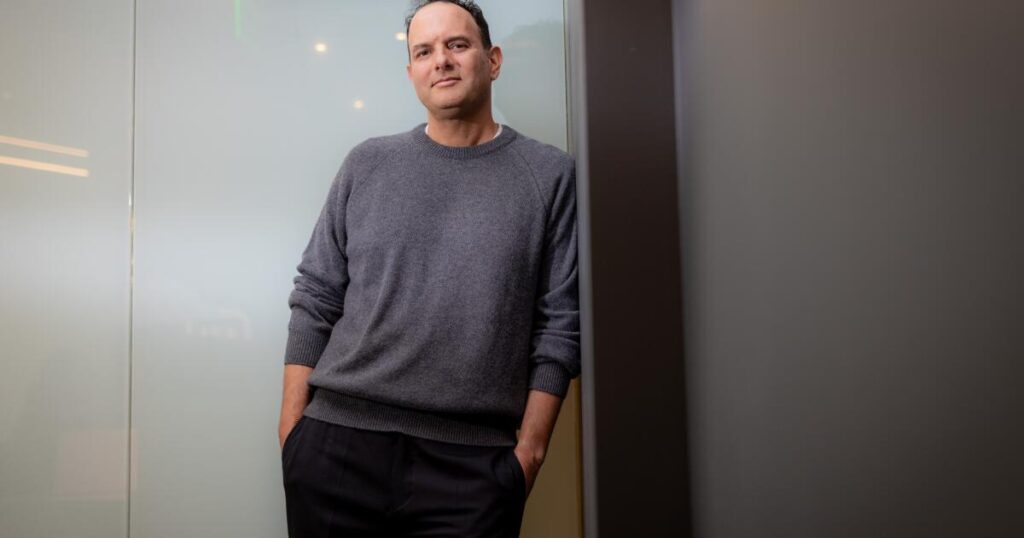
As he mills around backstage at Inglewood’s YouTube Theater on a recent evening, John Janick could be just another of the countless dads who’ve brought their kids here to see the K-pop girl group Katseye.
Dressed in jeans and a rumpled T-shirt, the 47-year-old looks on as North West — rapper, influencer, middle-school-age daughter of Kim Kardashian and Kanye West — blows into the greenroom in a blur of sunglasses and blue hair and poses for a picture with the six bandmates after their show. It’s a valuable photo op for an act whose fans live on social media, and the young women of Katseye are clearly thrilled by West’s presence (at least until they all strike looks of studied nonchalance for the camera).
Yet when it’s Janick’s turn for an audience with the group, each member regards him no less attentively — which makes sense given that he’s a big part of why they’re here.
With his ball cap and untied sneakers, Janick is the chairman and chief executive of Interscope Capitol, the Santa Monica-based record company that houses a collection of labels including the storied pair in its name along with Geffen, Motown, Blue Note, Verve and a joint venture with the Korean behemoth Hybe. He and Hybe’s Bang Si-Hyuk put Katseye together, as chronicled in a slick 2024 Netflix docuseries, then shepherded the group to a string of hit singles with more than 2 billion Spotify streams between them.
This weekend, he’ll watch as the sextet competes for the coveted best new artist prize at Sunday’s 68th Grammy Awards — quite a feat for an act from the type of reality-TV background the Recording Academy once looked down upon.
“The dance break at the end of ‘Gnarly’ is gonna be so amazing at the Grammys,” Janick tells the group backstage, referring to their breakout song. The prospect sends a ripple of excitement through the musicians, none of whom were anywhere close to famous three years ago.
Katseye’s best new artist nod is just one of Interscope Capitol’s high-level Grammy nominations; among the others are album of the year noms for Lady Gaga’s “Mayhem” and Kendrick Lamar’s “GNX” — two of the three frontrunners for the academy’s most prestigious prize — as well as nods for record and song of the year for Gaga’s “Abracadabra,” Lamar and SZA’s “Luther,” Billie Eilish’s “Wildflower” and Doechii’s “Anxiety.”
In all, the company scored 13 nominations across the ceremony’s top four categories — more than any other major label group this go-around. Despite his low-key presence, Janick’s organization is a music industry powerhouse, having finished 2025 with a 15.7% share of the U.S. market for recorded music, according to the trade journal Hits.
“John’s a better executive than me by a f— mile,” says Jimmy Iovine, the veteran record producer who co-founded Interscope in 1989 and handed the reins to his successor in 2014.
Adds Lucian Grainge, chairman and CEO of Interscope’s parent company, Universal Music Group: “John is a winner, and his drive shapes Interscope’s culture. I like winners.”
Yet Janick’s success comes at a time when the primacy of the major label is arguably under threat. Social media and digital streaming have combined to make it easier than ever for independent artists to connect with mass audiences. (That third frontrunner for album of the year: “Debí Tirar Más Fotos” by Bad Bunny, who records for the indie Rimas Entertainment — and who will follow his appearance at the Grammys with a gig on music’s biggest stage at Super Bowl LX.)
The explosion of AI could prove even more disruptive to a business rooted in the creative labor of humans with non-replicable skills.
So why do artists need major labels in 2026?
“I don’t think they do,” Janick says. “I think it depends on what an artist wants.”
It’s a few nights before the Katseye show, and Janick is in his spacious corner office at UMG’s headquarters. He’s wearing jeans and a T-shirt, as always; on one wall hangs a replica of Nirvana’s “Nevermind” album cover rendered in what appear to be Rubik’s Cubes.
“I don’t want to be part of signing an artist and just taking a piece of what they would have done without us,” he says. “I want to help them achieve at a higher level.”
Interscope offers access to resources and relationships, he explains, that enable ambitious projects like the upcoming 3D concert movie Eilish made with director James Cameron. And in an era when every musical career is multimedia by nature, the idea is that the film will drive interest in Eilish’s catalog, which will drive interest in her perfume, which will drive interest in her ticket sales, which will drive interest in — well, you get the picture.
Janick calls the mechanism Interscope’s “flywheel,” a phrase he borrowed from Jim Collins’ best-selling business book “Good to Great.”
“What I get excited about is thinking about Disney,” he says. “IP is at the center” — that’s short for intellectual property — “and then they can go execute across all the verticals, whether it’s experiential, merchandise, licensing, films, music, all of it.”
Janick’s philosophy is well suited to the devoted, lore-hungry followings of Interscope’s established superstars — one reason Lady Gaga calls him “an incredibly talented visionary” in an email to The Times. “He cares so much about cultivating a team around the artist and their music and supports them in bringing their music to the world the way they want no matter how unexpected or unconventional,” she says of the exec. “That kind of approach is extremely rare.”
Chimes in Gaga’s fiancé and creative partner, Michael Polansky: “John understands how personal all of this is for artists and leads with trust and respect, which means everything.”
Yet the company is equally committed to “creating the next round of superstars,” Janick says. Among its up-and-comers are Leon Thomas (who’s also nominated for album of the year at the Grammys), Gracie Abrams, Role Model and Sienna Spiro. At the Katseye concert, Janick hobnobs with folks from Netflix and from Margot Robbie’s production company, LuckyChap — the flywheel in action for a group that has yet to drop a debut LP.
Asked how much time a chairman has to get involved in the nitty-gritty of a developing act, Janick says, “I’m a bit crazy in the sense that I feel a personal responsibility to anyone we’ve signed. It’s easy for people to get lazy in the music business because you can get lucky: You happen to get some great contract on an artist that becomes massive, and all of a sudden you’re a genius. But if I meet somebody early on, most of the time they get my cell phone number.”
Eilish’s brother, Finneas O’Connell, who’s made music with his sister since they were both teenagers living at home, recalls innumerable visits from Janick where he’d “be sitting on the bed in my childhood room listening to us play him primitive recordings.” He laughs. “Only looking back do I realize how vulnerable that was. But there was never any judgment.”
Janick’s deep investment in his acts goes back to his beginnings in the record industry. Thirty years ago, he started the indie label Fueled By Ramen out of his dorm room at the University of Florida; he used nascent social-web platforms like MySpace and MP3.com to build bands like Fall Out Boy and Paramore into such sensations that Warner Music bought half the company in 2008. At age 31 he was tapped to relaunch Warner’s Elektra Records, where he helped lay the groundwork for the ascent of Bruno Mars.
Yet Janick was “never like most people in the major-label system,” according to Paramore’s Hayley Williams. “He understands a fervent fan base but he knows how to speak to it and not just exploit it. He invented a lot of s— in those scrappy days that the industry would call standard now for developing artists’ careers.”
In 2012, Iovine hired him as Interscope’s president; two years later, Janick took over the top spot when Iovine left to focus on his and Dr. Dre’s Beats Electronics. To some, Janick’s background in rock made him a strange fit to head the label long known as a hip-hop hotbed thanks to the likes of Dre, Snoop Dogg and Eminem.
Not to Iovine: “I thought John was the guy for the job the day I met him,” he says.
Janick’s tenure has overlapped with a general dismantling of the barriers that once separated genres. Joie Manda, a seasoned record exec who worked under Janick at Interscope in the 2010s, points out that the first time he and Janick met with the rapper Juice Wrld, “he just wanted to talk with John about Paramore.” Juice Wrld, who’d go on to score huge emo-rap hits like 2018’s “Lucid Dreams” before dying in an accidental drug overdose at age 21, “was a Fueled by Ramen baby,” Manda adds.
Today, Janick’s diverse portfolio also includes Interscope Capitol Miami, with a roster of Latin-music stars such as Karol G and Xavi, and Lost Highway, a newly rebooted version of the connoisseur’s roots-music label that released records by Shelby Lynne and Ryan Bingham in the early 2000s.
Some in the business describe Janick, who’s married with three children, as a dictatorial boss unwilling to cede control to the execs leading the company’s various divisions. Manda rejects that characterization, as does Anthony Tiffith, founder of Top Dawg Entertainment, who brought Lamar to Interscope and Doechii to Capitol.
“He’s got full trust in what we built and what we’ve done so far,” Tiffith says.
For Janick, Doechii’s recent success on the charts and at the Grammys — last year she won the rap album prize with “Alligator Bites Never Heal” — is a testament to his belief in slow and steady artist development. (She signed to Capitol in 2022.)
Yet rapid advancements in AI are sure to raise questions in the industry about the necessity of spending time and money to allow a human to hone his or her talent. In October, UMG announced that it had struck a licensing deal with Udio, the AI-powered music-creation platform; Warner soon announced its own partnership with a rival platform, Suno.
Janick says his principal concern regarding AI is ensuring that his artists are paid when their music is used to train the technology that allows a user to summon a song from the digital ether by typing a prompt into a text bar.
Has he tried asking Udio to create a song for him?
“I sat with the founder and let him do it,” he replies. And? “It’s interesting. I mean, I can see why artists don’t want certain things. But then I have a 13-year-old who’s making songs every day.”
Perhaps more than any other issue, AI will demand the attention of those in charge of the major labels for the foreseeable future. Grainge, who’s 65, has been atop UMG since 2011 — hardly an eternity but long enough that insiders have started speculating about who will eventually succeed him in a job often described as the most powerful position in recorded music.
Janick says it’s not a question he ponders. “I think about succession in my company,” he says, referring to Interscope Capitol, “and making sure I’m developing executives just like I’m developing artists. As far as UMG, the only thing I think about is making sure that who I work for I want to work for. And I like working for Lucian.”
Good thing, according to Iovine.
“Lucian ain’t going anywhere,” he says with a laugh.
The post Why this ‘visionary’ record exec still believes in the major label appeared first on Los Angeles Times.