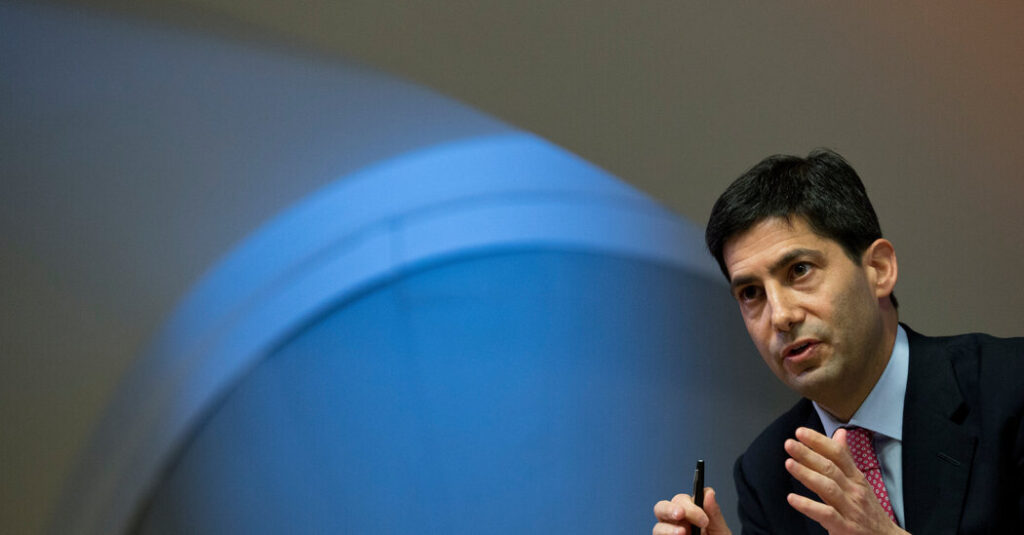
President Trump has chosen Kevin M. Warsh as his next chair of the Federal Reserve. If confirmed by the Senate, Mr. Warsh would replace Jerome H. Powell, the current chair, whose term ends in May.
Here’s what to know about Mr. Warsh.
A former inflation hawk
Mr. Warsh, 55, is no stranger to the Fed. He served at the central bank from 2006 to 2011 after being installed by President George W. Bush. While at the Fed, Mr. Warsh established himself as a so-called inflation hawk, who was worried about price pressures and urged higher interest rates.
The view continued even amid the 2008-2009 financial crisis and the Great Recession. While the Fed slashed interest rates, Mr. Warsh warned that the central bank risked exacerbating price pressures if it continued to cut rates, a tool he called “the hammer.”
“Even if the economy were to weaken somewhat further, we should be inclined to resist expected, reflexive calls to trot out the hammer again,” he said in May 2008.
Mr. Warsh, a financier who was the Fed’s chief liaison to Wall Street during the financial crisis, played a central role in the bank’s broader response — including helping to broker the sale of Bear Stearns to JPMorgan Chase and arranging the federal government’s bailout of American International Group, the insurance giant.
Now backs lower rates
More recently, Mr. Warsh has publicly backed the need for interest rate cuts, which President Trump has demandeed. Mr. Warsh has argued that Mr. Trump’s tariffs will not lead to persistently higher inflation.
He has argued that his current support for lower rates is consistent with his earlier stance. He wants the Fed to reduce its holdings of bonds — currently worth more than $6 trillion — which he says would allow it to cut rates without causing inflation to rise. But few mainstream economists endorse that view.
Mr. Warsh has also criticized the outgoing Fed chair, Mr. Powell, writing in The Wall Street Journal that “inflation is a choice, and the Fed’s track record under Chairman Jerome Powell is one of unwise choices.” In an interview on CNBC earlier this year, he called for “regime change” at the central bank and has said that policymakers, including Mr. Powell, undermined their credibility by responding too slowly to the surge in inflation coming out of the Covid-19 pandemic.
Former Wall Street banker
Mr. Warsh began his career working in Morgan Stanley’s mergers and acquisitions department. He helped structure deals and advised companies “across a range of industries, including manufacturing, basic material, professional services, and technology,” according to the Fed’s website.
He also “helped structure capital markets transactions and facilitated fixed income and equity financing,” according to the Fed.
Lauder family ties
Mr. Warsh is married to Jane Lauder, daughter of Ronald Lauder, who is the heir to the Estée Lauder Companies. Mr. Lauder, one of the richest men in New York, has known Mr. Trump since college and was instrumental in planting the idea in Mr. Trump’s mind of buying Greenland.
“A friend of mine, a really, really experienced businessman, thinks we can get Greenland,” Mr. Trump is said to have told his national security adviser. “What do you think?”
A second chance at chair
Mr. Warsh has made no secret of his interest in leading the Fed. He narrowly missed out on the job during Mr. Trump’s first term, ultimately losing out to Mr. Powell. Mr. Trump has suggested that he regretted the choice after Mr. Powell refused to deliver the big rate cuts that he wanted.
When Mr. Trump returned to the White House last year, Mr. Warsh immediately emerged as a leading candidate for the job. Other candidates at times seemed to edge ahead of him in the running, including Kevin Hassett, Mr. Trump’s top economic adviser. But after a long and very public search process, Mr. Warsh finally landed the nomination.
Sydney Ember is a Times business reporter, covering the U.S. economy and the labor market.
The post What to Know About Kevin Warsh, Trump’s Pick to Lead the Fed appeared first on New York Times.