For the past half-century, policymakers have taken for granted that the Federal Reserve would seek to maintain control over inflation, and that it had the power to do so.
It is time to start rethinking both of those assumptions.
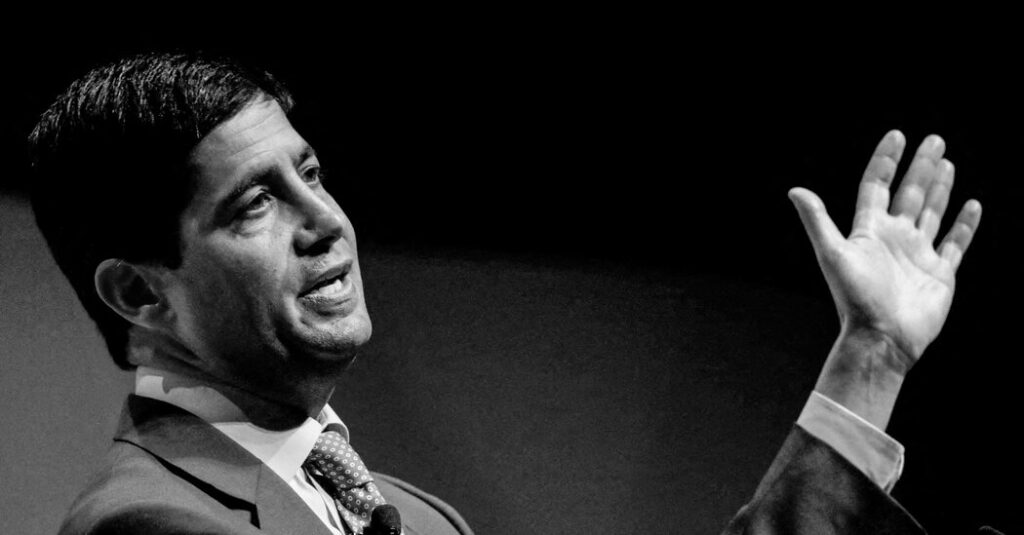
President Trump’s choice to nominate Kevin Warsh as the next Fed chairman is intended to break the Fed’s focus on inflation. Mr. Trump has made clear that he wants the Fed to deliver lower interest rates, inflation be damned, and said plainly and publicly that he would nominate someone willing to deliver on his demands. “Anybody that disagrees with me will never be the Fed chairman,” he posted on social media in December.
Even if the central bank under Mr. Warsh defies Mr. Trump and keeps trying to do its job, it will face a second problem: Its hands will be increasingly tied by the federal debt.
The government’s dependence on borrowed money is growing at an unsustainable rate. The Treasury paid $970 billion in interest last year, or about 19 cents of every dollar collected in taxes. By 2035, interest payments on the debt could consume 27 cents of every tax dollar.
It is a problem that Mr. Trump has exacerbated through his reckless approach to fiscal policy, including another round of large tax cuts in 2025. There are also signs that foreign investors are reconsidering their appetite for lending to the United States. A Danish pension fund recently announced plans to divest its U.S. Treasuries.
Congress could ease the pressure by embracing fiscal probity through some combination of raising taxes and reducing the growth of entitlement spending. If federal borrowing instead continues to outpace the nation’s economic growth, it will force the Fed onto the horns of a dilemma. Governments that struggle to pay their debts often turn to monetary policy for relief, pressing their central bankers to print more money. That drives up inflation. The alternative, however, is allowing a government default.
Economists describe this situation as “fiscal dominance” because the profligacy of the fiscal authorities effectively forces the hand of the central bank.
It calls to mind the old saying that if you owe the bank $100, that’s your problem, but if you owe the bank $100 million, that’s the bank’s problem. When the debts are large enough, the debtor calls the shots, because default becomes unbearable.
In short, this is not a fun time to be a central banker. The president doesn’t want you to do your job, and Congress is making the job even harder. At an annual meeting of the American Economic Association in early January, several prominent economists participated in a panel discussion about the Fed’s future. The perspectives ranged from bleak to bleaker. The nearest thing to reassurance was offered by Janet Yellen, a former Fed chair, who emphasized that the government still has time to improve its fiscal health.
“The Fed is not and must never become the fiscal authority’s financing arm,” Ms. Yellen said.
David Romer, an economics professor at the University of California, Berkeley, agreed that there was time to act, but, given the state of Congress, didn’t see much reason for optimism.
The Fed’s future “is likely to be very different,” he said.
The Fed is charged by Congress with maintaining the health of the financial system and the stability of the broader economy. Its main tool is its ability to raise and lower interest rates, modulating the pace of economic growth to keep unemployment low and inflation steady.
Raising interest rates to maintain control of prices is never popular, but presidents since the inflationary 1970s have generally accepted that it was in the national interest, even if caused political pain. One of the most consistent aspects of Mr. Trump’s political identity, however, is a refusal to countenance short-term sacrifices.
There’s a famous psychology experiment: A single marshmallow is placed in front of a child, who is told that he can eat it — or, if he waits 15 minutes, he will receive a second marshmallow, and then he can eat both. As I’ve said previously, Mr. Trump is a man who always chooses to eat the first marshmallow immediately.
He has said repeatedly that the Fed should lower interest rates, both to boost economic growth and to reduce the government’s borrowing costs.
Of course, if Mr. Trump does get his way, he may still be in for a rude shock. The central bank can force down short-term interest rates, at least for a time, but if markets conclude that the effect will be inflationary, both short- and long-term rates are likely to increase. By messing with the Fed, Mr. Trump could end up increasing the federal government’s borrowing costs — and those of consumers, to boot.
Installing Mr. Warsh wouldn’t guarantee that the Fed embarks on this counterproductive course. The chair holds only one of the 12 votes on the Federal Open Market Committee, which sets monetary policy, and just three of the other voters were chosen by Mr. Trump.
But the Fed has the feel of a castle under siege. The current chair, Jerome Powell, is now the subject of an investigation by the Justice Department that appears motivated less by any plausible evidence of wrongdoing than by Mr. Trump’s fury that Mr. Powell has not bent to his will. Mr. Trump is seeking the Supreme Court’s blessing to oust another board member, Lisa Cook, who has similarly resisted his demands for lower rates.
The Fed so far has managed to continue its work, but it will not be able to resist political pressures indefinitely. And there is no cavalry on the horizon.
The Times is committed to publishing a diversity of letters to the editor. We’d like to hear what you think about this or any of our articles. Here are some tips. And here’s our email: [email protected].
Follow the New York Times Opinion section on Facebook, Instagram, TikTok, Bluesky, WhatsApp and Threads.
The post Meet the Federal Debt, the Fed’s Actual New Boss (Sorry, Kevin Warsh) appeared first on New York Times.