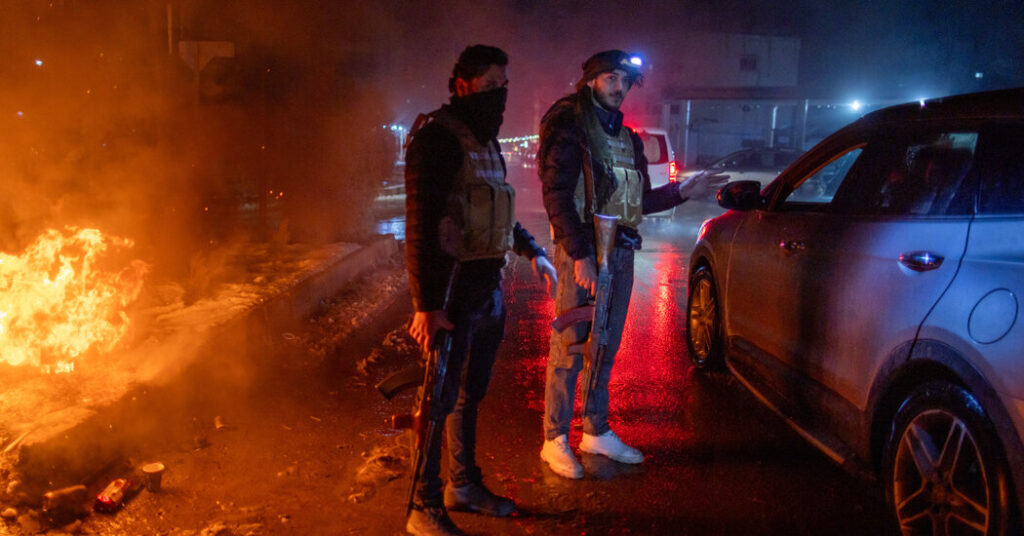
Syria’s government and a powerful Kurdish-led militia reached a comprehensive agreement on Friday to integrate Kurdish forces into the Syrian military, according to Kurdish officials and Syrian state media, the most decisive step yet to bringing calm after clashes between the sides had threatened to reignite a full-blown conflict in the country’s northeast.
The agreement included the formation of a Syrian military division made up of three brigades from the Kurdish-led militia, the Syrian Democratic Forces, as well as the integration of Kurdish-led civil institutions into Syria’s central government. In addition, government forces that had amassed along a front line in the north would withdraw.
“The agreement aims to unify Syrian territory and achieve full integration in the region by strengthening cooperation between the concerned parties and unifying efforts to rebuild the country,” according to a statement from the Syrian Democratic Forces.
The long-anticipated deal closes a period of intense uncertainty in northeastern Syria after rebel forces led by Ahmed al-Sharaa, now the Syrian president, toppled the Assad government and seized power in December 2024.
For months, the two sides had tried to negotiate a deal with no success. But the tide shifted once Mr. al-Sharaa made a military push into Kurdish territory and the United States withdrew its support of the Kurdish militia.
The United States had viewed the Syrian Democratic Forces as its main ally in Syria in the fight against the terrorist group the Islamic State. Washington has since thrown its weight behind Mr. al-Sharaa’s government.
The U.S.-backed Kurdish-led forces were the largest of several armed groups in Syria that demanded greater political representation and territorial control from the new government in Damascus. For more than a decade, Syria’s Kurds, who make up about 10 percent of the country’s population, have built up a military force and established a civil administration that governs a region that is roughly a quarter of Syria and that stretches beyond Kurdish-majority areas.
Mr. al-Sharaa has insisted that Syria be united under a central government and one military. Yet parts of the southern provinces of Sweida and Quneitra, and much of eastern Syria, remain outside government control.
After Mr. al-Sharaa came to power, his government engaged in negotiations with Kurdish leaders over how to integrate Kurdish-controlled areas into the new Syrian government, talks that had stalled in recent months.
Then, this month, Mr. al-Sharaa appeared to run out of patience. His government launched a military offensive in the Kurdish-held northeast, capturing large swaths of northern and eastern Syria once under Kurdish control. After the United States withdrew its support, the leader of the Syrian Democratic Forces, Mazloum Abdi, agreed both to a broader cease-fire deal and to enter into more serious discussions over the terms by which his forces would integrate into the Syrian state.
The agreement on Friday brought those discussions largely to a close. It included the creation of a brigade for Kurdish fighters in Kobani, a town held by the Syrian Democratic Forces that was under siege after clashes between government troops and the militia broke out earlier this month. Government forces would also be allowed to enter Hasaka and Qamishli, two cities under Kurdish control.
The U.S. special envoy for Syria, Thomas J. Barrack Jr., welcomed the agreement in a social media statement on Friday as “a profound and historic milestone in Syria’s journey toward national reconciliation, unity, and enduring stability.”
Carlotta Gall and Reham Mourshed contributed reporting.
Christina Goldbaum is The Times’s bureau chief in Beirut, leading coverage of Lebanon and Syria.
The post Syrian Government and Kurdish-Led Militia Seal a Deal to Merge Forces appeared first on New York Times.