It’s more than likely that the NAD+ supplement craze has already crossed your path. The Biebers have infused it. Joe Rogan has podcasted about it. Gwyneth Paltrow swears by it and, of course, sells her own Youth-Boost NAD+ Peptide Rich Cream. NAD+ is the latest biohacker’s darling. It’s in longevity clinics and the wellness aisle, in your dietary supplements and your topical skin care.
NAD+ (short for nicotinamide adenine dinucleotide) is a coenzyme that your body makes naturally—it contributes to energy production and immune function, among other things. But the current obsession with supplementing NAD+ isn’t just about anti-aging. It reflects a broader shift in how people think about healthy aging and extending their healthspan overall. Instead of reacting to symptoms after they emerge, more people are trying to prevent the diagnosis from happening in the first place.
Some studies suggest that many of the biological changes associated with aging don’t suddenly emerge with old age; they begin much earlier, often in our thirties and forties, and are closely tied to chronic conditions like neurodegeneration, metabolic dysfunction, and cardiovascular disease.
“Throughout any decade of life, people want to function at what they see as their optimal level,” board-certified internist and longevity specialist Amanda Khan tells WIRED. That desire has pushed attention toward compounds that support basic cellular processes. Like NAD+. “This feels like an easy lift,” says Rachele Pojednic, who investigates NAD and its precursors at Stanford. “It’s accessible, it seems safe, and it could potentially have long-term effects.”
In This GuideLargeChevron
- What Is NAD+?
- Why Do NAD+ Levels Decline?
- Potential Benefits of NAD+
- Safety, Side Effects, and Considerations
- NAD+ Precursors and IVs
- How to Choose a NAD+ Supplement (If You Do)
- What We Still Don’t Know
- Meet the Experts
- What Are We Testing?
What Is NAD+?
As we said, NAD+ is short for nicotinamide adenine dinucleotide. Your body produces and replenishes NAD+ by converting precursor molecules into NAD+ inside cells, using multiple metabolic pathways fueled by nutrients from foods like whole grains, lean meats, and legumes. Its most critical role is helping convert nutrients into ATP (adenosine triphosphate), the molecule cells use for energy.
One way to think about NAD+ is as an energy courier. It shuttles electrons to the mitochondria, where ATP is produced. When NAD+ picks up electrons, it becomes NADH; after delivering them, it converts back into NAD+ and repeats the cycle. If that process slows or becomes inefficient, energy production suffers.
Beyond mitochondrial function, NAD+ is involved in immune function, cellular signaling, and limiting cellular senescence (aka “zombie cells”). It also activates sirtuins, which are proteins that regulate DNA repair, inflammation, and oxidative stress responses. Because these processes are so foundational, researchers are paying closer attention to how declining NAD+ levels may contribute to aging and disease.
“If our cells don’t have energy, neurons won’t be able to send signals to other neurons,” explains Paul Barrett, who is a program officer at the National Institute on Aging. “They won’t be able to make memories or function properly, so losing the ability to make energy has a profound impact on many biological functions.”
Why Do NAD+ Levels Decline?
If your body already makes NAD+, why supplement it?
The short answer is that NAD+ is constantly being used up. Over time, it becomes harder to replace. Every time your cells produce energy, NAD+ is consumed. While the body has recycling pathways, some of that supply is lost. On top of that, NAD+ levels naturally decline with age.
Your lifestyle and exposure to pollution can also accelerate depletion. Alcohol, stress, and infections all affect NAD+ levels. According to Khan, people may have lost half of their NAD+ levels by age 40, though genetics and environmental factors play a major role.
As NAD+ production declines, metabolic health drops, cellular energy levels slow, and tissues become more vulnerable to damage. In the skin, this can show up as reduced elasticity, impaired collagen and elastin production, and increased inflammation. These links help explain why NAD+ has become popular not only in longevity circles, but also in beauty products.
Potential Benefits of NAD+
Most human studies don’t focus on NAD+ itself, but on its precursors, which are compounds the body can convert into NAD+ once they are inside cells. The most common include NR (nicotinamide riboside), NMN (nicotinamide mononucleotide), NA (nicotinic acid), NAM (nicotinamide), and tryptophan. NR and NM are the most studied of the precursors. NR, NMN, NA, and NAM are forms of vitamin B3. Tryptophan is an amino acid that can be found in dairy, poultry, and seafood; it’s also generally considered to be the least efficient precursor. All have been shown to increase intracellular NAD levels, but they haven’t been compared head-to-head in large trials.
“Even patients in their twenties have symptoms of brain fog, fatigue, chronic inflammation, and chronic infection post-Covid,” Khan says. In her clinical experience, some report improvements in energy, mental clarity, migraines, and circadian disruption after using NAD-related therapies, especially during periods of high physical or cognitive stress.
“I have a lot of fitness enthusiasts [as patients], who recover better after an injury or an intense exercise routine,” Khan adds. “They feel like they can get more reps in, swim more laps, and their tissues aren’t as easily tired.”
Early research is also exploring NAD+’s role in neurodegenerative disease, inflammatory pain pathways, and addiction, though much of this work remains preliminary. In people with existing degenerative conditions—such as Parkinson’s disease, sarcopenia, or Alzheimer’s disease—NAD precursors may help slow decline. What remains unclear is whether starting supplementation can prevent disease or significantly alter the aging trajectory.
Safety, Side Effects, and Considerations
Among NAD+ boosters, NR supplements have the most robust safety data. They have been studied in doses ranging from 1,000 to 3,000 milligrams per day in healthy adults, with minimal to no side effects reported.
Although NMN has also been widely studied, it was sidelined for years by regulatory issues. In 2022, the US Food and Drug Administration stated that NMN couldn’t be sold as a supplement because it was being investigated as a drug. That decision was later reversed in 2025.
Niacin, another NAD+ precursor, is effective but less popular because high doses can cause flushing, where the cheeks become red and warm, and an increased heart rate due to vasodilation. While uncomfortable, this reaction isn’t generally dangerous.
Animal studies have raised concerns that extremely high doses of NAD+ precursors could promote tumor growth, which has led clinicians to exercise caution in patients with active cancer. In practice, NAD supplementation is typically avoided during active malignancy and considered on a case-by-case basis for those in long-term remission, often in consultation with an oncologist.
Importantly, no human clinical trials have shown increased risk from oral NAD precursors. Some researchers even hypothesize that NAD may support genomic stability and cancer surveillance. “If you don’t have signs of malignancy or a strong family history of genetic syndromes like BRCA and breast cancer,” Khan says, “I firmly believe that NAD+ is actually cancer-protective.” Still, long-term data are limited.
Pregnancy remains another gray area; most clinicians recommend avoiding NAD+ supplements during pregnancy due to a lack of safety data. Still, according to Khan, “there is some evidence that NAD+ can support fertility leading up to pregnancy, preserve egg quality, and sperm quality.”
NAD+ Precursors and IVs
Some products claim to deliver NAD+ directly, but physiologically, that’s unlikely to work when taken orally. NAD+ itself has a poor bioavailability and doesn’t cross the gastrointestinal tract or easily enter cells. That’s why most longevity experts recommend precursors, which can be absorbed, transported into cells, and converted into NAD+ internally.
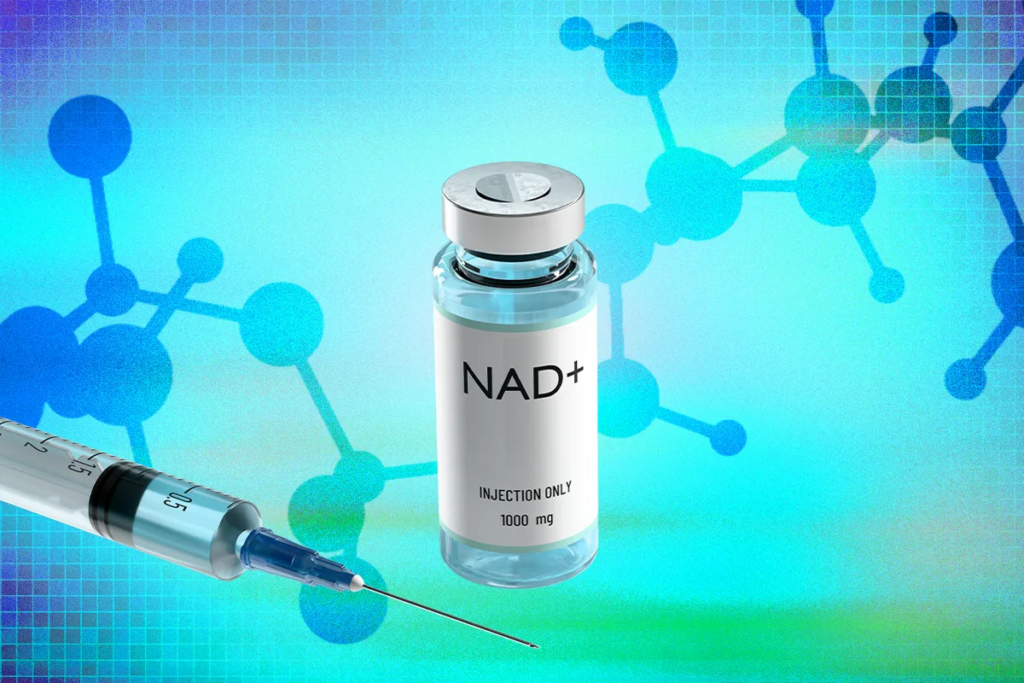
IV and injectable NAD+ have surged in popularity, but evidence supporting their effectiveness is thin. No known transporter moves NAD+ directly from the bloodstream into cells, meaning much of the infused molecule may be rapidly broken down or excreted.
“It has to convert it to either NR or NMN, and that’s a really inefficient mechanism because your body actually sees that NAD+ inside the blood and thinks something is wrong,” explains Pojednic. “It thinks your cells have kind of exploded, and the NAD+ is in a place that it shouldn’t be. That’s where your liver and your kidneys start to work, and you’re peeing most of it out.”
Patients also frequently report side effects with infusions, including nausea, chest tightness, jaw tingling, and sudden diarrhea; this is possibly due to an immune response triggered by NAD+ appearing where it doesn’t belong.
“The blood-brain barrier is very selective, so even if something is in the bloodstream, it may not enter the brain,” Barrett says. “That adds complexity to whether these methods do what people want them to do neurologically.”
In short, for most healthy adults, oral precursors remain the simplest and best-studied option.
How to Choose a NAD+ Supplement (If You Do)
Because supplements are loosely regulated, quality and sourcing matter. When purchased from unverified online retailers, NAD+ supplements can be contaminated or mislabeled. Experts recommend choosing reputable manufacturers, avoiding products that claim to deliver NAD+ directly, and consulting a health care professional, especially if you have underlying conditions or take medications.
Dosing isn’t standardized and typically depends on individual goals, health status, and delivery method. “I want patients to feel like we’ve examined their personal and safety profile, had a risk-benefit discussion, and made sure they feel confident in these molecules,” Khan says. Many clinicians like Khan also recommend using NAD precursors in cycles rather than continuously, reassessing over time.
What We Still Don’t Know
The biggest unanswered question is causality: Does NAD+ decline drive aging, or does aging itself accelerate NAD+ loss?
Most studies focus on people who already have disease. Whether supplementation earlier in life can meaningfully prevent age-related decline or extend healthspan in otherwise healthy people remains unproven. “We need a better understanding of metabolism in the brain in general and how it’s altered with aging,” Barrett says.
For now, NAD+ occupies a familiar space in the wellness world: biologically plausible, generally safe when used appropriately, and culturally ubiquitous, yet still waiting for definitive answers.
Meet the Experts
LargeChevron
- Amanda Khan, MD, is a board-certified internist and longevity specialist in New York City.
- Rachele Pojednic, PhD, is an adjunct lecturer at Stanford University, the director of education at Stanford Lifestyle Medicine, and chief science officer at Restore Hyper Wellness.
- Paul Barrett, PhD, is a program officer in the Division of Neuroscience at the National Institute on Aging at the National Institutes of Health in Rockville, Maryland.
What Are We Testing?
LargeChevron
We’re currently testing Tru Niagen and Pure Encapsulations NR Longevity.
Power up with unlimited access to WIRED. Get best-in-class reporting and exclusive subscriber content that’s too important to ignore. Subscribe Today.
The post NAD+ Supplement 101: Possible Benefits and Precautions Explained (2026) appeared first on Wired.